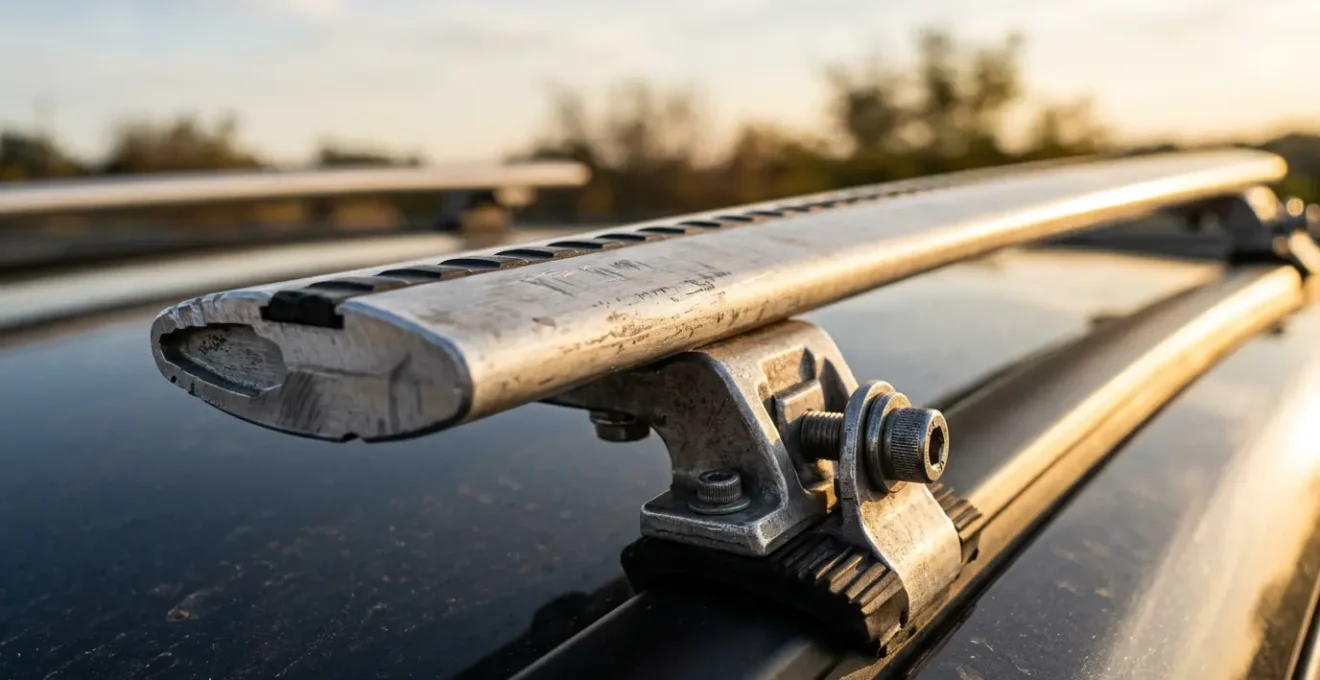
The whistle from your roof rack is not random; it’s a predictable aerodynamic effect called vortex shedding that signals wasted energy.
- The noise changes with speed because the frequency of the air vortices changes, sometimes moving out of the human hearing range or being masked by other sounds.
- Understanding this principle is key to selecting the right equipment (aero vs. square bars) and loading it safely to respect your vehicle’s dynamic load limit, not just the rack’s stated capacity.
Recommendation: Always prioritise your car’s dynamic roof load limit (found in the owner’s manual) over the roof rack’s static rating, and reduce your speed when carrying heavy or bulky loads.
Every UK driver who has used a roof rack knows the sound. That persistent, maddening whistle that starts up as you merge onto the motorway and hit 60 mph. It becomes the unwanted soundtrack to your journey, a high-pitched hum that bores into your concentration. Many resort to common fixes seen online: wrapping a bungee cord in a spiral around the bar or investing in a pricey wind fairing. But then, a strange thing happens. As you accelerate to 70 mph to overtake, the noise suddenly diminishes, or disappears entirely. Is it magic? A fluke?
The truth is far more interesting and infinitely more useful. That noise isn’t just an annoyance; it’s a direct, audible measurement of your car’s aerodynamic inefficiency. It’s a physical signal telling you about wasted fuel, increased drag, and potentially compromised stability. The silence at higher speeds isn’t a solution; it’s simply a shift in the physics of the problem. Understanding the science behind that whistle—a phenomenon known as vortex shedding—is the key to unlocking a quieter, safer, and more fuel-efficient driving experience with roof-mounted cargo.
This guide moves beyond the simple « it’s wind noise » explanation. We will decode the aerodynamic principles at play and demonstrate how this knowledge directly applies to critical, often-overlooked aspects of using a roof cargo system. From understanding true load limits and preventing leaks in your panoramic sunroof to saving hundreds of pounds in fuel, you will learn to see your roof rack not as a dumb accessory, but as an active component of your vehicle’s performance system.
This article will guide you through the essential physics and practical considerations of roof-mounted cargo systems. The following summary outlines the key areas we will explore to turn you from a frustrated driver into an informed cargo-carrying expert.
Summary: The Complete Physics of Roof Racks for Safe and Quiet UK Journeys
- Why Your Roof Rack Holds 100kg but Your Car Roof Only Allows 75kg?
- How to Fit Roof Bars to a Panoramic Sunroof Vehicle Without Causing Water Ingress?
- Aero Bars or Square Bars: Which Save More Fuel Over 10,000 Miles?
- The Speed Limit Reduction Nobody Mentions When You Fit Heavy Roof Cargo
- How to Position 3 Bikes on Your Roof to Minimise Crosswind Instability?
- Why Driving at 70 MPH Uses 25% More Fuel Than 60 MPH on the Same Journey?
- Why Your Standard SUV Cannot Handle What a Properly Prepared Defender Can?
- Why Do 30% of Off-Road Expeditions End With Vehicle Recovery Within the First Day?
Why Your Roof Rack Holds 100kg but Your Car Roof Only Allows 75kg?
This is one of the most critical and misunderstood aspects of using a roof cargo system. You see a « 100kg » rating on the roof bar box and assume you can load it up to that limit. This is a dangerous mistake. The crucial number is not what the rack can hold, but what your vehicle’s roof is engineered to safely support *while in motion*. This is the difference between Static Weight Capacity (SWC) and Dynamic Weight Capacity (DWC).
The 100kg your rack advertises is its SWC—the weight it can support when the car is parked. This is useful for things like a rooftop tent with occupants sleeping inside. However, the moment the vehicle moves, the forces acting on that load multiply. Braking, accelerating, cornering, and hitting bumps in the road all exert immense dynamic forces. Your car manufacturer’s 75kg limit is the DWC, a carefully calculated figure that accounts for these forces to prevent damage to the roof structure and, more importantly, to maintain vehicle stability and prevent a catastrophic failure or rollover.
As expert Jessica Shea Choksey clarifies in the JD Power Vehicle Load Capacity Guide, the physics are unambiguous:
DWC is always lower than the static weight capacity, or SWC, due to the force and momentum created through motion.
– Jessica Shea Choksey, JD Power Vehicle Load Capacity Guide
Automotive engineering standards confirm this disparity; dynamic load capacity typically ranges from 75-165 lbs (approx. 34-75 kg), while static capacity can be more than double that. Always check your vehicle’s owner’s manual for the DWC and adhere to it strictly. The number on the roof rack box is secondary.
How to Fit Roof Bars to a Panoramic Sunroof Vehicle Without Causing Water Ingress?
Fitting roof bars to a car with a large panoramic sunroof requires extra care. The concern isn’t just about scratching the glass; it’s about compromising the integrity of the water seals and even the chassis itself. The roof of a modern car, especially one with a large glass panel, is a complex structural component designed with specific flex points. Incorrectly fitted roof bars can create concentrated pressure points that distort the sunroof frame or pinch the rubber seals, creating a pathway for water ingress that may only become apparent weeks later.
The primary cause of leaks is uneven pressure from the mounting feet. If one corner is tighter than the others, it can subtly twist the frame. Over time, combined with the vehicle’s natural body flex during driving, this can break the seal. It’s crucial to use a rack system specifically designed for your vehicle model and its panoramic roof, and to follow the manufacturer’s torque specifications precisely using a torque wrench. Do not simply tighten the bolts as hard as you can.
Furthermore, the load itself can exacerbate the problem. A heavy, off-centre load can increase chassis flex, putting additional stress on the sunroof assembly. Post-trip inspections are just as important as pre-trip checks to ensure the system’s integrity hasn’t been compromised during your journey. A simple, careful check can save you from costly water damage repairs down the line.
Your Action Plan: Panoramic Sunroof Seal Health Check
- Visual Inspection: Immediately after fitting the bars, visually inspect the rubber seal around the sunroof for any signs of pinching, compression, or deformation where the mounting feet make contact.
- Torque Verification: Use a torque wrench to tighten all mounting hardware to the exact specifications in the instructions. This ensures even pressure distribution across all fixing points.
- Low-Pressure Water Test: After your first drive, perform a simple water test. Use a watering can (not a pressure washer) to gently pour water around the perimeter of the sunroof seals and mounting points, checking inside for any signs of water ingress.
- Chassis Flex Check: After a journey with a heavy load, park on level ground and inspect the sunroof. Look for any new, small gaps or slight misalignments in the frame that might indicate stress or flex.
- Scheduled Re-inspections: Re-inspect the seals and bolt torques after the first 100 miles with a load, and make it a habit to check again after any journey involving rough terrain or particularly bumpy roads.
Aero Bars or Square Bars: Which Save More Fuel Over 10,000 Miles?
The choice between traditional square bars and modern aerodynamic (aero) bars goes far beyond aesthetics. It has a direct and measurable impact on your vehicle’s fuel consumption, and it all comes back to the physics of that whistling sound. Square bars present a flat, inefficient profile to the wind, creating significant turbulence and drag. This is the « vortex shedding » that generates noise and, more importantly, forces your engine to work harder to maintain speed. Aero bars, with their wing-like shape, allow air to flow over them much more smoothly, dramatically reducing both drag and noise.
This paragraph introduces a complex concept. To well understand it, it’s useful to visualise its main components. The illustration below breaks this process down.
As this diagram shows, the smooth airflow over the aero profile contrasts sharply with the chaotic, energy-sapping turbulence behind the square bar. The difference in fuel economy is not trivial. Controlled tests show that even empty square bars can decrease fuel economy by 2-5%. Aerodynamic bars cut this penalty by nearly half. While a few percent might not sound like much, it adds up significantly over thousands of miles of driving.
To put this in financial terms, let’s consider the real-world cost over a typical year of driving. The following table, based on data and principles from the U.S. Department of Energy, illustrates the potential savings when driving 10,000 miles in a car that averages 25 mpg.
| Bar Configuration | Fuel Penalty (%) | Extra Fuel (gallons/10k mi)* | Cost at $3.83/gal | Annual Cost Difference |
|---|---|---|---|---|
| Square Bars (Permanent) | 5-15% | 50-150 | $191-$574 | Baseline |
| Aero Bars (Permanent) | 1-5% | 10-50 | $38-$191 | Save $153-$383 |
| Aero Bars (Removed When Idle) | 0% | 0 | $0 | Save $191-$574 |
| *Based on 25 mpg baseline vehicle; actual savings vary by vehicle type and driving conditions | ||||
The data is clear: choosing aero bars over square bars can save you hundreds of pounds a year. The most efficient solution, of course, is to remove any roof bars when not in use, eliminating the aerodynamic penalty entirely.
The Speed Limit Reduction Nobody Mentions When You Fit Heavy Roof Cargo
Just as a vehicle has a dynamic weight limit, it also has dynamic performance limits that are significantly altered by a roof load. Adding weight to the highest point of your car raises its centre of gravity, making it less stable in corners and more susceptible to body roll. This has a profound impact on its handling during emergency manoeuvres, such as swerving to avoid an obstacle on the motorway. A heavily loaded vehicle will not react as crisply as an unloaded one, and the braking distance will be noticeably longer due to the forward transfer of weight under deceleration.
While car manufacturers don’t publish a « reduced speed limit » for loaded vehicles, experienced overland drivers and off-road professionals have developed their own safety protocols. These principles are born from operating vehicles at their absolute limits in challenging conditions, where the consequences of miscalculation are severe. The stress on a vehicle’s systems increases exponentially on uneven surfaces; professional standards even mandate that the maximum load rating is reduced by 33% when travelling off-road due to the intense, repetitive shocks.
This thinking has led to a widely adopted best practice for on-road driving with heavy roof loads, which serves as an excellent guideline for any responsible driver.
Case Study: The 80% Rule for Loaded Roof Cargo Safety Margins
Professional overland drivers commonly apply the ‘80% Rule’ when vehicles are loaded close to their dynamic limits: they restrict highway speeds to approximately 80% of the posted limit (e.g., driving at 56 mph in a 70 mph zone). As expedition training programmes teach, this practice accounts for the elevated centre of gravity’s impact on rollover susceptibility during emergency manoeuvres, the increased body roll in corners, and the extended braking distances. The rule provides a robust, real-world safety margin that acknowledges the compromised handling of a top-heavy vehicle, giving the driver more time to react and the vehicle a greater chance of remaining stable.
Adopting a similar mindset is crucial. When carrying a heavy roof box or multiple bikes, you are not driving the same car. Reducing your speed on motorways and B-roads is not just about fuel economy; it’s a critical adjustment for safety.
How to Position 3 Bikes on Your Roof to Minimise Crosswind Instability?
Loading three bicycles onto a roof rack is a masterclass in managing aerodynamics and weight distribution. The goal is not simply to fit them all on, but to arrange them in a way that minimises instability, especially in crosswinds on an exposed motorway or bridge. Bikes, with their large, flat profiles, act like sails. An improperly balanced load can cause the vehicle to feel twitchy and difficult to control, particularly when being passed by a large lorry.
The key principle is to create as symmetrical and low-profile an arrangement as possible. This involves thinking about the frontal area and weight of each bike. A modern mountain bike with wide handlebars and chunky tyres presents a much larger « sail » to the wind than a sleek road bike. Placing the largest bike in the centre creates aerodynamic symmetry, helping to balance the forces acting on the car. Flanking it with lower-profile bikes further enhances this stability.
Another expert trick is to alternate the direction the bikes are facing. Mounting the two outer bikes backwards can help balance the asymmetrical drag created by components like the drivetrain. The ultimate solution for stability is using fork-mount carriers, which position the bikes lower and reduce the overall centre of gravity, though this requires removing and storing the front wheels.
Here is a step-by-step strategy for optimal aerodynamic stability:
- Position the largest bike in the centre: Place the bicycle with the largest frontal area (e.g., a modern mountain bike with wide bars) in the central position to create aerodynamic symmetry.
- Flank with lower-profile bikes: Mount the bikes with narrower profiles (e.g., road bikes) on the outer positions.
- Alternate directions: Mount the central bike facing forward and the two outer bikes facing backward. This helps to balance the asymmetrical « sail effect » from drivetrains and handlebars.
- Use fork-mounts for lower gravity: If possible, use fork-mount carriers instead of upright frame-mounts to position the bikes lower, significantly improving stability.
- Secure and verify: Ensure all mounting hardware is torqued to the manufacturer’s specification and double-check that every bike is secure before driving.
- Reduce drag further: When using fork-mounts, always secure the removed front wheels inside the vehicle, not on the roof, to further reduce drag and instability.
Why Driving at 70 MPH Uses 25% More Fuel Than 60 MPH on the Same Journey?
This question gets to the very heart of our whistling roof rack mystery. The dramatic increase in fuel consumption between 60 and 70 mph is almost entirely due to one factor: aerodynamic drag. At low speeds, like in city driving, most of your engine’s power is used to overcome rolling resistance from the tyres and mechanical friction. However, as your speed increases, air resistance becomes the dominant force the engine has to fight against.
This relationship is not linear; it is exponential. The power required to overcome aerodynamic drag increases with the cube of your velocity. This means that a small increase in speed results in a much larger increase in the power needed, and therefore, fuel burned. As automotive research council testing demonstrates, aerodynamic drag can be responsible for over 50% of a vehicle’s fuel consumption during highway driving. Going from 60 to 70 mph is a 17% increase in speed, but it can require up to 30-40% more power to push the air out of the way.
This effect is massively amplified when you add a roof rack and cargo. You are essentially strapping a large, un-aerodynamic object to your car, drastically increasing its frontal area and turbulence. This is the aerodynamic penalty in action. According to U.S. Department of Energy efficiency data, a large rooftop cargo box can reduce fuel economy by a staggering 10% to 25% at motorway speeds of 65-75 mph. That’s why the difference in consumption feels so pronounced when you have the car loaded for a holiday.

The whistling sound you hear at 60 mph is the audible evidence of this inefficient airflow. At 70 mph, the frequency of the vortex shedding may shift outside the range of human hearing or be drowned out by other noises, but the aerodynamic penalty—the drag and wasted fuel—is even higher. The silence is deceptive; your fuel gauge tells the true story.
Why Your Standard SUV Cannot Handle What a Properly Prepared Defender Can?
This comparison might seem unrelated to roof racks, but it reinforces the central theme of this guide: understanding a vehicle’s true, engineered capabilities versus its marketed image. Many standard SUVs are marketed with rugged, adventurous imagery, leading owners to believe they can tackle serious off-road terrain. In reality, these vehicles are fundamentally designed for on-road comfort and safety, with all-wheel-drive (AWD) systems optimised for wet tarmac and icy roads, not for climbing over rocks or through deep mud.
A properly prepared, purpose-built off-roader like a Land Rover Defender is engineered from the ground up for a completely different set of physical challenges. The differences are not superficial; they are baked into the vehicle’s core geometry and mechanical systems. The most critical differentiators are a vehicle’s approach, breakover, and departure angles, which determine its ability to traverse obstacles without getting stuck or damaged.
The following data highlights the vast engineering gap between a purpose-built 4×4 and a typical road-focused SUV.
| Vehicle Type | Approach Angle | Breakover Angle | Departure Angle | Ground Clearance | Key Differentiator |
|---|---|---|---|---|---|
| Land Rover Defender (Prepared) | 38-45° | 28-31° | 35-40° | 11.5″ | Low-range transfer case + locking differentials |
| Standard Midsize SUV | 18-25° | 16-20° | 20-25° | 7.5-8.5″ | AWD optimized for on-road traction |
| Premium Full-Size SUV | 20-28° | 18-22° | 22-27° | 22-27° | Electronic terrain management (no mechanical locks) |
| Critical difference: Defender’s short overhangs and high chassis allow obstacle clearance that would halt or damage standard SUVs with road-focused bumpers | |||||
Beyond geometry, the mechanical systems are worlds apart. A Defender’s low-range transfer case and locking differentials provide the torque multiplication and guaranteed traction needed for extreme situations. An SUV’s electronic systems are designed to manage slip, not conquer obstacles. As a professional off-road analysis points out, even the tyres tell the story: « A Defender on off-road tyres has mechanical grip from deep treads that dig into loose surfaces. An SUV on road-biased highway terrain tyres is designed to skim over water on tarmac and is instantly defeated by mud or sharp rocks. » Just as you must respect your car’s dynamic roof load limit, you must respect its fundamental design purpose.
Key Takeaways
- Dynamic Load is King: Always obey the vehicle manufacturer’s dynamic roof load limit found in your owner’s manual. It is the only number that matters for safety in motion.
- Aerodynamics Dictate Efficiency: Aero-profile bars are significantly quieter and can save hundreds of pounds in fuel over their lifetime compared to square bars. The whistle is the sound of you wasting money.
- Speed Amplifies Every Problem: Aerodynamic drag, fuel consumption, and stability risks all increase exponentially with speed. Slowing down when loaded is the single most effective safety measure you can take.
Why Do 30% of Off-Road Expeditions End With Vehicle Recovery Within the First Day?
The high rate of early-expedition failures provides a powerful final lesson that ties all these concepts together. While the statistic itself is a stark warning, the reason behind it is what’s truly enlightening. According to findings from the Off-Road Safety Academy, over 70% of off-road drivers have needed recovery at least once, and these incidents are rarely caused by a single, dramatic event. Instead, they are the result of a misunderstanding of a vehicle’s limits and poor preparation, a pattern that has direct parallels with on-road roof cargo safety.
The initial whistling from a roof rack is a minor annoyance. Ignoring it, or not understanding what it represents, is the first step in a potential chain of failures. It signifies a misunderstanding of aerodynamics, which is linked to fuel economy. This is often paired with a misunderstanding of dynamic load limits versus the number on the box. This, in turn, can lead to overloading, which raises the centre of gravity and compromises the vehicle’s handling and braking. Each is a seemingly small error in judgment, but they build on each other.
This phenomenon is perfectly encapsulated in a common pattern observed in off-road recovery situations, which serves as a cautionary tale for any vehicle owner.
Case Study: The Cascade of Minor Errors
Analysis of first-day expedition failures reveals a common pattern: the ‘Cascade of Minor Errors.’ A typical sequence, as detailed in expert recovery guides, begins with a small oversight, like slightly incorrect tyre pressures, leading to a puncture in a difficult location. The driver then finds their recovery gear is buried under all their luggage, wasting valuable time and energy unpacking. When they finally access the gear, they might discover a critical tool is missing or they are unsure how to use it safely. This cascade perfectly mirrors the gap between a vehicle’s marketed capability and its actual physical limits—the very same gap that exists between a roof rack’s 100kg static rating and a car’s 75kg dynamic limit.
That whistle at 60 mph is your first warning light. It’s an invitation to understand the physics of your vehicle and its cargo. Listening to it, and acting on what it tells you, is the difference between a safe, efficient journey and becoming part of a statistic.
To ensure your next journey is safe, quiet, and efficient, the most important step you can take is to consult your vehicle’s owner’s manual. Find the official Dynamic Weight Capacity for your roof and make that your absolute limit, and then inspect your entire cargo system to ensure it is correctly fitted and secured.