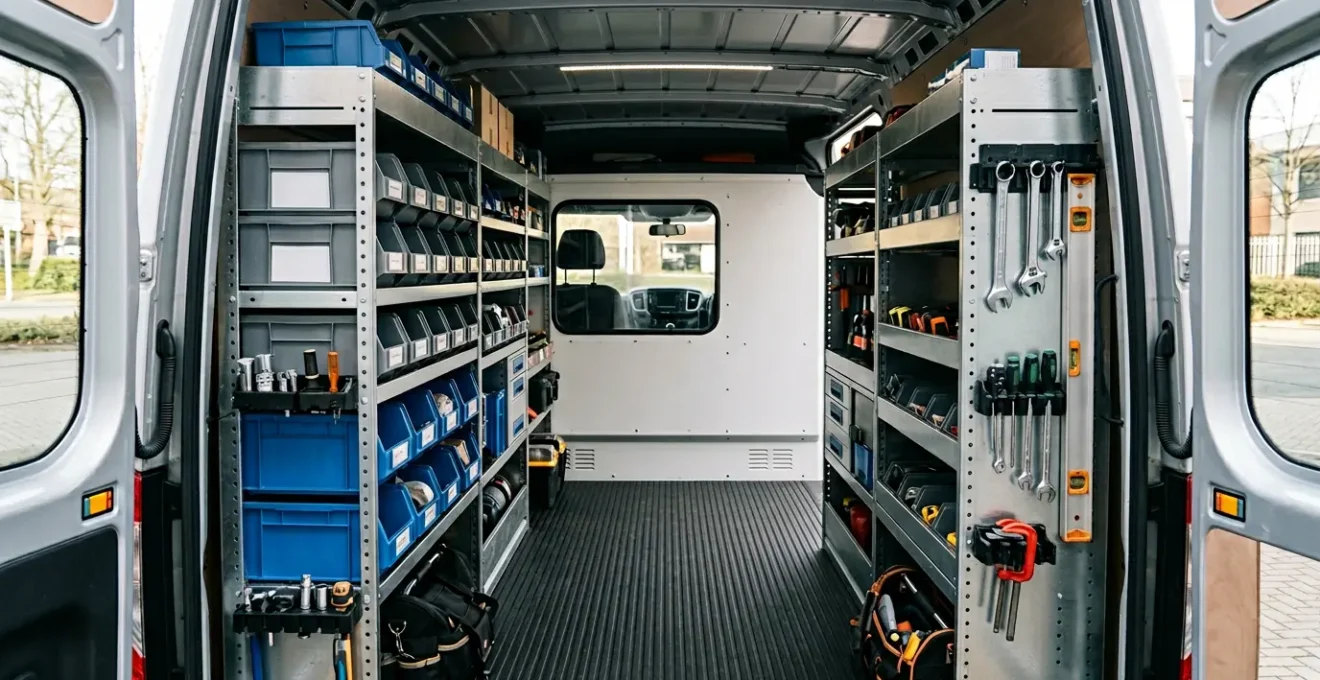
The core problem isn’t your van’s payload; it’s the hidden cost of volumetric inefficiency and poor access workflows.
- Wasted « void space » and disorganised tools fill up your van long before you hit your weight limit, killing productivity.
- Treating your van like a high-density « mobile warehouse »—not a toolbox on wheels—is the key to unlocking its full capacity.
Recommendation: Shift your focus from simply storing items to designing a system where any tool is accessible in under 30 seconds, directly boosting your job profitability.
For any UK van operator, it’s a familiar and frustrating paradox. You know your vehicle’s payload capacity is, say, 1,000kg, but with only 500kg of tools and materials on board, the cargo area is a chaotic mess you can barely step into. Every surface is covered, items are stacked on top of each other, and finding that one specific tool becomes a five-minute excavation project. You are nowhere near your legal weight limit, yet for all practical purposes, your van is completely full.
The common advice is to either « declutter » or « buy more racking. » While well-intentioned, this advice often misses the real issue. The problem isn’t a lack of space, but a fundamental misunderstanding of how to use it efficiently. You’ve been treating your van like a shed, when you should be managing it like a high-density, high-efficiency logistics hub.
But what if the solution wasn’t about cramming more shelves in, but about rethinking the entire system? This guide moves beyond the basics of payload versus volume. We will explore the hidden costs of volumetric inefficiency, the critical importance of access workflows, and how a strategic approach to organisation can not only reclaim your space but also safeguard your warranty, your insurance, and even your driving licence. This is how you transform your van from a source of frustration into a streamlined, profitable asset.
This article provides a complete strategic breakdown. To guide you, this table of contents outlines the key areas we will cover, from the foundational principles of space optimisation to the critical details of insurance and legal compliance.
Summary: The Van Operator’s Guide to Mastering Cargo Space and Profitability
- Why Your Van Runs Out of Space Before It Runs Out of Payload Capacity?
- How to Access Any Tool in Under 30 Seconds From a Fully Loaded Service Van?
- Fixed Van Racking or Removable Boxes: Which Suits a Vehicle Used for Work and Family?
- The Unsecured Load Mistake That Carries £5,000 Fines and 3 Points on Your Licence
- When Does Van Racking Installation Void Your Commercial Vehicle Warranty?
- Why Does a £4.99 Delivery Actually Cost Your Business £8.50 in Total Fulfilment?
- Why Generic Cardboard Boxes Void Your Electronics Shipping Insurance?
- Why Does Insurance Refuse to Pay When Your £5,000 Laptop Arrives Broken?
Why Your Van Runs Out of Space Before It Runs Out of Payload Capacity?
The root of the problem lies in a concept that logistics professionals obsess over: packing density. Your van isn’t just a container for weight; it’s a container for volume. The reason it feels full is due to « volumetric inefficiency »—the dead air and unusable gaps created by poorly organised items. Every awkwardly shaped power tool case, loose box of screws, and coil of cable creates significant « void space. » This is the unseen enemy that consumes your cargo area.
Think about it: a pile of ten toolboxes might only weigh 150kg, but stacked haphazardly on the floor, they create a mountain of unusable space above and around them. You can’t place anything on top without it being unstable, and the gaps between them are too irregular to be useful. Professional logistics industry analysis shows that this void space is a critical factor in efficiency calculations. While you are focused on the 150kg payload, the real issue is the 2 cubic metres of volume that pile has rendered useless.
This leads to a secondary problem: poor access. To get to the toolbox at the bottom of the pile, you have to move the other nine. This constant shuffling and re-stacking doesn’t just waste time; it actively discourages organisation, leading to a vicious cycle where the easiest solution is to just toss the next item on top. Your van feels full because its layout is fighting against you, turning a simple storage area into a three-dimensional puzzle with no solution. The goal is to minimise void space and maximise usable, accessible volume.
How to Access Any Tool in Under 30 Seconds From a Fully Loaded Service Van?
The answer is to stop thinking about storage and start designing an access workflow. A 30-second retrieval time isn’t a fantasy; it’s the result of treating your van like an ergonomic workstation. The key is to make your most-used items accessible with minimal movement: no climbing, no rummaging, and no shifting other items. This means designing your layout around your body and your daily tasks.
Slide-out drawers, particularly those at waist height, are a game-changer. They bring the tools to you, eliminating the need to climb into the van and contort your body to reach a back shelf. This ergonomic approach has a measurable impact on productivity. For instance, a 2025 study from The Ergonomics Center at North Carolina State University found an 18% improvement in task cycle time with optimised workstations. That 18% is pure profit, gained back from time that was previously wasted searching.
This image perfectly illustrates the principle of an ergonomic access workflow. The tools are brought out of the van to the technician, at a comfortable height, eliminating the need to climb in and search.
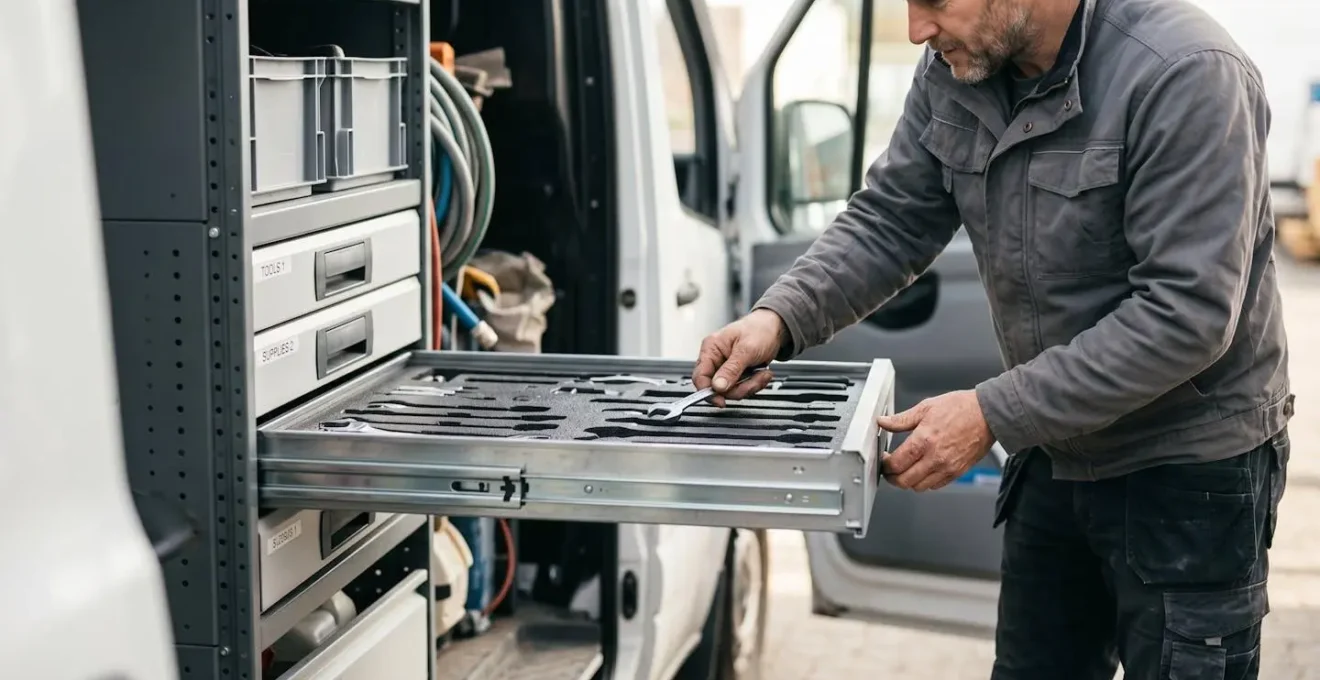
Achieving this level of efficiency requires a system. It’s about zoning your van based on frequency of use. Daily-use tools should be near the doors. Weekly-use items can be further in. Seasonal or job-specific equipment can be stored in the deepest sections. By applying these principles, you transform your van from a chaotic pile into a high-performance « mobile warehouse » where every item has a designated, easily accessible home.
Your Van Organisation Audit Checklist
- Access Point Audit: List your top 10 most-used tools. Where are they currently located in relation to the side and rear doors?
- Inventory & Zoning: Empty the van. Group all items by task (e.g., plumbing, electrical) and then by frequency of use (daily, weekly, monthly).
- Workflow Test: Place your daily-use items in the most accessible zones. Time yourself retrieving three different tools for a single job. Is it under 90 seconds total?
- Void Space Hunt: Identify the top 3 largest areas of wasted « dead air. » Could a specific shelf, drawer, or bin convert this into usable storage?
- Illumination Check: Open your van in a dimly lit area. Are all compartments and shelves clearly visible, or do you need to add targeted LED lighting to stop searching in the dark?
Fixed Van Racking or Removable Boxes: Which Suits a Vehicle Used for Work and Family?
The choice between permanent, fixed racking and a system of removable boxes or modules is a critical one for the dual-use operator. This isn’t just about storage; it’s about flexibility and the speed of transformation. Your goal is to switch from a professional work van to a family vehicle in the minimum amount of time, without compromising on safety or organisation in either role.
Fixed racking systems, typically made of steel or aluminium, offer unparalleled organisation and security for your tools. They maximise volumetric efficiency by using the van’s height and contours. However, their permanence is their biggest drawback for dual-use. Removing a fixed system is a major undertaking, making your van a dedicated work vehicle. For some, a hybrid approach works: installing a fixed rack on one side of the van, leaving the other side free for larger family-related cargo like bikes or luggage.
Removable storage boxes and modular systems (like brands offering pack-out style solutions) are the champions of flexibility. They allow you to load only the specific tools needed for the day’s job, leaving the rest in the workshop. At the end of the week, the entire system can be wheeled out, returning your van to an empty cargo bay in minutes. The trade-off is often in volumetric efficiency and security. Stacking boxes on the floor doesn’t utilise the van’s full height, and unless they are properly strapped down, they become a significant safety hazard—a point we’ll cover later. The best material for these is impact-resistant polymer, which offers a good balance of durability and weight.
Ultimately, the decision depends on your ratio of work to family use. If you use the van for family trips only a few times a year, a permanent, well-designed fixed system is likely more efficient in the long run. If the switch happens weekly, a high-quality, interlocking modular box system is the only practical solution. It allows you to maintain professional organisation while having the ability to completely clear the deck for personal use. The key is to ensure any removable system can be securely fastened to the vehicle’s anchor points.
The Unsecured Load Mistake That Carries £5,000 Fines and 3 Points on Your Licence
In a disorganised van, every loose item—from a heavy toolbox to a single copper fitting—is a potential projectile. During a sudden stop or collision, an unsecured object’s effective weight can multiply dramatically. What many operators fail to realise is that the Driver and Vehicle Standards Agency (DVSA) considers the inside of your van just as important as a flatbed truck. An unsecured load is an unsecured load, and the consequences are severe.
Under UK law, you are personally responsible for ensuring everything in your vehicle is secure. If an object from your van were to cause an accident or injury, the penalties are not trivial. Updated UK DVSA guidance confirms fines up to £5,000, three penalty points on your driving licence, and even potential disqualification. The police don’t need to wait for an accident; a roadside stop that reveals a dangerously loaded van is enough to trigger these penalties.
The human cost of this negligence can be catastrophic, far outweighing any fine. A well-organised van with proper racking and securing points isn’t a luxury; it’s a fundamental safety requirement that demonstrates your professional duty of care.
Case Study: The Tragic Cost of an Unsecured Load
In December 2022, an 11-year-old boy in East Sussex lost his life when unsecured scaffolding fell from a light goods vehicle and went through a car windscreen. The van driver, who pleaded guilty to causing death by dangerous driving, admitted he had not received any load security training in 15 years. He received a four-year prison sentence and a seven-year driving disqualification. This devastating case highlights that the ultimate responsibility for load security rests with the driver, and the consequences of failure can be irreversible.
When Does Van Racking Installation Void Your Commercial Vehicle Warranty?
Investing in a new van is a significant financial commitment, and the last thing any operator wants is to inadvertently void its manufacturer warranty. A common fear is that installing aftermarket racking will automatically do this. The truth is more nuanced: it’s not *that* you install racking, but *how* it’s installed that matters.
The primary concern for vehicle manufacturers is unauthorised modification to the vehicle’s structure or electrical systems. If your racking installation involves drilling new holes into the chassis, body panels, or structural pillars, you are giving the manufacturer a clear reason to deny a future warranty claim related to corrosion, structural integrity, or any subsequent rattles and squeaks. An installer who simply drills wherever is convenient is creating a future liability for you.
To combat this, reputable racking manufacturers have invested heavily in vehicle-specific engineering. They design mounting brackets that use the existing, factory-drilled holes that manufacturers provide for this very purpose. These are the anchor points used to secure cargo and partitions. By using a « no-drill » system, the racking is securely attached to the van’s strongest points without altering the vehicle’s bodywork. This preserves the integrity of the van and, critically, protects your warranty. Many professional upfitters take this so seriously that some leading van upfitting companies now offer a 10-year manufacturer’s warranty plus a lifetime installation warranty, guaranteeing their work won’t compromise your vehicle.
So, can you install racking yourself? Yes, if you use a no-drill, vehicle-specific kit and follow the instructions precisely. However, using a manufacturer-certified installer provides an extra layer of protection, as they are trained to do the job right and provide documentation that can be invaluable if a warranty issue ever arises. Always verify the installer’s certification and document the installation process with photos to show non-intrusive methods were used.
Why Does a £4.99 Delivery Actually Cost Your Business £8.50 in Total Fulfilment?
This question, common in the e-commerce world, holds a powerful lesson for every tradesperson. The £4.99 is the visible cost (the fuel, the time on the road). The extra £3.51 represents the « hidden » costs of fulfilment: the time spent picking the item, packing it, and processing the order. For a van operator, the same logic applies. The cost of a job isn’t just your materials and the time spent on-site; it includes the « fulfilment » time spent in and around your van.
Industry analysis confirms that every minute spent searching for tools or shifting equipment is lost productivity and, therefore, lost money. If you spend just 15 minutes a day rummaging through your van—five minutes at the start, five minutes looking for a specific part, five minutes packing up—that’s over an hour of lost, unbillable time every week. Over a year, that’s more than a full working week you’ve spent fighting your own disorganisation, a direct hit to your bottom line.
The solution is to adopt the « mobile warehouse » mindset. In a real warehouse, every item has a specific bin location, and pickers follow an optimised route to fulfil orders. Your van must operate on the same principle. A systematic layout with labelled zones, clear containers, and a logical flow turns searching time into productive working time.
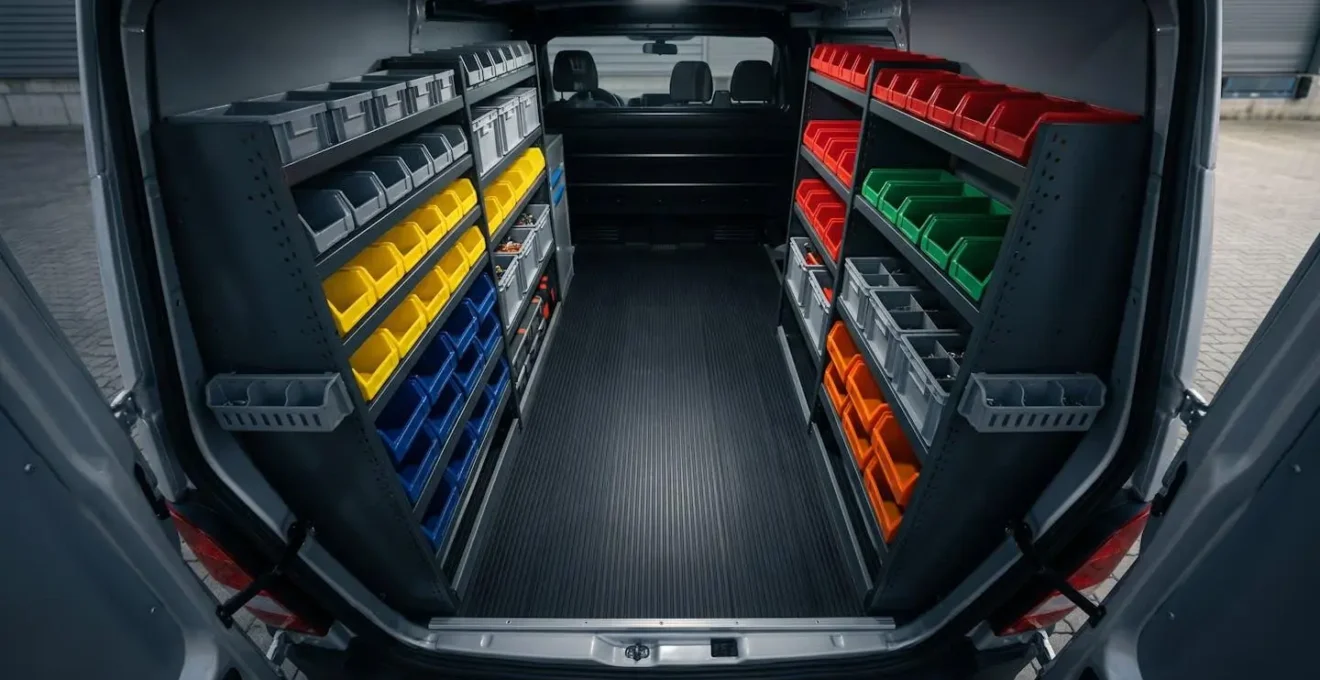
This bird’s-eye view shows the « mobile warehouse » concept in practice. Symmetrical shelving, clear aisles, and zoned storage mimic the efficiency of a professional logistics operation. By reducing your internal « fulfilment » costs, you increase the profitability of every single job. That £8.50 cost is a reminder that the most expensive activities are often the ones you aren’t tracking.
Why Generic Cardboard Boxes Void Your Electronics Shipping Insurance?
When a courier’s insurance denies a claim for a broken laptop, it’s often because the item was shipped in a generic cardboard box. The insurer argues this constitutes « insufficient packaging » or owner negligence. The same principle of « due care » applies to the high-value electronics—laptops, diagnostic tools, testing equipment—stored in your van every day. Your standard van insurance or tool policy may not cover damage if it can be argued you failed to protect the equipment properly.
Your van is a continuous, high-vibration, high-impact environment. A simple pothole or sudden stop can subject your equipment to significant G-forces. A laptop sliding around in a loose-fitting box or an unpadded shelf space is an accident waiting to happen. If you need to make a claim, the first thing an loss adjuster will look for is evidence of negligence. A generic box is Exhibit A.
Professional courier services understand this. They use specific packing techniques with appropriate materials to ensure items remain secure during transit, which is a core part of their service agreement. Applying this logic to your « mobile warehouse » is essential. To demonstrate due care for your electronics, you must create a secure, purpose-built storage environment. This means:
- Using dedicated, lockable cabinets or drawers.
- Installing anti-static foam inserts custom-cut to the equipment’s dimensions to eliminate movement.
- Storing laptops and tablets in shock-rated cases designed for continuous vibration.
- Placing this storage in lower sections of the van to minimise the impact of bumps and sudden stops.
These measures are not just for protection; they are your evidence. Documenting your storage methods with photos can be a powerful tool to counter any claims of negligence and ensure your insurance pays out when you need it most.
Key Takeaways
- Your van’s biggest problem is wasted volume (« void space »), not excess weight.
- An organised van is a safety requirement; unsecured loads inside your van can lead to £5,000 fines and 3 license points in the UK.
- Protect your vehicle warranty by using « no-drill » racking systems that utilise the manufacturer’s existing mounting points.
Why Does Insurance Refuse to Pay When Your £5,000 Laptop Arrives Broken?
The refusal often boils down to one word: negligence. From an insurer’s perspective, their policy covers unforeseen accidents, not the predictable outcome of poor practice. When a £5,000 piece of diagnostic equipment is damaged inside your van, the insurer will investigate whether you, the owner, took reasonable steps to prevent that damage. If your expensive laptop was simply placed on a passenger seat or a loose shelf, the insurer has a strong case to argue that you failed to show « due care. »
This is where your van’s organisation system becomes your most important piece of evidence. A disorganised, chaotic van is a clear signal to an insurance adjuster that a culture of carelessness may exist. Conversely, a well-organised van tells a very different story. It demonstrates a professional, systematic approach to protecting your assets. As commercial vehicle insurance specialists note, a well-organised van with dedicated, secure, and padded storage for electronics serves as powerful evidence against insurer claims of owner negligence.
Furthermore, your track record matters. UK insurance industry data shows that drivers with poor load security records face higher van insurance premiums. Insurers see poor organisation not just as a risk for tool damage, but as an indicator of a higher overall risk profile for accidents. Proving you have a system in place—through photos of your racking, receipts for professional installation, and records of regular checks—can be the deciding factor between a paid claim and a costly denial.
Ultimately, investing in proper organisation is a form of self-insurance. It actively reduces the risk of damage in the first place and, if the worst should happen, provides the critical evidence needed to ensure your actual insurance policy does its job. It transforms your van’s setup from a potential liability into a documented asset protection strategy.