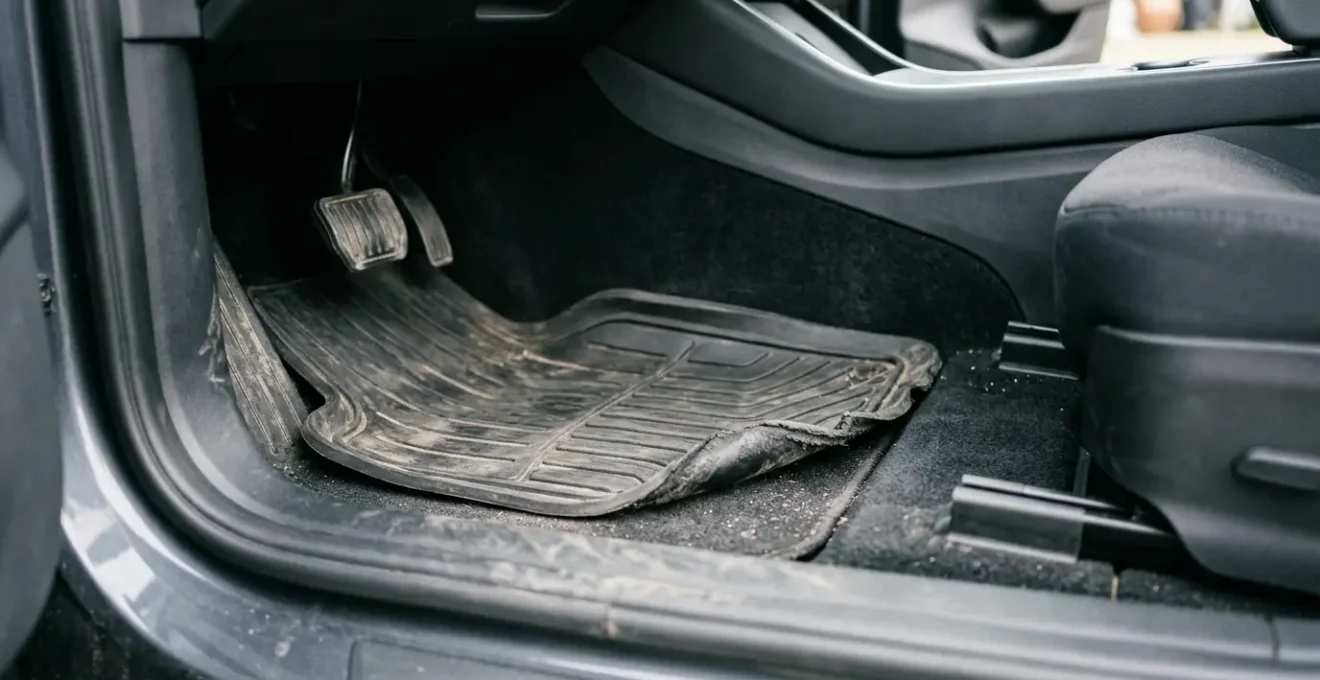
The sliding floor mat under your pedals is not a minor annoyance; it’s a predictable system failure caused by poor engineering and material science.
- A mat’s safety is determined by its geometric integrity and retention engineering, features absent in cheap, universal-fit products.
- Premium materials like TPE offer critical temperature stability and durability that cheap PVC lacks, preventing cracking and warping.
Recommendation: Evaluate floor mats based on their engineered fit and material certification, not just their initial price, to ensure long-term safety and avoid catastrophic pedal interference.
That creeping sensation is familiar to many UK drivers. A cheap rubber mat, purchased as a sensible measure to protect the car’s carpet, begins its slow, inevitable migration forward. At first, it’s a minor inconvenience, requiring a kick to pull it back. Then one day, you press the brake and feel a disconcerting sponginess, a reduced travel. The mat has bunched up under the pedal. For a terrifying moment, the car is not fully under your control. This isn’t a random accident; it’s the predictable result of a fundamental misunderstanding of what a floor mat is supposed to do.
The common response is to blame the « cheapness » and perhaps buy another £30 set from eBay, hoping for a better outcome. We look at other interior accessories, like phone holders or air fresheners, and assume a mat is just as simple. But what if the real issue isn’t the price, but a complete breakdown in what we can call ‘system-level safety’? The problem isn’t just a piece of sliding rubber. It’s a failure of geometric integrity, material science, and safety engineering that transforms a simple accessory into a potential killer.
This article will dissect the reasons behind this failure. We will move beyond the simple « cheap is bad » narrative to explore the critical engineering and material differences that separate a safe, reliable floor liner from a hazardous piece of plastic. We will explore why some mats carry safety certifications while others don’t, how fit dictates safety, and why the material itself is your first line of defence against a catastrophic failure. Understanding these principles is the only way to make an informed choice that truly protects both your vehicle’s interior and the lives within it.
To navigate this critical topic, we’ve structured this analysis to cover every aspect of floor mat safety and performance. The following sections will guide you through the engineering, materials, and long-term costs that define the difference between a bargain and a liability.
Summary: The Engineering of a Safe Car Mat
- Why Some Floor Mats Carry Safety Certifications and Others Could Kill You?
- Universal or Tailored Mats: Which Actually Stays Locked in Place for 5 Years?
- Which Mat Material Handles Winter Salt, Muddy Boots, and Summer Beach Sand Best?
- The Worn Mat Edge That Creates a Trip Hazard Every Time You Exit Your Car
- How to Clean Rubber Floor Mats Without Leaving a Slippery Surface?
- Genuine Ford Mats or £30 eBay Alternatives: What Actually Lasts 5 Years?
- Steering Correction or Power Steering Failure: How to Tell the Difference?
- Why Do Genuine Manufacturer Accessories Cost 3x More Than Pattern Parts?
Why Some Floor Mats Carry Safety Certifications and Others Could Kill You?
The stark difference between a certified floor mat and a generic one is not a matter of branding, but of life and death. A non-compliant mat is an unrecognised danger in the vehicle’s cabin, capable of initiating a catastrophic loss of control. The most infamous example remains the 2009-2011 Toyota recalls affecting approximately 9 million vehicles worldwide, triggered by floor mats causing unintended acceleration. This wasn’t a freak accident; it was a predictable failure of an unregulated component.
Safety-certified mats, often from Original Equipment Manufacturers (OEMs) or reputable aftermarket brands, undergo rigorous testing. This process verifies that the mat’s shape, thickness, and retention system will not, under any foreseeable condition, interfere with pedal operation. They are designed with specific clearance zones and use non-slip backing and anchoring points that match the vehicle’s factory-installed hooks or posts. Generic, uncertified mats bypass this entire safety-critical process. They are manufactured to a general shape, with no guarantee of pedal clearance or secure anchoring. Their tendency to slide is not a flaw; it is a fundamental design characteristic.
Case Study: The San Diego Crash That Exposed the Danger
On August 28, 2009, a fatal crash occurred when an unsecured, all-weather floor mat from a different vehicle model was placed in a Lexus ES 350. The mat entrapped the accelerator pedal, leading to uncontrolled acceleration. A subsequent investigation by NHTSA found evidence of extreme heat damage to the brakes, proof of the driver’s desperate attempts to stop the vehicle. As detailed in the final report on unintended acceleration, this single, tragic incident, caused by an incompatible floor mat, demonstrated the catastrophic consequences of improper design and became a catalyst for stricter safety standards.
The urgency of this issue was captured by the authorities at the time. In the midst of the crisis, then U.S. Transportation Secretary Ray LaHood issued a stark warning to the public:
This is an urgent matter. For everyone’s sake, we strongly urge owners of these vehicles to remove mats or other obstacles that could lead to unintended acceleration.
– Ray LaHood, U.S. Transportation Secretary statement on Toyota floor mat safety, NPR coverage September 2009
This wasn’t just about Toyota; it was a warning about the inherent danger of any object that can shift and interfere with the driver’s most critical controls. A certified mat is engineered to prevent this. An uncertified one invites the risk.
Universal or Tailored Mats: Which Actually Stays Locked in Place for 5 Years?
The debate between universal « trim-to-fit » mats and vehicle-specific tailored mats is fundamentally a debate about geometric integrity. A universal mat is designed to be ‘good enough’ for hundreds of different footwell shapes. A tailored mat is engineered to be perfect for just one. This perfection is the key to a mat that stays locked in place, not for months, but for the life of the car.
Universal mats rely on primitive methods for retention: sharp spikes on the underside that dig into and damage the vehicle’s carpet, or sheer weight. These methods inevitably fail. The spikes lose their grip as the carpet fibres break down, and weight alone is no match for the rotational force of a driver’s heel and the G-forces of acceleration and braking. This leads to the mat sliding, bunching, and ultimately, creating a pedal obstruction hazard. In contrast, a tailored mat achieves security through precision engineering.
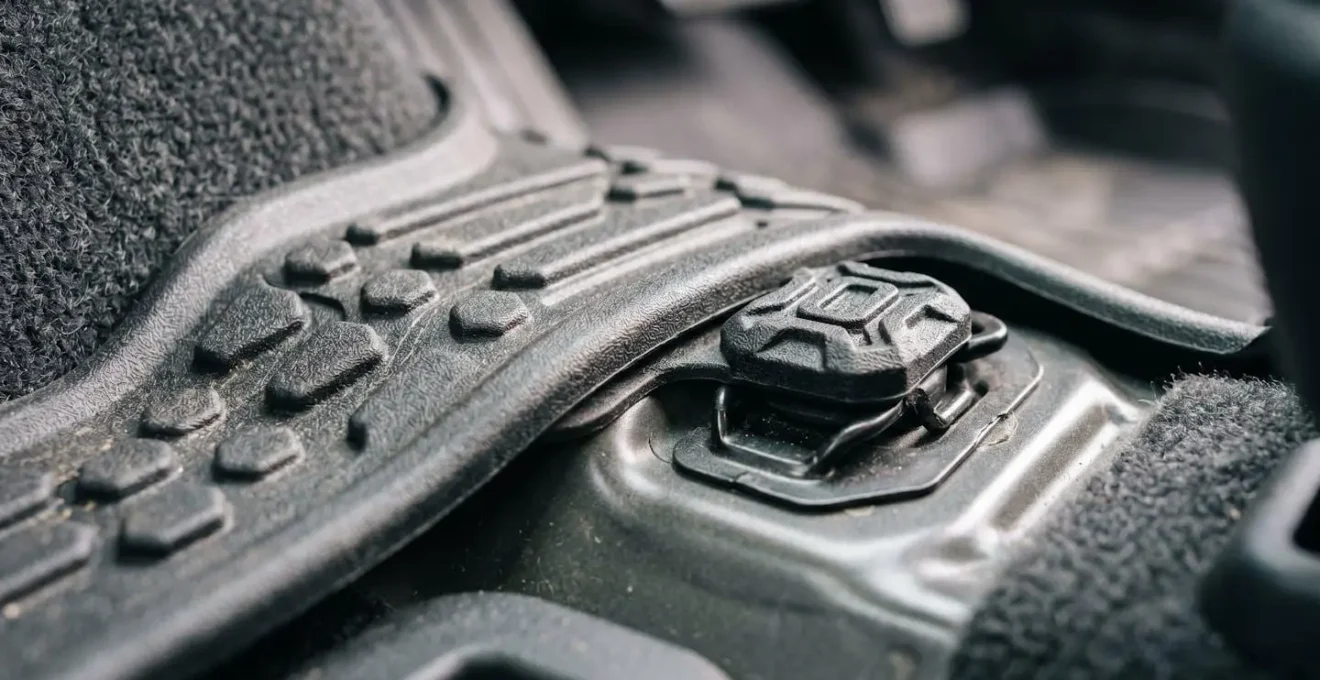
As the illustration demonstrates, high-quality aftermarket or OEM mats are often developed from 3D laser scans of the vehicle’s floor pan. This data allows for the creation of a mat that is a perfect negative of the floor, conforming to every contour and curve. This precise fit is the primary method of movement prevention. The mat is physically locked in place by the footwell’s own geometry. Secondly, they integrate with the vehicle’s factory retention system—the hooks or posts built into the floor by the car manufacturer specifically for this purpose. This creates a mechanical lock that makes sliding virtually impossible.
The following table breaks down the critical differences in retention features, which an in-depth guide on all-weather mats confirms is the primary determinant of long-term safety and performance.
| Retention Feature | Custom-Fit Mats | Universal Mats |
|---|---|---|
| Anchoring Method | Factory retention clips + precise fit geometry | Spikes, velcro, or weighted corners |
| Floor Coverage | 90-100% floor surface area | 65-70% floor surface area |
| Movement Prevention | Minimal opportunity to shift due to contour-matching design | Weight alone cannot prevent sliding during aggressive driving |
| Carpet Damage Risk | None (uses factory anchor points) | Spikes damage carpet; velcro loses grip over time |
| Pedal Interference Risk | Engineered clearance verified for specific model | High risk if mat slides forward |
Choosing a tailored mat is not a luxury; it is the only way to ensure the product’s retention system is an integrated part of the vehicle’s existing safety design, rather than a hopeful afterthought.
Which Mat Material Handles Winter Salt, Muddy Boots, and Summer Beach Sand Best?
Beyond fit, the material of a floor mat is the single most important factor determining its durability, safety, and effectiveness. A cheap mat fails after a few months not just because it slides, but because its material physically breaks down. The primary battle in the materials war is between low-cost PVC (Polyvinyl Chloride) and modern, engineered TPE (Thermoplastic Elastomer).
PVC is the material of choice for most cheap, mass-market mats because of its low cost. However, it is fundamentally unsuitable for the extreme environment of a vehicle footwell. PVC suffers from poor thermal stability. In the cold of a UK winter, it becomes brittle, stiff, and prone to cracking. In the heat of a summer day, it can soften, off-gas unpleasant chemical odours, and even deform permanently. This material fatigue directly impacts safety; a cracked mat can snag a shoe, and a warped one will no longer lie flat, creating a new set of hazards.
In contrast, TPE is an engineered compound designed specifically for resilience. It is a blend of plastic and rubber, offering the strength and form-holding ability of plastic with the flexibility and impact resistance of rubber. Crucially, material performance testing shows that TPE maintains its flexibility and structural integrity across a vast temperature range, from freezing winters to scorching summer heat. It doesn’t crack in the cold or warp in the sun. This stability ensures the mat’s geometric integrity is maintained year after year.
The superiority of TPE is not just a theoretical advantage; it’s a practical reality experienced by automotive material engineers. As the team at 3W Liners, a manufacturer of TPE products, notes:
PVC mats can wear out quickly, especially in areas with lots of rain, snow or dirt. They tend to crack or break after a few months of use. TPE mats are much stronger.
– 3W Liners Material Engineering Team, TPE vs PVC Material Comparison for Automotive Applications
This strength translates directly to performance. TPE’s non-porous, durable surface effectively contains mud, road salt, and sand, and can be cleaned easily without degrading. A PVC mat absorbs stains and its texture wears down quickly, losing its ability to trap dirt. For all-season, all-condition protection, the choice of an advanced material like TPE is non-negotiable.
The Worn Mat Edge That Creates a Trip Hazard Every Time You Exit Your Car
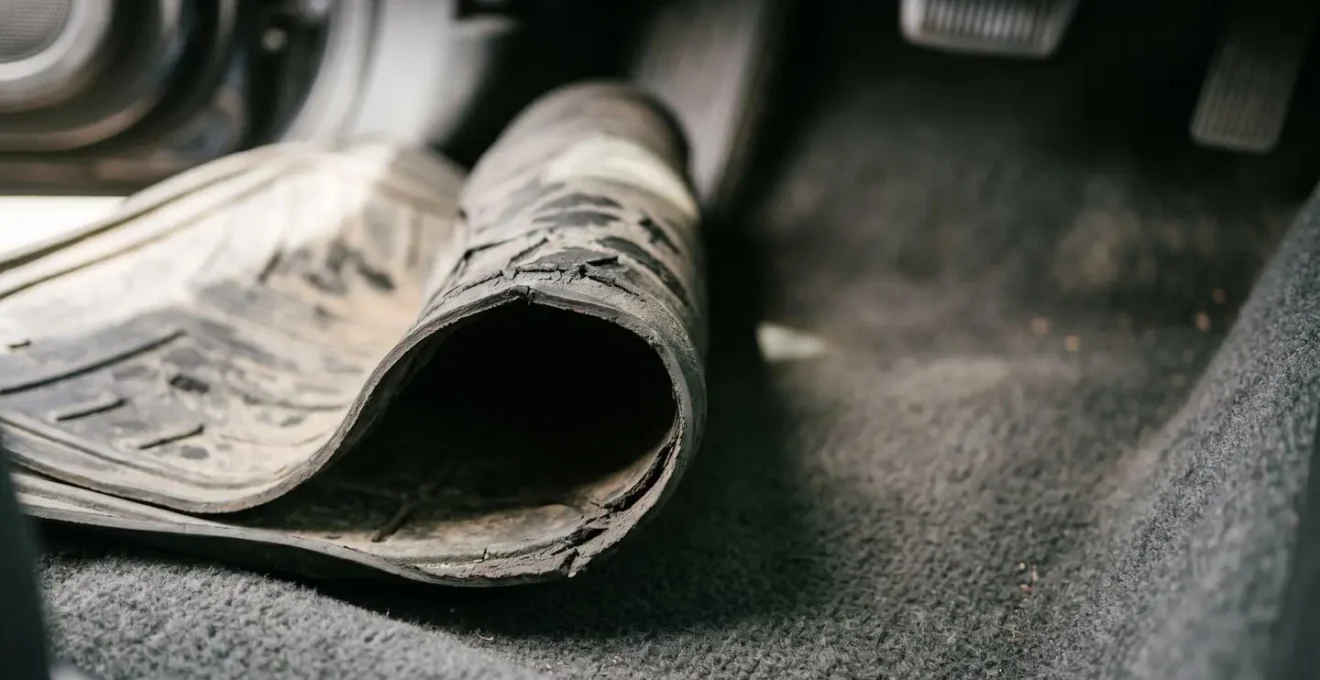
The failure of a cheap floor mat often manifests in a less dramatic but equally insidious way: the curling of its edges. This degradation is most common in the driver’s footwell, where the constant rotational pressure of the heel pivoting between pedals puts immense stress on the mat’s perimeter. A low-quality mat, made from inferior materials like recycled PVC, lacks the structural rigidity to withstand this force. Over time, the edge begins to curl upwards.
This curled edge does two dangerous things. First, it compromises the mat’s ability to contain spills. Water, mud, and melting snow now have a clear path to the vehicle’s carpet, leading to mould, mildew, and corrosion underneath. Second, and more importantly, it creates a significant trip hazard. The raised lip can easily catch the heel or sole of a shoe as the driver or passengers enter or exit the vehicle, leading to a fall. This seemingly minor detail is a clear indicator of poor design and material choice.
Well-engineered floor liners are designed to prevent this type of failure from the outset. They use materials like TPE with superior dimensional stability, meaning they resist deformation under stress and temperature changes. Furthermore, premium designs often feature a continuous raised lip or « tray » style. This design is not just a wall to contain spills; its geometry provides structural reinforcement, making it physically incapable of curling upwards. Many also include a reinforced heel pad zone, using a denser or thicker material in the high-wear area to distribute pressure and prevent breakdown.
By understanding the failure points, you can proactively assess a mat’s design for long-term durability and safety. The following checklist outlines the key features to look for to prevent edge curling and wear.
Checklist: Preventing Floor Mat Edge Failure
- Verify the mat features a reinforced heel pad zone with densified material in the high-wear driver pivot area.
- Confirm a continuous raised lip design (floor liner style) that is structurally incapable of curling due to its tray-like geometry.
- Check the material specification for a high abrasion resistance rating, prioritising TPE or premium rubber formulations.
- Ensure mat coverage extends fully under the pedals and beyond the heel pivot zone to distribute wear.
- Inspect the retention system to confirm it prevents mat rotation, which would expose edges to concentrated heel grinding.
A mat that curls at the edges is not just showing its age; it is demonstrating its inherent design flaws and broadcasting its potential to cause harm, both to the vehicle’s interior and its occupants.
How to Clean Rubber Floor Mats Without Leaving a Slippery Surface?
Cleaning rubber or TPE floor mats seems straightforward, but doing it incorrectly can turn a safety feature into a serious hazard. The goal is not just to make them look new, but to restore their grip and texture without leaving behind a treacherous, low-friction surface. The single biggest mistake is using products that contain silicone or solvent-based dressings, such as many popular tyre shine sprays or interior « protectants ».
These products are designed to create a glossy, slick finish. While this might look appealing, it is disastrous for a floor mat. The silicone molecules fill in the micro-textures of the mat’s surface, drastically reducing its coefficient of friction. This creates a dangerously slick surface for your shoes. Worse, this residue is not self-contained. It transfers from the mat to the soles of your shoes, and then from your shoes directly onto the brake and accelerator pedals. The result is a critical loss of pedal feel and grip precisely when you need it most.
The professional, safety-conscious approach to cleaning focuses on degreasing and restoring the mat’s natural, satin finish. The process is methodical:
- Removal and Decontamination: Always remove the mats from the vehicle. This prevents water and cleaning chemicals from soaking into the carpet and underlay, which can lead to mould and corrosion. Shake them out vigorously to remove loose dirt and debris.
- Degreasing: Use a dedicated rubber floor mat cleaner or a quality all-purpose cleaner (APC) diluted to the manufacturer’s recommendation. Spray the mat liberally and let the cleaner dwell for a minute to break down oils and grime.
- Agitation: This is a critical step. Using a medium-stiff brush, scrub the entire surface of the mat. This mechanical action is necessary to lift embedded dirt from the textured grooves and channels that are designed to provide grip.
- Thorough Rinsing: Rinse the mat completely with a hose or pressure washer. Ensure all traces of the cleaning solution are gone, as leftover soap residue can also be slippery.
- Drying and Dressing (The Safe Way): Allow the mats to air dry completely. If you wish to apply a dressing for a restored look, it is imperative to use a water-based, non-silicone product specifically designed for this purpose. These products provide a deep, satin finish without compromising grip.
As automotive detailing safety guidelines explicitly state, the danger of using the wrong products is significant and often overlooked.
Silicone and solvent-based dressings create a low-friction microscopic layer, making the mat and pedals dangerously slick. Residue transfers from the treated mat to your shoe sole, and then from your shoe to the brake and accelerator pedals.
– Automotive Detailing Safety Guidelines, Floor Mat Cleaning Best Practices Documentation
Proper cleaning is a maintenance task that directly impacts vehicle safety. It’s about removing dirt, not adding danger.
Genuine Ford Mats or £30 eBay Alternatives: What Actually Lasts 5 Years?
The choice between a genuine OEM mat and a cheap online alternative is a classic example of a false economy. The £30 eBay mat seems like a bargain compared to the £80-£120 dealer price, but this comparison only considers the initial purchase. To understand what truly lasts, we must analyze the Total Cost of Ownership (TCO) over a five-year period, factoring in durability, performance, and the risk of collateral damage.
A useful way to frame this is a three-tier quality framework. Tier 3 is the cheap, universal « trim-to-fit » mat. Tier 2 represents the vehicle-specific, OEM-supplied mat. Tier 1 is the premium aftermarket floor liner, which often exceeds OEM quality. A comparative analysis of custom vs. universal mats provides data that helps populate this framework, clearly showing the lifespan and cost implications.
| Quality Tier | Examples | Fit Precision | Material Quality | Typical Lifespan | 5-Year TCO |
|---|---|---|---|---|---|
| Tier 3: Cheap Universal | £30 eBay alternatives | Generic trim-to-fit, 65-70% coverage | Recycled PVC, poor UV stability | 6-18 months | £90+ (3 replacements + carpet damage risk) |
| Tier 2: OEM/Genuine | Dealer-branded mats | Vehicle-specific CAD data, 85-95% coverage | Manufacturer-spec materials, tested durability | 3-5 years | £80-120 (single purchase) |
| Tier 1: Premium Aftermarket | WeatherTech, Husky Liners | Laser-scan precision, 95-100% coverage | Premium TPE, rigorous testing, lifetime warranty | 5+ years (often lifetime) | £100-150 (single purchase, protects resale value) |
As the table demonstrates, the £30 mat is the most expensive option over five years. Its poor material quality (often recycled PVC) leads to cracking and wear within 18 months, requiring multiple replacements. This calculation doesn’t even include the hidden cost of a damaged vehicle carpet from spills and abrasion, which can significantly impact a car’s resale value. The OEM mat provides a solid baseline of quality and fit, designed to last the typical length of first ownership. The Tier 1 premium liner, while having the highest initial cost, offers the best value. Its superior TPE material and laser-scanned fit mean it will likely outlast the vehicle itself, providing a single, lifetime purchase that offers maximum protection.
Consumer behaviour is beginning to reflect this understanding. The market is shifting away from the « one-size-fits-none » approach, with a 2022 SEMA market survey showing a 30% growth in consumer preference for vehicle-specific accessories over universal products. Drivers are realizing that paying for engineering and proper materials upfront is more cost-effective and far safer in the long run.
Steering Correction or Power Steering Failure: How to Tell the Difference?
In modern vehicles, it can be disconcerting to feel the steering wheel move on its own. It’s crucial to distinguish between a normal function of an advanced driver-assistance system (ADAS) and the early signs of a power steering system failure. Understanding the difference is key to your safety.
Steering Correction is a feature of Lane Keeping Assist (LKA) or Lane Departure Warning (LDW) systems. Its purpose is to keep the vehicle within its lane. You will typically experience this as:
- A gentle, brief nudge of the steering wheel, guiding you back towards the centre of the lane.
- It occurs only when you are drifting towards a lane marking without indicating.
- A corresponding light or icon may flash on your dashboard, indicating the system has activated.
- The feeling is smooth and controlled, like a subtle suggestion rather than a forceful pull.
This is a normal and intended operation, designed to enhance safety by correcting momentary lapses in driver attention.
A Power Steering Failure, on the other hand, is a serious mechanical or electrical issue. Its symptoms are more alarming and persistent. They can include:
- The steering becomes suddenly very heavy and difficult to turn, especially at low speeds or when stationary. This is the most common sign.
- A groaning, whining, or squealing noise when you turn the wheel, often indicating low power steering fluid or a failing pump.
- A warning light on the dashboard, often an icon of a steering wheel, sometimes with an exclamation mark.
- Vibration in the steering wheel or a feeling of « lumpiness » as you turn.
If you experience any symptoms of power steering failure, it is a serious safety risk. You should reduce your speed, pull over to a safe location as soon as possible, and call for professional assistance. Do not continue to drive the vehicle, as a complete loss of steering assist could occur at any time, requiring immense physical effort to control the car.
Key takeaways
- The safety of a floor mat is not determined by its price, but by its engineered fit (geometric integrity) and retention system, which prevents pedal interference.
- Material science is critical: premium TPE offers the durability and temperature stability that cheap PVC lacks, preventing cracking, warping, and the creation of new hazards.
- The true cost of a « cheap » mat includes multiple replacements and the risk of damage to your vehicle’s carpet, making it the most expensive option in the long run.
Why Do Genuine Manufacturer Accessories Cost 3x More Than Pattern Parts?
The price disparity between a genuine OEM accessory and a « pattern part » or cheap aftermarket alternative is a source of constant frustration for car owners. Why does a set of manufacturer-branded floor mats cost £120 when a visually similar set can be found online for £30? The answer lies in a series of hidden costs that the cheap part conveniently ignores: research and development, materials validation, rigorous testing, and liability.
When a car manufacturer designs an accessory, it is treated as part of the vehicle’s integrated system. The floor mat, for example, is designed using the same CAD data as the car’s floor pan, ensuring a perfect geometric fit. The material is not just « rubber »; it’s a specific compound that has undergone thousands of hours of testing for UV stability, abrasion resistance, thermal performance, and off-gassing, ensuring it meets strict health and safety standards. The retention clips are engineered to withstand a specific pull-force, and the entire assembly is crash-tested to ensure it does not become a projectile or hazard in an accident.
The pattern part manufacturer shortcuts this entire process. They often reverse-engineer the product, creating a mould from a genuine part, which introduces small inaccuracies. They use the cheapest material available (like recycled PVC) that looks the part but lacks the tested durability. They skip the extensive safety and validation testing entirely. Their business model is based on volume and low overhead, not on engineering excellence or long-term safety. The 3x price difference isn’t just profit margin; it represents the cost of engineering, testing, certification, and the legal liability that the manufacturer assumes by guaranteeing the part is safe and fit for purpose. You are paying for the assurance that the part will perform as designed and, most importantly, that it will not fail in a way that compromises your safety.
Therefore, before your next vehicle accessory purchase, empower yourself to look beyond the price tag. Evaluate the part based on its engineering, material specification, and safety credentials. Your vehicle is a complex system, and every component, no matter how simple it seems, has a role to play in its safety and performance. Making an informed choice is the best way to protect your investment and, more importantly, yourself.