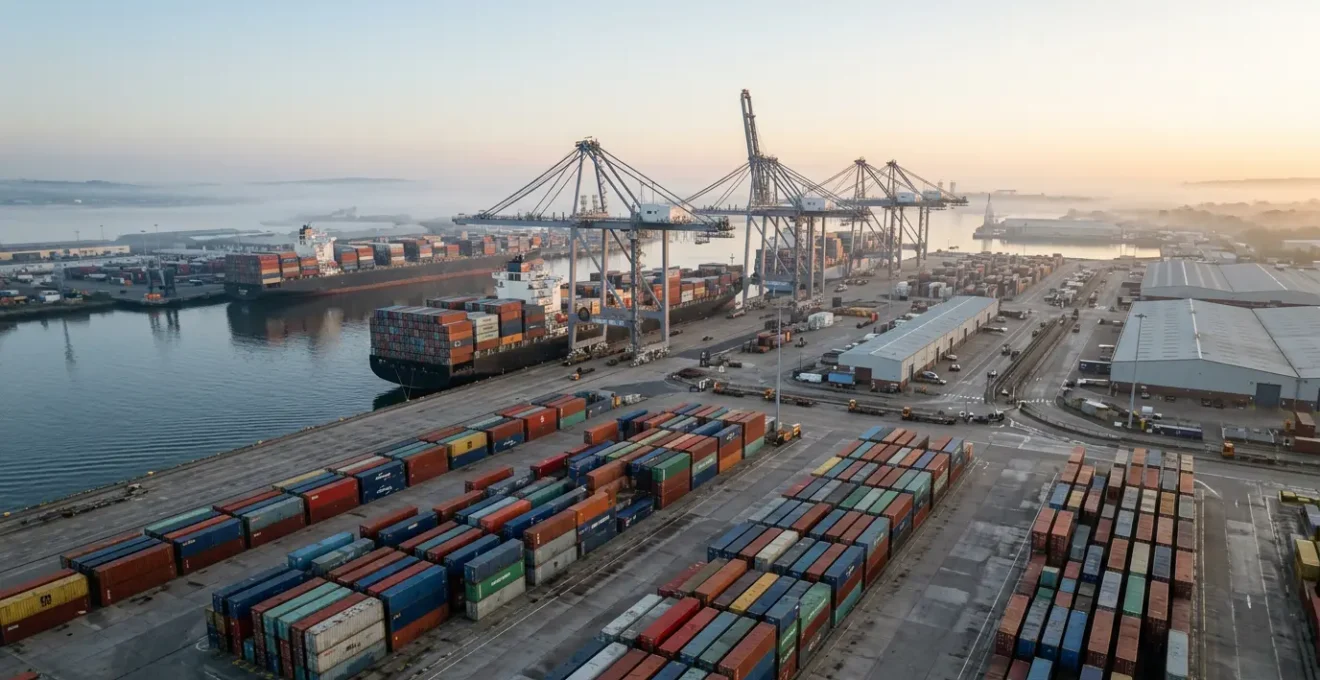
The key to overcoming post-Brexit disruption isn’t just resilience; it’s turning resilience into a measurable 18% cost advantage through strategic redesign.
- Strategic infrastructure choices, like deploying regional hubs over a single mega-warehouse, directly cut last-mile costs and mitigate delays.
- Proactive compliance, especially accurate HS code classification, can be transformed from a cost centre into a profit driver by eliminating unnecessary duties.
Recommendation: Stop treating Brexit as a problem to be managed and start auditing your supply chain for quantifiable efficiency gains.
For any UK supply chain director, the post-Brexit landscape has been a relentless test of patience and planning. The familiar rhythm of logistics has been replaced by a cacophony of unexpected delays, spiralling costs, and frustrating customs paperwork. You’ve seen shipments that left a supplier on time mysteriously arrive three days late, faced angry calls from customers about stock-outs, and likely stared in disbelief at a customs bill inflated by duties you never anticipated. The standard advice to « diversify suppliers » or « digitise paperwork » feels painfully inadequate, like applying a plaster to a compound fracture.
These reactive measures only address the symptoms of a much deeper issue. They fail to recognise the fundamental shift in the rules of the game. But what if the chaos of Brexit wasn’t just a crisis to be managed, but an unprecedented opportunity to re-engineer your entire network from the ground up? What if the real key to survival wasn’t just building resilience, but designing a logistics infrastructure so efficient it could actually reduce cross-border costs by 18% compared to pre-Brexit models? This isn’t a hypothetical; it’s the tangible result of a strategic, forward-looking approach.
This article deconstructs that approach. We will move beyond the platitudes and dive into the specific, structural decisions that turn disruption into a competitive advantage. We will explore how single points of failure expose catastrophic risk, how the debate between mega-warehouses and regional hubs is won or lost, and how the meticulous art of customs classification becomes a profit centre. This is the playbook for transforming your supply chain from a reactive cost centre into a proactive, resilient, and demonstrably more profitable operation.
To navigate this complex topic, we have broken down the core strategic pillars that underpin a truly resilient and cost-effective post-Brexit supply chain. The following sections will guide you through each critical decision point.
Summary: The Post-Brexit Playbook for Supply Chain Resilience and Cost Reduction
- Why Did a Single Port Closure Cost UK Retailers £2.3 Million in Lost Sales?
- How to Build 3 Alternative Route Options for Every Critical Supply Line?
- One Mega-Warehouse or Five Regional Hubs: Which Cuts Delivery Times by 40%?
- The Demand Forecasting Mistake That Leaves 30% of Your SKUs in the Wrong Location
- When to Expand Warehouse Capacity: Reading the 6-Month Lead Indicators
- The Sole-Supplier Dependency That Cost UK Retailers £50 Million During the Suez Blockage
- Why Getting Your HS Code Wrong Costs You 12% in Unnecessary Import Duty?
- Why Does Your Stock Arrive 3 Days Late Despite Leaving the Supplier on Time?
Why Did a Single Port Closure Cost UK Retailers £2.3 Million in Lost Sales?
The £2.3 million figure isn’t just a headline; it’s the sound of a single, critical domino falling and taking a row of businesses with it. In the post-Brexit world, supply chain vulnerability is no longer a theoretical risk. It’s a clear and present danger, where dependence on a single port, a single supplier, or a single transport mode can trigger catastrophic financial consequences. The illusion of a frictionless, predictable network has been shattered, exposing the fragility of lean, just-in-time models that lack redundancy.
Consider the real-world impact of a single facility failure. The closure of the blast furnaces at Port Talbot, for instance, led to a near-total collapse of its dry bulk freight. Official UK port freight statistics show this event caused a dramatic 99% drop in dry bulk tonnage in just one quarter. This wasn’t a gradual decline; it was a sudden shockwave that forced freight to be chaotically redistributed across an already strained UK port network. For businesses reliant on that specific piece of infrastructure, the cascading effects were immediate: increased transport costs, crippling delays, and, ultimately, lost sales.
This single-point dependency is the silent killer of supply chain resilience. Whether it’s industrial action at Felixstowe, a customs IT system failure at Dover, or a sudden infrastructure collapse, the result is the same. Without pre-planned alternative pathways, inventory is stranded, production lines halt, and shelves remain empty. The cost is not just the lost revenue from a missed sale but the long-term damage to brand reputation and customer loyalty. Strategic de-risking begins with identifying and mitigating these single points of failure before they bring your operations to a standstill.
How to Build 3 Alternative Route Options for Every Critical Supply Line?
The answer to the vulnerability exposed by events like the Port Talbot disruption is not to simply find one alternative, but to embed optionality into the very DNA of your logistics network. A truly resilient supply chain doesn’t have a Plan B; it has a playbook of pre-vetted, pre-costed options that can be activated at a moment’s notice. For every critical supply line, the goal is to have at least three viable route options, each representing a different trade-off in the strategic triangle of Cost, Speed, and Carbon.
This isn’t about having three identical routes. It’s about strategic diversification. Option A might be your primary, most cost-effective route (e.g., sea freight into a major port). Option B could be a faster but more expensive alternative (e.g., rail freight or a different shipping line into a secondary port). Option C might be a land-based, nearshoring route that bypasses maritime chokepoints altogether, offering maximum resilience at a premium cost. The key is to model and understand the financial and operational implications of each path *before* a crisis hits.

As the visual demonstrates, the goal is to create a web of possibilities, not a single, fragile line. This proactive route planning transforms your organization from a victim of disruption to a master of adaptation. When a primary port is congested, you’re not scrambling for a solution; you’re executing a pre-defined protocol to switch to a secondary port. When a shipping lane is blocked, you seamlessly activate a nearshoring supplier. This level of preparedness is the foundation of turning potential chaos into a controlled, strategic response.
Your Action Plan: Building a Diversified Supply Network
- Supplier Diversification: Actively expand your portfolio of suppliers across different geographic regions to absorb shocks and reduce dependency on single-source EU partners.
- Nearshoring Strategy: Identify opportunities to transfer key operations closer to the UK market, mitigating the customs complexity and red tape introduced by the Trade and Cooperation Agreement.
- Systematic Risk Assessment: Implement a regular, risk-based review of your entire value chain, evaluating the potential threats posed by each supplier and transport link.
- Real-Time Monitoring Investment: Invest in technologies that provide real-time data and monitoring across your value chain, enabling you to anticipate disruptions rather than just react to them.
- Fine-Slicing Value Chains: Reconfigure your supply chain by breaking down activities into smaller modules, allowing you to select and onboard the best suppliers for each specific task with greater agility.
One Mega-Warehouse or Five Regional Hubs: Which Cuts Delivery Times by 40%?
The question of warehouse strategy is no longer just about storage capacity; it’s about velocity and resilience. The post-Brexit reality, where delivery timelines extended by an average of 30%, has forced a radical rethink of inventory placement. The traditional, centralized model of a single mega-warehouse, once prized for its economies of scale, now represents a significant single point of failure and a bottleneck for last-mile delivery. The strategic choice between a centralized and a decentralized network is a critical lever for cutting delivery times and costs.
A mega-warehouse offers simplicity in inventory management and lower overheads per square foot. However, it pushes all last-mile complexity outward, resulting in longer, more expensive final delivery journeys and leaving the entire operation vulnerable to a single localised disruption (e.g., a motorway closure or regional industrial action). Conversely, a network of five regional hubs brings inventory closer to the end customer. This drastically reduces last-mile delivery times and costs, improves responsiveness to regional demand fluctuations, and builds incredible resilience. A fire, flood, or labour dispute at one hub only affects 20% of your operation, not 100%.
This « infrastructural arbitrage » is about balancing economies of scale with the high cost of delays and unreliability. For many, the higher operating costs of multiple sites are more than offset by the savings in final-mile transportation and the priceless benefit of business continuity. As supply chain experts have noted, the new regulatory environment has introduced significant financial pressures that demand smarter structural choices.
Brexit has led to increased costs and regulatory hurdles, with 70% of UK firms reporting higher supply chain costs due to new tariffs and trade rules.
– Zycus Supply Chain Research Team, Brexit Impact on Supply Chains in UK: Challenges and Strategic Responses
The decision is not one-size-fits-all. It requires a sophisticated analysis of your specific customer geography, SKU velocity, and risk tolerance. But for businesses aiming to slash delivery times and insulate themselves from disruption, moving from a single point of storage to a resilient web of regional hubs is a powerful strategic move.
The Demand Forecasting Mistake That Leaves 30% of Your SKUs in the Wrong Location
Even with a perfectly designed network of regional hubs, your efficiency gains can be completely nullified by one fundamental error: poor demand forecasting. The biggest mistake in the post-Brexit era is assuming that historical sales data is still a reliable predictor of future demand. New trade barriers, shifting consumer behaviours, and volatile lead times have rendered old forecasting models obsolete. This leads to a phenomenon we can call ‘inventory gravity’ failure—your stock is not being pulled to where the actual demand is, leaving up to 30% of your SKUs stranded in the wrong warehouse.
The result is a costly paradox. You have excess stock of a popular item in Scotland while facing a stock-out in London. This forces expensive, inefficient inter-warehouse transfers or, worse, lost sales and dissatisfied customers. The problem is compounded by the fact that, according to ONS survey data, only a small fraction of businesses have truly adapted. It’s noted that just 7.5% of UK businesses transformed their supply chains within the first year after the transition, meaning many are still operating on outdated assumptions.

Effective modern forecasting moves beyond simple historical analysis. It requires integrating a much wider range of data signals: real-time point-of-sale data, regional marketing campaign schedules, local economic indicators, and even competitor stock levels. It means using machine learning models that can detect subtle shifts in regional demand patterns far earlier than a human analyst. By investing in this data-driven approach, you can ensure your inventory is proactively positioned to meet demand where it arises, maximizing sales velocity and minimizing the costly dead weight of misplaced stock.
When to Expand Warehouse Capacity: Reading the 6-Month Lead Indicators
Deciding when to invest in new warehouse capacity is one of the most capital-intensive decisions a supply chain director will make. Getting it wrong—expanding too early or too late—can have severe financial repercussions. In the current climate, traditional indicators like sales growth are no longer sufficient. Instead, a more nuanced set of lead indicators, looking 6-12 months into the future, is required to make a truly strategic decision.
One such indicator is the ‘inventory dwell time’. Are your goods spending more time in the warehouse post-customs clearance due to administrative friction or last-mile bottlenecks? If your average dwell time is creeping up, your existing capacity will be exhausted faster, even if sales volumes are flat. Another key metric is the ‘supplier lead time variability’. If the delivery window from your key suppliers is becoming less predictable, you will be forced to hold more safety stock as a buffer, directly consuming more warehouse space.
Interestingly, even seemingly negative macroeconomic data can be a lead indicator for expansion. For example, recent official port freight statistics indicate UK ports handled 429.7 million tonnes in 2024, the lowest volume since 2000. On the surface, this suggests a slowdown. However, for a savvy strategist, it could signal an opportunity. Lower overall throughput might ease congestion, but if it’s coupled with increased import friction causing goods to be held inland for longer, the need for domestic buffer warehousing could actually increase. This is why looking beyond top-line sales figures is critical.
The decision to expand should be triggered by a composite index of these lead indicators: rising dwell times, increased lead time variability, a strategic shift to holding more buffer stock, and changes in freight flow patterns. By monitoring these metrics, you can move from a reactive « we’re full » crisis to a proactive, data-driven investment decision that supports future growth.
The Sole-Supplier Dependency That Cost UK Retailers £50 Million During the Suez Blockage
While Brexit has focused attention on UK-EU trade, the 2021 Suez Canal blockage was a brutal reminder that some of the greatest supply chain risks are entirely global. The image of the Ever Given wedged in the canal, holding up an estimated 12% of global trade, was a stark illustration of sole-supplier and single-route dependency. For UK retailers, the immediate cost ran into the tens of millions, but the event provided an invaluable lesson: your supply chain is only as strong as its most fragile global link.
The financial impact was staggering. An analysis of the Ever Given incident shows the blockage resulted in supply chain disruptions costing $15 to $17 billion globally. This single chokepoint created a logistical nightmare, delaying everything from consumer electronics to critical manufacturing components. For a UK business heavily reliant on a single supplier in Asia, shipping exclusively via this route, the event was a catastrophe. There was no alternative. They were forced to wait, watching their stock levels deplete and their production schedules collapse.
The strategic response is not to abandon global sourcing, but to build in redundancy and understand the true cost of alternatives. The knee-jerk reaction during the blockage was to reroute ships around the Cape of Good Hope, but this was not a simple fix. As the following comparison shows, this alternative came with significant trade-offs in time, cost, and security.
| Route Factor | Suez Canal (Normal) | Cape of Good Hope (Alternative) | Impact |
|---|---|---|---|
| Additional Transit Time | Baseline | +10 to 14 days | Significant delay to delivery schedules |
| Fuel Costs | Standard | Higher (longer distance) | Increased operational expenses |
| Security Costs | Lower | Higher (pirate-prone waters off Somalia) | Additional surveillance required |
| Total Added Sailing Time | – | +1 week minimum | Compounded supply chain disruption |
| Supply Chain Recovery Period | – | 2-3 months to normalize | Extended impact beyond immediate event |
A resilient strategy involves diversifying not just suppliers but also shipping routes and modes. It means having a portion of your supply sourced from nearer regions (like Turkey or Eastern Europe) that aren’t dependent on maritime chokepoints. It’s about knowing the cost and transit time of your Plan B and Plan C before you ever need to use them. The Suez blockage taught us that the cost of building this redundancy is a fraction of the cost of not having it when you need it most.
Why Getting Your HS Code Wrong Costs You 12% in Unnecessary Import Duty?
In the complex world of post-Brexit logistics, the most significant cost savings—and the most catastrophic financial risks—are often hidden in plain sight. No area is more critical, or more frequently misunderstood, than customs classification using the Harmonized System (HS) code. Getting this code wrong isn’t a minor administrative error; it is a direct path to overpaying duty, facing severe penalties, and eroding your profit margins. For many product categories, a simple classification mistake can mean paying 12% or more in unnecessary import duty, turning a profitable shipment into a loss-making one.
The scale of the problem is enormous. Recent statistical data on customs compliance reveals that classification errors account for 30-40% of all customs violations. This is because classification is a complex legal and technical exercise, not a simple lookup task. It requires a deep understanding of a product’s composition, form, and function. A smartwatch, for example, is not just a watch. Is it a time-telling device (Chapter 91) or a telecommunication device (Chapter 85)? The difference can be a 0% duty rate versus a 4.5% rate, a distinction that can save or cost a company tens of thousands of pounds on a single shipment.

This is where the concept of « compliance as a profit centre » comes into play. By investing in expertise—either in-house or through a specialist partner—to ensure every product is classified under the most favourable correct HS code, you are not just avoiding fines; you are actively optimising your cost base. The financial leverage is immense, as a real-world example illustrates.
Case Study: The $300,000 Smartwatch Mistake
A U.S. electronics importer incorrectly classified smartwatches under HS code 9102 (wristwatches) instead of the correct code 8517 (telecommunication devices). This single misclassification error resulted in paying 4.5% duty instead of 0%, costing $67,500 on a $1.5 million shipment. When customs discovered the error during a routine audit three years later, it triggered retroactive duties plus 15% penalties, creating a total liability exceeding $300,000—demonstrating how a seemingly minor classification mistake can compound into catastrophic financial exposure.
This is the hidden engine behind the 18% cross-border cost saving. It’s a meticulous, legally-sound process of tariff engineering. It requires treating customs classification not as an administrative afterthought for the shipping department, but as a core strategic financial function.
Key Takeaways
- Single points of failure, whether a port or a supplier, represent an existential risk that must be actively designed out of your network.
- Your warehousing strategy (centralized vs. decentralized) is a primary lever for controlling last-mile costs and delivery speeds; it must be tailored to your customer distribution.
- Proactive and expert customs compliance, particularly with HS codes, is not a cost but a powerful profit driver capable of delivering significant, direct savings on duties.
Why Does Your Stock Arrive 3 Days Late Despite Leaving the Supplier on Time?
It’s the most frustrating problem for any supply chain director: you have confirmation that goods left the supplier on schedule, yet your dashboard shows them arriving two, three, or even five days late. This phantom delay, which occurs between the supplier’s gate and your warehouse door, is the manifestation of post-Brexit « friction. » It’s not one single event, but an accumulation of small delays at borders, in customs clearance, and during transit that compound into a significant disruption to your schedule.
The data paints a stark picture. A report by the Centre for Economic Policy Research found that since Brexit, export costs from the UK to the EU have increased by 15%, accompanied by a staggering 42% increase in transit times. This isn’t just about longer queues at Dover; it’s about the entire ecosystem of cross-border trade slowing down. It’s the time spent ensuring paperwork is 100% correct, the delays waiting for a customs agent to become available, and the bottleneck caused by physical inspections. Each step adds hours, which quickly accumulate into days.
This friction has had a chilling effect on trade, particularly for exporters who bear the brunt of the new administrative burden. As research from Logistics UK highlights, the impact has been significant and imbalanced, disproportionately affecting businesses trying to sell into the EU.
Between 2017 and 2024, UK exports to the EU fell by 23%, from 106.4 million tonnes to 82.4 million tonnes, while imports declined by just 5% in the same period. This imbalance highlights how exporters, particularly smaller businesses without dedicated customs teams, have struggled to cope with the additional barriers.
– Logistics UK Research Team, The Impact of Brexit on UK Logistics: Costs, Delays, and Workforce Challenges
Overcoming this friction requires a forensic « friction audit » of your supply chain. You must map every single touchpoint and potential delay, from the moment a truck is booked to the final customs release. By quantifying the time and cost of each step, you can identify your biggest bottlenecks. Perhaps the delay is with your customs broker, or maybe your haulier isn’t using the most efficient border crossing procedure. Only by making this invisible friction visible can you begin to systematically eliminate it, clawing back those lost days and restoring predictability to your network.
Stop reacting to post-Brexit challenges. Start strategically redesigning your network for a competitive edge. Begin your friction audit today to identify the hidden costs and turn disruption into your next efficiency gain.