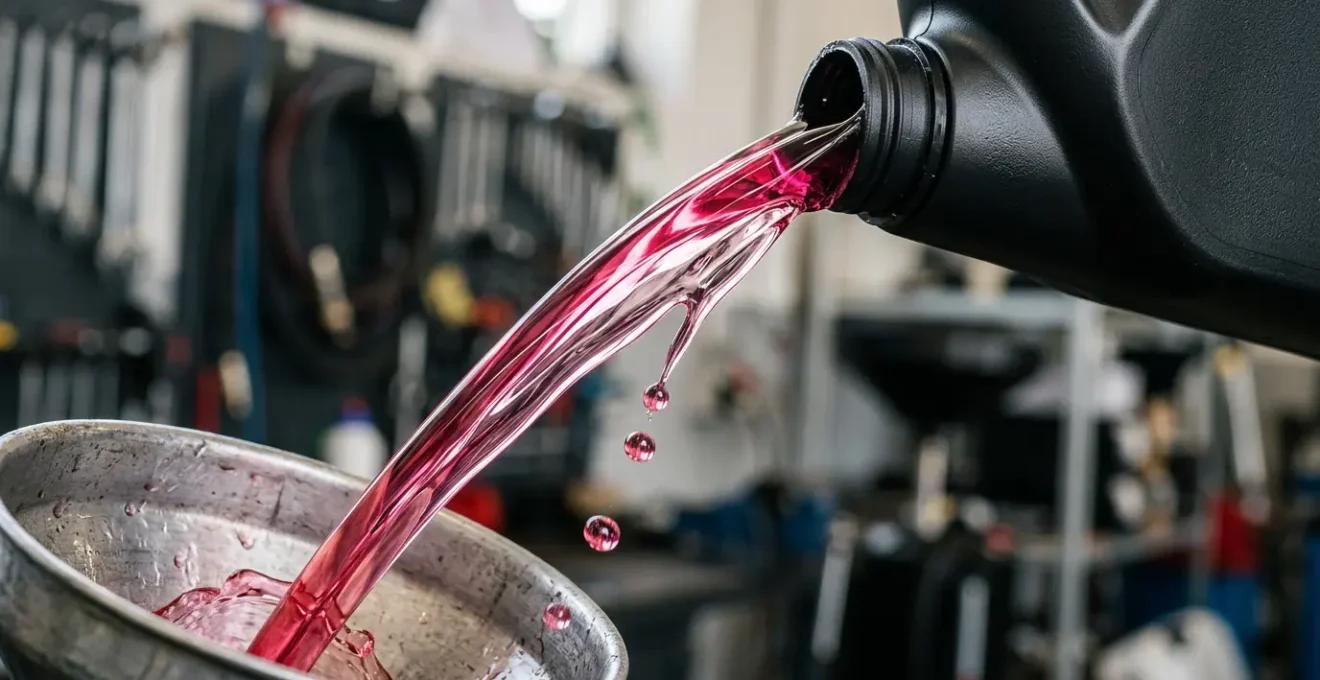
The £3,000 gearbox replacement you want to avoid is caused by heat-degraded fluid, not bad luck, and the « sealed for life » label on your transmission is the primary source of this misunderstanding.
- « Sealed for life » actually means sealed for the life of the vehicle’s original warranty period, not the life of the car.
- Heat from city driving is the number one killer of transmission fluid, rapidly depleting the additives that protect internal components.
Recommendation: To prevent catastrophic failure, a specialist should service your automatic transmission fluid and filter every 60,000 miles (or sooner if you primarily drive in the city), regardless of what the manufacturer’s marketing suggests.
Every UK driver dreads the phone call from the garage. The one that starts with a sharp intake of breath and ends with a four-figure repair bill. For automatic vehicle owners, the most feared diagnosis is « gearbox failure. » It’s a bill that can easily eclipse the value of the car itself. Many owners believe they are safe because their car’s manual states the transmission is « sealed for life. » They follow the service schedule diligently, yet one day, the gears start slipping, whining, or refusing to engage at all.
As a transmission rebuild specialist, I see the consequences of this misunderstanding every single day. I see the metal shavings in the pan, the burnt clutch packs, and the warped valve bodies. And I can tell you unequivocally: the « sealed for life » concept is the most expensive myth in the automotive world. The key to gearbox longevity isn’t some complex secret; it’s about understanding what really destroys a transmission from the inside out. The enemy isn’t mileage; it’s thermal degradation.
This article will dismantle that myth from an engineering perspective. We will explore why this fluid, even in a sealed unit, has a finite lifespan. We’ll show you how to spot the early warning signs of fluid breakdown using a simple paper towel, explain the critical differences between fluid types, and reveal which common garage « service » can actually cause more harm than good. Ultimately, you’ll understand how a £200-£300 preventive service is the best insurance policy against a £3,000 catastrophic failure.
This guide provides a comprehensive overview of transmission health, from understanding the fluids that keep it alive to the driving habits that can extend its life. To navigate this essential information, use the summary below.
Summary: Why Does Changing Transmission Fluid at 60,000 Miles Prevent £3,000 Gearbox Replacements?
- Why Does « Sealed for Life » Transmission Fluid Still Need Changing Every 60,000 Miles?
- How to Check Your Automatic Transmission Fluid Without Draining the System?
- CVT or Traditional Automatic: Why Using the Wrong Fluid Destroys Your Gearbox?
- The Transmission Flush That Causes More Failures Than It Prevents on Old Vehicles
- When to Service Your Transmission After Switching From Motorway to City Driving?
- How to Add 50,000 Miles to Your Gearbox Life Through Throttle Management?
- Steering Correction or Power Steering Failure: How to Tell the Difference?
- Why Does Your Steering Wheel Suddenly Resist When You Change Lanes Quickly?
Why Does « Sealed for Life » Transmission Fluid Still Need Changing Every 60,000 Miles?
The phrase « sealed for life » is a masterpiece of marketing, not a statement of engineering fact. It creates a perception of a maintenance-free component, reducing the perceived cost of ownership during the warranty period. However, as the AMSOIL technical team succinctly puts it, « filled for life really means filled for the life of the warranty. » Once that period is over, any failure is the owner’s financial responsibility. The fluid itself is subject to the laws of physics, not marketing slogans. It degrades through a process of thermal breakdown and mechanical shearing.
Every time your transmission shifts, it generates heat. The fluid’s primary job, besides providing hydraulic pressure, is to cool and lubricate hundreds of moving parts. Over time, this constant heating and cooling oxidises the fluid, depleting its crucial anti-wear and friction-modifying additives. The fluid loses its ability to manage heat, leading to a vicious cycle of ever-increasing temperatures. This is why even ZF, a leading manufacturer of these ‘sealed’ automatic transmissions, quietly recommends fluid and filter changes. According to Blauparts, an independent parts specialist, ZF transmission manufacturer recommends fluid changes every 50,000 miles or 8 years, a stark contrast to the « lifetime » claim.
Ignoring this reality is a gamble. The degraded fluid allows for increased friction, which generates microscopic metal particles from wearing clutches and gears. These particles contaminate the fluid, turning it from a lubricant into a gritty abrasive slurry that clogs narrow passages in the delicate valve body and solenoids, leading to erratic shifting, and eventually, total failure. A service at 60,000 miles removes this degraded fluid and suspended contaminants, replacing them with fresh fluid rich in the additives needed for another 60,000 miles of protection.
How to Check Your Automatic Transmission Fluid Without Draining the System?
While many modern cars have eliminated the traditional dipstick, you don’t need to be a mechanic to get an indication of your fluid’s health. You can perform a simple « blotter test » which is a technique we use in the workshop every day. After a drive, when the engine is warm, carefully pull out the transmission dipstick (if equipped) and let a single drop of fluid fall onto a plain white paper towel. If there is no dipstick, a very small amount can be sampled from the fill plug by a technician. The way the fluid behaves on the paper is incredibly revealing.

Healthy fluid will be bright pink or red and will spread out evenly, creating a wide, translucent stain. It should smell neutral. Conversely, degraded fluid will be dark brown or black, will barely spread, and may leave a concentrated spot of dark particles at the centre. A burnt, acrid smell is a definitive sign of advanced thermal breakdown and potential internal damage. This simple visual check is your best early warning system.
Beyond the fluid itself, your car will give you sensory clues that the fluid is failing to do its job. Pay close attention to these symptoms:
- Strange Noises: A new whining, clunking, or humming sound that changes with engine RPM or during gear changes is a major red flag.
- Slipping Gears: The engine revs up, but the car doesn’t accelerate accordingly, especially when shifting. This indicates the fluid can no longer provide the necessary hydraulic pressure for the clutches to grip.
- Harsh Shifts: If the gear change, particularly the first-to-second shift when the car is cold, feels unusually rough or jerky, it often means the fluid’s friction modifiers are depleted.
- Shuddering: A vibration or shudder during gentle acceleration can be a sign that the torque converter clutch fluid is worn out.
CVT or Traditional Automatic: Why Using the Wrong Fluid Destroys Your Gearbox?
All automatic transmission fluids are not created equal. Using the wrong type is one of the fastest and most certain ways to destroy a perfectly good gearbox. The most critical distinction is between fluid for a traditional planetary gear automatic (ATF) and a Continuously Variable Transmission (CVT). They are designed with fundamentally opposite friction requirements. A traditional automatic relies on clutch packs that need to engage smoothly. Therefore, ATF is designed for low friction to allow for controlled slippage during shifts.
A CVT, on the other hand, has no discrete gears. It uses a high-strength steel belt running between two variable-diameter pulleys. For this system to work, there must be zero slippage between the belt and the pulleys. Consequently, CVT fluid requires high friction to ensure the belt grips the pulleys without fail. Putting low-friction ATF into a CVT is like oiling your brake pads; the belt will slip, causing catastrophic overheating and failure. Conversely, putting high-friction CVT fluid in a traditional automatic will cause the clutches to grab violently, leading to harsh shifts, glazing, and premature wear.
The following table, based on specialist analysis, breaks down the critical differences. As you can see from a recent comparative analysis of fluid specifications, their properties are engineered for entirely different mechanical systems.
| Characteristic | CVT Fluid | Traditional ATF |
|---|---|---|
| Primary Function | High friction for belt/pulley grip | Low friction for smooth clutch engagement |
| Mechanical System | Belt-and-pulley (infinite ratios) | Planetary gears (discrete steps) |
| Friction Requirement | High coefficient to prevent slipping | Controlled slippage for smooth shifts |
| Viscosity Profile | Higher viscosity for shear stability | Optimized for hydraulic pressure |
| Additive Package | Extreme pressure & friction modifiers | Hydraulic control & torque converter optimization |
| Consequence of Wrong Fluid | Belt slippage, overheating, failure | Harsh shifts, clutch glazing, premature wear |
This is why you must never use a « universal » or « multi-vehicle » fluid unless it is explicitly certified by the vehicle manufacturer for your specific transmission model. The risk of a £3,000+ replacement far outweighs any small savings on a bottle of generic fluid.
The Transmission Flush That Causes More Failures Than It Prevents on Old Vehicles
When a transmission starts showing signs of trouble, some garages may recommend a « power flush. » The logic seems sound: use a machine to force all the old, dirty fluid out and replace it with clean fluid. However, on a high-mileage vehicle (over 80,000 miles) that has missed its service intervals, this is one of the riskiest procedures you can perform. It often causes the very failure it claims to prevent.
The problem lies in the sludge and varnish deposits that build up over many years of neglect. As John Ibbotson, Chief Mechanic for Consumer Reports, warns, the procedure can be counterproductive. In a statement on vehicle maintenance, he noted, » In a high-mileage car, power-flushing the transmission fluid can dislodge sludge and other particles, leading to clogs even after the clean fluid has been added. » These newly liberated particles can then travel through the system and get lodged in the tiny, intricate channels of the valve body, blocking solenoids and causing immediate and often irreversible shifting problems.
The « Beneficial Scabs » Phenomenon
A documented finding from transmission specialists at Durham Transmission highlighted a paradox in neglected systems. They observed that in very old transmissions, the accumulated debris and sludge can act as ‘beneficial scabs.’ This material can paradoxically plug micro-leaks in old, hardened seals, maintaining hydraulic pressure. A high-pressure flush scours these deposits away, which can suddenly expose dozens of previously sealed leaks. The result is a catastrophic drop in hydraulic pressure and a transmission that stops working altogether, often within minutes or miles of the « service. »
The far safer alternative for a high-mileage vehicle is a simple « drain and fill » service. This process only removes about 30-50% of the old fluid (the portion in the pan), which is then replaced with fresh fluid. It doesn’t use high pressure and is far less likely to dislodge harmful deposits. For a neglected transmission, performing several drain-and-fills over a period of a few thousand miles can gently and safely improve the overall quality of the fluid without the shock of a power flush.
When to Service Your Transmission After Switching From Motorway to City Driving?
A vehicle’s service interval is based on an « average » use case, which typically includes a mix of driving conditions. However, not all miles are created equal. The single biggest factor in accelerating transmission fluid breakdown is heat, and nothing generates more heat than city driving. A car driven primarily on the motorway may cover 60,000 miles with relatively little stress on the transmission. It stays in top gear, at a constant speed, with plenty of airflow keeping temperatures stable.
In contrast, a vehicle covering the same distance in stop-and-go London or Manchester traffic is subjecting its gearbox to a brutal ordeal. Every acceleration from a standstill, every crawl in traffic, and every gear change is a « shift cycle » that generates a burst of heat. With low speeds and minimal airflow, this heat accumulates in the transmission, rapidly accelerating the thermal degradation of the fluid. The constant shifting puts immense strain on the clutches, solenoids, and valve body.

Because of this, your driving environment should dictate your service schedule more than the odometer alone. If your driving patterns have changed significantly—for example, a new job with a city commute instead of a motorway one—you must adjust your maintenance plan. Transmission specialists are unanimous on this point: for vehicles under « severe service » conditions, which includes frequent city driving, towing, or operating in hilly terrain, the manufacturer’s recommended service interval should be drastically reduced. The general rule of thumb is that vehicles driven in city traffic or towing conditions should reduce manufacturer service intervals by 30%. This means a standard 60,000-mile fluid change should be brought forward to around 42,000 miles to prevent premature wear.
Essentially, you must service your transmission based on the work it’s doing, not just the distance it has travelled. If your commute is a constant cycle of braking and accelerating, you are a « severe service » driver, and your transmission requires more frequent care to survive.
How to Add 50,000 Miles to Your Gearbox Life Through Throttle Management?
While regular servicing is the foundation of transmission longevity, your driving style has a profound and direct impact on the lifespan of your gearbox. The way you use the accelerator pedal can either preserve the internal components or actively destroy them. Aggressive driving—characterised by abrupt throttle inputs, hard acceleration, and sudden braking—forces the transmission to perform high-pressure shifts. These « slam shifts » cause clutch packs to engage violently, generating intense localised heat and shearing forces that degrade the fluid and wear down the clutch material.
Conversely, a smooth and anticipatory driving style minimises stress on every part of the drivetrain. By learning to manage the throttle with finesse, you can significantly reduce wear and tear, potentially adding tens of thousands of miles to your transmission’s life. The goal is to help the transmission shift as smoothly and at the lowest pressure possible. This isn’t about driving slowly; it’s about driving intelligently.
Integrating a few simple techniques into your daily driving can make a substantial difference. Think of it as mechanical empathy—working with your car’s systems instead of fighting against them. Below is a checklist of throttle management techniques that directly reduce transmission wear.
Your Action Plan: Driving Techniques to Extend Gearbox Life
- Throttle Lift Technique: As you feel the car is about to upshift, slightly and gently reduce pressure on the accelerator. This allows the transmission to engage the next gear at a lower hydraulic pressure, resulting in a much smoother, less wearing shift.
- Avoid Shift Shock: Eliminate abrupt changes in throttle. Flooring the accelerator and then lifting off suddenly forces the transmission control unit to make rapid, high-pressure adjustments, slamming clutches and generating heat.
- The Complete Stop Rule: Always bring the vehicle to a complete and total stop before shifting from Drive (D) to Reverse (R) or vice-versa. A « rolling reversal » forces the internal clutch packs and bands to act as brakes, causing extreme wear.
- Progressive Acceleration: Apply the throttle gradually and smoothly from a standstill. This allows the transmission’s electronic brain to anticipate torque demand and manage shift pressures optimally, reducing clutch glazing.
- Anticipatory Driving: Look far ahead in traffic. By anticipating slowdowns and maintaining a steady speed, you reduce the overall number of unnecessary upshifts and downshifts, which directly correlates to fewer heat-generating cycles.
Mastering these habits costs nothing but can save you thousands in the long run. It’s the most direct control you have over the health of one of your vehicle’s most expensive components.
Steering Correction or Power Steering Failure: How to Tell the Difference?
Modern cars are packed with advanced driver-assistance systems (ADAS) that can sometimes mimic the symptoms of a mechanical failure, leading to confusion and unnecessary worry. One common example is feeling a « nudge » or resistance in the steering wheel and immediately fearing a power steering failure. It’s crucial to be able to distinguish between an intentional action by a safety system like Lane Keep Assist (LKA) and a genuine component problem.
Lane Keep Assist is designed to be a gentle guide. When it detects you are unintentionally drifting out of your lane without indicating, it applies a small amount of steering torque to « nudge » you back towards the centre. This force is subtle, intermittent, and usually silent. It only happens near lane markings and typically activates above a certain speed (e.g., 40 mph). A small icon on the dashboard may briefly illuminate to show the system is active.
In stark contrast, a power steering failure is a consistent and heavy problem. The steering becomes suddenly and uniformly difficult to turn, often described as feeling like « dead weight. » This difficulty is present at all speeds and in all situations, being most noticeable during low-speed manoeuvres like parking. It is often accompanied by a groaning or whining noise from the power steering pump (in hydraulic systems) and a dedicated power steering warning light on the dashboard. The following chart provides a clear diagnostic comparison.
| Symptom | Lane Keep Assist (Normal) | Power Steering Failure (Problem) |
|---|---|---|
| Force Character | Gentle, intermittent ‘nudge’ toward center | Sudden, consistent ‘dead weight’ heaviness |
| Sound | Silent operation, no mechanical noise | Groaning/whining from pump or motor |
| Dashboard Indication | Lane departure icon may appear briefly | Power steering warning light illuminated |
| Consistency | Only when drifting from lane markers | Constant difficulty regardless of lane position |
| Speed Dependency | Typically active above 40 mph | Present at all speeds, especially parking |
| Intent | Intentional safety system intervention | Unintentional system breakdown |
Understanding the character, consistency, and context of the symptom is key. A gentle, brief nudge is the car’s safety system working as intended. A heavy, constant resistance accompanied by noise is a call to have your steering system inspected immediately.
Key takeaways
- « Sealed for life » means sealed for the warranty period; fluid degrades with heat and requires changing every 60,000 miles to prevent failure.
- A simple paper towel « blotter test » can reveal the health of your transmission fluid; dark, smelly fluid is a major warning sign.
- A high-pressure « power flush » on a high-mileage, neglected transmission is risky and can cause damage; a gentle « drain and fill » is the safer alternative.
Why Does Your Steering Wheel Suddenly Resist When You Change Lanes Quickly?
That feeling of increased resistance in the steering wheel when you make a quick lane change at motorway speeds is not a sign of a fault. In fact, it is the opposite: it’s a sophisticated safety feature called variable-assist or speed-sensitive power steering working exactly as designed. Its purpose is to make the car both easier to drive at low speeds and safer to control at high speeds.
At parking speeds, the system provides maximum assistance, making the wheel feel light and easy to turn with one finger. As your speed increases, the system progressively reduces the level of hydraulic or electric assistance. According to the automotive experts at AAA Mountain West Group, » Variable-assist steering provides high assistance at low speeds for easy parking and reduces assistance at high speeds to prevent twitchiness and improve stability. » This added « weight » or resistance at high speed is intentional. It prevents you from making an accidental, jerky movement that could unsettle the car and cause a loss of control. The system ensures that high-speed inputs must be deliberate.
So, when you initiate a quick lane change at 70 mph, you are feeling the system’s programmed resistance, designed to ensure the manoeuvre is smooth and stable. It’s a testament to the advanced engineering that keeps modern cars safe. However, when a truly critical system like the transmission is neglected, the financial consequences are severe. Understanding and maintaining these systems is not optional. When a transmission fails due to fluid neglect, the repair bill is staggering. In fact, market research data from 2024 shows that traditional automatic transmission repair costs range from £1,500 to £2,900 with an average of £2,100, confirming that the £3,000 figure for a complex replacement is a very real possibility.
Don’t wait for a warning light, a slipping gear, or a strange noise. The most expensive repair is always the one that could have been prevented. Check your vehicle’s service history today. If it is approaching or has passed 60,000 miles without a transmission service, book an appointment with a trusted specialist for a fluid and filter change. It is the single most effective and cheapest insurance policy you can buy against a three-thousand-pound bill.