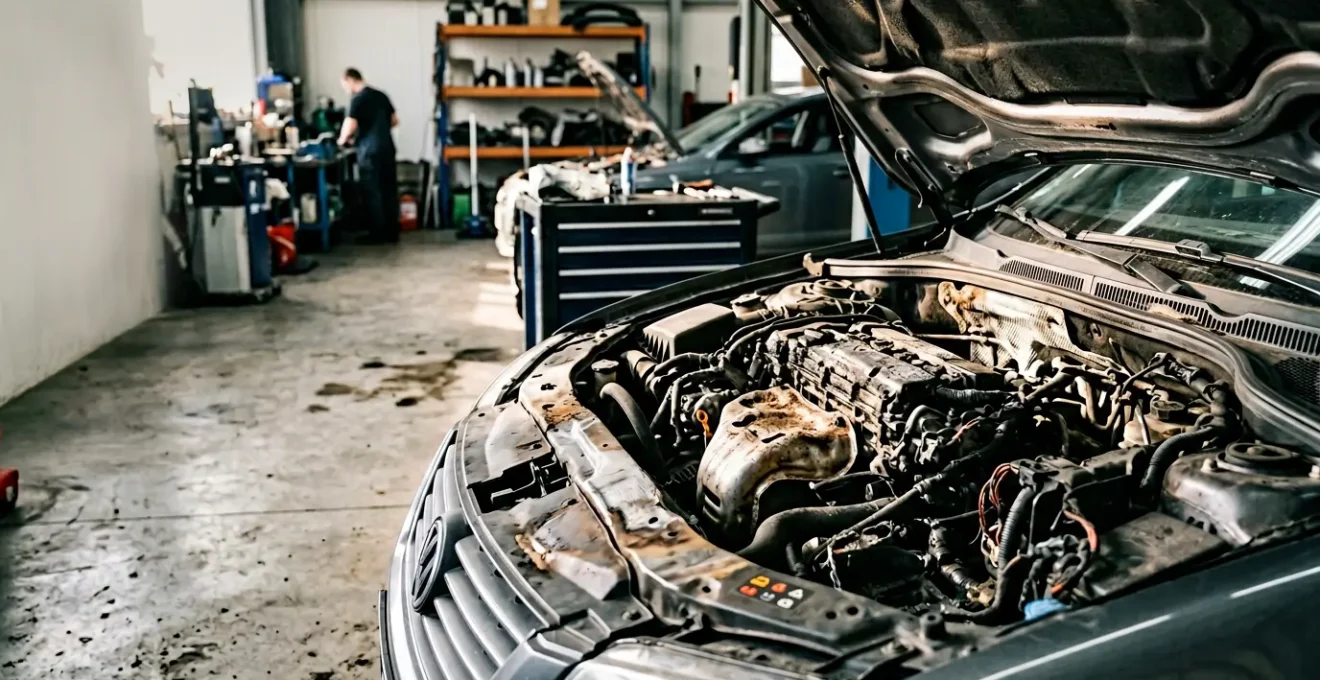
Ignoring a dashboard warning light is not a gamble; it’s the start of a predictable and catastrophic mechanical failure. From an engineering perspective, your vehicle’s fluids operate at critical tolerances. This article breaks down the precise, minute-by-minute sequence of events—from a simple low coolant level to a seized engine—to demonstrate how a simple 5-minute weekly check is the only reliable defence against thousands of pounds in preventable damage.
For any driver, it’s a moment of quiet dread: a small, illuminated symbol glowing on the dashboard. The temptation to ignore it, to hope it’s just a sensor glitch or something that can be dealt with ‘later’, is powerful. We tell ourselves it’s probably nothing serious. But from a fluid systems engineering standpoint, a warning light is never the beginning of a problem; it is the final, desperate alert that a critical system is already in a state of failure.
The common advice is to « get it checked by a mechanic, » which is true but incomplete. It overlooks the fundamental reality that most catastrophic engine failures, like a £6,000 engine seizure from overheating, are not sudden events. They are the direct result of a rapid, predictable chain reaction that begins with fluid neglect. Understanding the *physics* of this failure is far more powerful than simply knowing the ‘what’. It transforms abstract maintenance tasks into concrete, preventive actions.
This article moves beyond the generic advice. We will dissect the engineering realities behind your car’s five critical fluids. We will not just tell you to check them; we will explain the precise mechanism of thermal and chemical breakdown that occurs when you don’t. The goal is to arm you with an engineer’s understanding, turning you from a passive driver into a proactive owner who can identify the earliest signs of trouble and prevent a four-figure repair bill before it even begins.
The following sections provide a detailed, evidence-based breakdown of each critical fluid system, explaining the science behind its maintenance schedule and the clear signals of impending failure. This is your guide to preventive forensics for your vehicle.
Summary: Why Did Ignoring a Low Coolant Warning Destroy a £6,000 Engine in 15 Minutes?
- Why Does Brake Fluid Need Replacing Every 2 Years Even if You Barely Drive?
- How to Check All 5 Critical Fluids in Under 5 Minutes Every Sunday Morning?
- Dashboard Warnings or Dipstick: Which Catches Low Fluid Levels First?
- The 4 Fluid Colour Changes That Signal Immediate Mechanical Problems
- When to Switch to Winter-Grade Fluids in the UK: The October Deadline Most Miss
- Why Does « Sealed for Life » Transmission Fluid Still Need Changing Every 60,000 Miles?
- Why Do 15% of UK Engine Failures Stem From Cooling System Neglect?
- Why Driving Just 2 Miles With a Hot Engine Warning Costs £4,000 in Damage?
Why Does Brake Fluid Need Replacing Every 2 Years Even if You Barely Drive?
The two-year replacement rule for brake fluid seems counter-intuitive, especially for low-mileage drivers. The engine isn’t running, so the fluid shouldn’t degrade, right? This misunderstands the fundamental nature of brake fluid. Its greatest enemy isn’t mileage; it’s time and humidity. Most brake fluids are hygroscopic, meaning they actively absorb moisture from the atmosphere through microscopic pores in hoses and seals.
Over time, this water content becomes critical. Fresh, or ‘dry’, brake fluid has a high boiling point (often over 200°C). This is essential to withstand the extreme heat generated by friction in the braking system. However, water boils at 100°C. As water contaminates the fluid, it drastically lowers its boiling point. In fact, DOT brake fluid reaches 3.7% water content after approximately 2 years, which is considered the critical ‘wet’ boiling point threshold.
When you brake heavily, the contaminated fluid can vaporise into steam. Unlike liquid, steam is compressible. The terrifying result is a condition called vapour lock: your brake pedal suddenly goes soft and travels to the floor with little to no stopping power. The two-year interval is not arbitrary; it’s a safety-critical deadline based on the predictable rate of chemical contamination, regardless of how many miles are on the clock.
How to Check All 5 Critical Fluids in Under 5 Minutes Every Sunday Morning?
The idea of checking vehicle fluids can seem daunting, but creating a simple, repeatable routine demystifies the process and makes it a quick, empowering habit. The key is consistency. Dedicating the same five minutes every week, such as a Sunday morning before the first drive of the day, builds muscle memory and allows you to spot changes long before they become critical problems. Most modern cars have colour-coded caps and clear reservoirs to make it easy.
The five critical fluids to monitor are engine oil, coolant, brake fluid, power steering fluid, and windscreen washer fluid. For the first four, the engine should be cold and the car parked on level ground for an accurate reading. A cold engine allows the oil to drain back into the sump and prevents the risk of burns from hot components.
This routine isn’t just about topping up; it’s about active monitoring. You are performing preventive forensics, looking for clues. Is one fluid level dropping faster than others? Has the colour of the coolant or oil changed? Catching these subtle shifts is the difference between a £10 bottle of top-up oil and a £4,000 engine rebuild.
Your 5-Minute Sunday Fluid Check Plan
- Engine Oil: With the engine cold, remove the dipstick, wipe it clean, reinsert it fully, then remove it again. Check that the oil level is between the ‘Min’ and ‘Max’ marks. Note the colour and consistency.
- Coolant: Look at the semi-transparent reservoir tank. The coolant level should be between the ‘F’ (Full) and ‘L’ (Low) markings. Never open the radiator cap on a hot engine.
- Brake Fluid: Locate the small reservoir, usually near the back of the engine bay. The fluid level should be between the ‘Min’ and ‘Max’ lines. The fluid should be clear to light amber; dark or cloudy fluid indicates contamination.
- Power Steering Fluid: On some cars, this is a sealed unit, but if there’s a reservoir with a dipstick (often on the cap), check the level. It may have ‘Hot’ and ‘Cold’ markings; use the ‘Cold’ mark.
- Windscreen Washer: This is the only non-critical fluid, but essential for visibility. Top it up regularly. It’s often indicated by a blue cap with a windscreen symbol.
Dashboard Warnings or Dipstick: Which Catches Low Fluid Levels First?
The dipstick, unequivocally. This is a critical distinction that all drivers must understand. A dashboard warning light for oil or coolant is not an early warning system; it is a last-resort failure indicator. By the time that light illuminates, the fluid level is not just low, it is critically low, meaning the system is already operating outside its designed tolerances and damage may already be occurring.
Think of the oil pressure light. It doesn’t measure the *amount* of oil in the engine, but the *pressure* of that oil being circulated. By the time pressure drops low enough to trigger the sensor, the oil pump is likely already starving and failing to lubricate vital components like bearings and camshafts. A manual dipstick check, by contrast, allows you to see if your oil level has dropped from ‘Max’ to the halfway mark, a change that would never trigger a sensor but is a crucial piece of diagnostic information. It tells you the engine is consuming oil and needs attention.
This proactive versus reactive monitoring is the core of preventive maintenance. The dipstick is your proactive tool, a sensitive gauge that shows trends over time. The dashboard light is a reactive alarm, the system’s final scream for help. Relying solely on dashboard warnings is like removing the batteries from your home smoke detector and waiting for the fire brigade’s sirens to tell you there’s a problem.
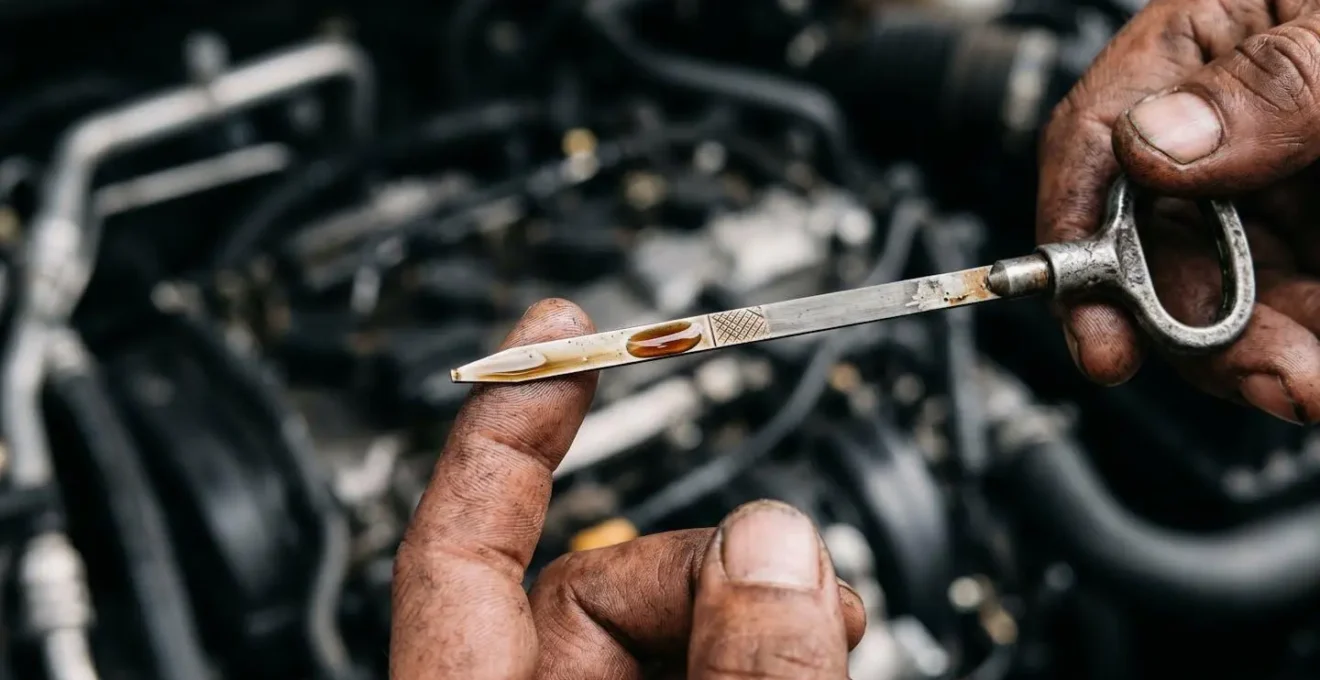
As this image illustrates, the physical act of checking the dipstick gives you direct, tactile information about both the quantity and the quality of your oil—data a sensor simply cannot provide. A regular manual check is the only way to stay ahead of the failure curve.
The 4 Fluid Colour Changes That Signal Immediate Mechanical Problems
Healthy automotive fluids have specific colours and transparencies. When these properties change, it’s a clear visual signal that something is wrong internally. Learning to read these colours is like a doctor reading a blood test; it’s a non-invasive diagnostic that can reveal serious problems long before a catastrophic failure.
Here are four of the most critical colour changes you should never ignore:
- Engine Oil: From Golden Brown to Milky/Frothy. Healthy engine oil is a clear, amber-to-brown colour. If you check the dipstick and find a creamy, frothy, or milky-brown substance, it’s a classic sign that coolant is leaking into the oil. This is most commonly caused by a failed head gasket, a serious and expensive repair. The contaminated oil loses its lubricating properties, leading to rapid engine wear.
- Transmission Fluid: From Bright Red to Dark Brown/Black with a Burnt Smell. Automatic transmission fluid is typically a translucent bright red. Over time, it naturally darkens. However, if it becomes dark brown or black and has a distinct burnt smell, it indicates the transmission is overheating. The fluid has broken down and can no longer properly lubricate and cool the complex internal clutches, leading to shift problems and eventual transmission failure.
- Brake Fluid: From Clear/Light Amber to Dark Brown/Black. As discussed, brake fluid absorbs moisture, but it can also become contaminated with tiny particles from degrading seals and hoses. When the fluid turns dark and opaque, its performance is severely compromised, and the risk of vapour lock increases. It’s a clear sign that the two-year replacement interval has been exceeded.
- Coolant: From Bright Pink/Green/Blue to Rusty Brown or Oily. Coolant contains anti-corrosion inhibitors. When these are depleted, the fluid can no longer protect the metal components of the cooling system. A rusty brown colour is a direct indication of this process.
Case Study: The Meaning of Rusty Coolant
When coolant that should be pink, green, or blue turns rusty brown, it signals internal corrosion of the radiator, water pump, and engine block. This rust or discoloration requires immediate coolant change, as contaminated coolant loses protective properties and severely compromises heat dissipation capability. According to RAC UK analysis, continuing to run the engine with this contaminated fluid is like trying to cool it with saltwater—it accelerates the internal decay of the entire system, leading to leaks, blockages, and eventual overheating.
When to Switch to Winter-Grade Fluids in the UK: The October Deadline Most Miss
The concept of « winter-grade » fluids often gets overlooked in the UK’s relatively mild climate, but it is a critical factor in long-term engine health. The most important fluid to consider is engine oil. Its viscosity—or thickness—is rated with two numbers (e.g., 5W-30). The first number followed by a ‘W’ indicates its viscosity in cold weather. A lower ‘W’ number means the oil is thinner at low temperatures, allowing it to flow more quickly to protect engine components on a cold start.

This is not a trivial detail. The first few seconds of a cold start are when your engine is most vulnerable. As automotive engineers explain, cold, thick oil cannot circulate properly, temporarily starving vital parts of lubrication. Incredibly, it’s estimated that approximately 80% of total engine wear occurs during the first 30 seconds of a cold start. Using an oil with the correct winter rating for your vehicle (as specified in the owner’s manual) minimises this wear dramatically.
The ‘October deadline’ is a practical rule of thumb. As ambient temperatures in the UK consistently begin to drop below 7°C, typically around October, the difference in cold-start performance between a summer-optimised oil and a proper winter-grade oil becomes significant. This is also the perfect time to check your coolant’s antifreeze concentration and ensure your windscreen washer reservoir is filled with a winter-screenwash that won’t freeze. It’s a seasonal shift in mindset from simple fluid levels to ensuring the chemical properties of those fluids are optimised for the cold.
Why Does « Sealed for Life » Transmission Fluid Still Need Changing Every 60,000 Miles?
« Sealed for Life » is one of the most misleading marketing terms in the automotive industry. It gives drivers a false sense of security, leading them to neglect a fluid that is under immense thermal and mechanical stress. The « life » in « Sealed for Life » does not refer to the life of the vehicle; it typically refers to the manufacturer’s warranty period.
Automotive service experts offer a clear and concise explanation for this marketing language:
Lifetime typically refers to the warranty period, usually around 5 years or 100,000 miles, whichever comes first. This marketing term is designed to make vehicles appear more maintenance-free and lower the perceived cost of ownership during the warranty coverage period.
– Cable Dahmer CDJR automotive service experts, Is Transmission Fluid Really Lifetime analysis
Like any other fluid, transmission fluid degrades over time. It’s subjected to intense heat, which breaks down its lubricating properties, and it becomes contaminated with microscopic metal particles from the clutch packs and gears. This degraded fluid can lead to harsh shifting, slipping, and eventually, catastrophic transmission failure costing thousands of pounds to repair or replace.
The most compelling evidence against the « sealed for life » myth comes from the transmission manufacturers themselves. ZF, a major German company that builds automatic transmissions for brands like BMW, Audi, and Jaguar Land Rover, has its own clear service recommendations that often contradict the carmakers who use their products. For instance, transmission manufacturer specifications reveal that ZF recommends a transmission fluid change every 150,000 kilometers (approximately 93,200 miles) for many of its popular 8-speed transmissions, even when the car brand claims it’s « filled for life. » Independent specialists often recommend an even shorter interval, typically around 60,000 miles, for optimal longevity.
Why Do 15% of UK Engine Failures Stem From Cooling System Neglect?
While the 15% figure often cited is alarming, the deeper reality is likely far worse. A comprehensive industry analysis demonstrates that an estimated 50 percent of all engine failures are associated with problems in the cooling system. This system is a closed loop operating under pressure, and its failure is rarely a single, sudden event. It’s a cascade of smaller failures: a pinhole leak in a hose, a failing water pump bearing, or simply old, corrosive coolant.
The internal combustion engine is a controlled explosion, generating immense heat. The cooling system’s job is to manage this thermal energy, keeping the engine within its precise operating temperature range (typically 90-105°C). When the system is neglected, its efficiency drops. The coolant loses its anti-corrosion properties, leading to internal rust. Small leaks lower the system’s pressure, which in turn lowers the boiling point of the coolant. The system loses its ability to shed heat effectively.
The driver is often the last link in this failure chain. The decision to ignore a temperature gauge creeping into the red or a steam cloud from under the bonnet is a psychological one. It’s the denial of a problem that seems too large or inconvenient to handle at that moment. Yet, it is this decision that turns a manageable issue, like a £50 hose replacement, into a catastrophic engine failure.

That moment of decision, when the warning appears, is the final opportunity to prevent disaster. Pulling over immediately is not an inconvenience; it is the most critical action a driver can take to protect the heart of their vehicle. Continuing to drive, even for a few minutes, initiates a process of rapid, irreversible mechanical destruction.
Key takeaways
- Proactive vs. Reactive: A manual check with a dipstick is a proactive measure that detects trends; a dashboard light is a reactive alarm indicating a critical failure is already in progress.
- Colour is a Diagnostic Tool: Changes in fluid colour from clear and bright to dark, milky, or rusty are direct visual indicators of internal contamination, corrosion, or component failure.
- « Lifetime » Means Warranty: The term « sealed for life » fluid refers to the vehicle’s warranty period, not the vehicle’s entire lifespan. These fluids degrade and require regular changes for long-term reliability.
Why Driving Just 2 Miles With a Hot Engine Warning Costs £4,000 in Damage?
The phrase « my car is overheating » fails to capture the violent, rapid self-destruction occurring inside the engine block. The cost of damage is directly proportional to the time spent driving after the temperature needle enters the red or the warning light appears. Two miles at 30mph is four minutes—an eternity in the life of an overheating engine.
The damage escalates in a predictable, temperature-driven sequence. According to a detailed timeline from automotive experts, the destruction unfolds with terrifying speed:
- At 110-120°C (230-250°F): The engine begins to lose efficiency. The precisely machined metal components, particularly the aluminium cylinder head, start to expand beyond their design tolerances.
- At 120-135°C (250-275°F): This is the point of no return. The engine oil, which also plays a role in cooling, begins to break down, losing its lubricating properties. The head gasket, which seals the gap between the engine block and cylinder head, starts to fail under the immense pressure and heat.
- Above 135°C (275°F): Catastrophic, irreversible damage occurs within minutes, if not seconds. The aluminium cylinder head, now significantly softened by the heat, warps. The head gasket fails completely, allowing hot gases to blast into the cooling system and coolant to flood the cylinders. The engine block itself can crack, and pistons can expand so much they seize inside the cylinder bores, bringing the engine to a grinding, permanent halt.
This is why driving those « just two more miles » is a financial disaster. That four-minute journey is enough to turn a repairable problem (like a split hose) into a requirement for a new cylinder head (£1,500-£2,500) or a complete engine replacement (£4,000+). Automotive experts confirm that with severe overheating, the probability of major component failure becomes extremely high within a timeframe of just two to ten minutes. The moment you see that warning, every second counts. The only correct action is to pull over safely, turn off the engine, and call for assistance.
The engineering principles are clear. Systematic fluid checks are not an optional chore for car enthusiasts; they are the single most effective action a driver can take to prevent catastrophic, expensive engine failure. Make the 5-minute check a non-negotiable part of your weekly routine, starting this Sunday.