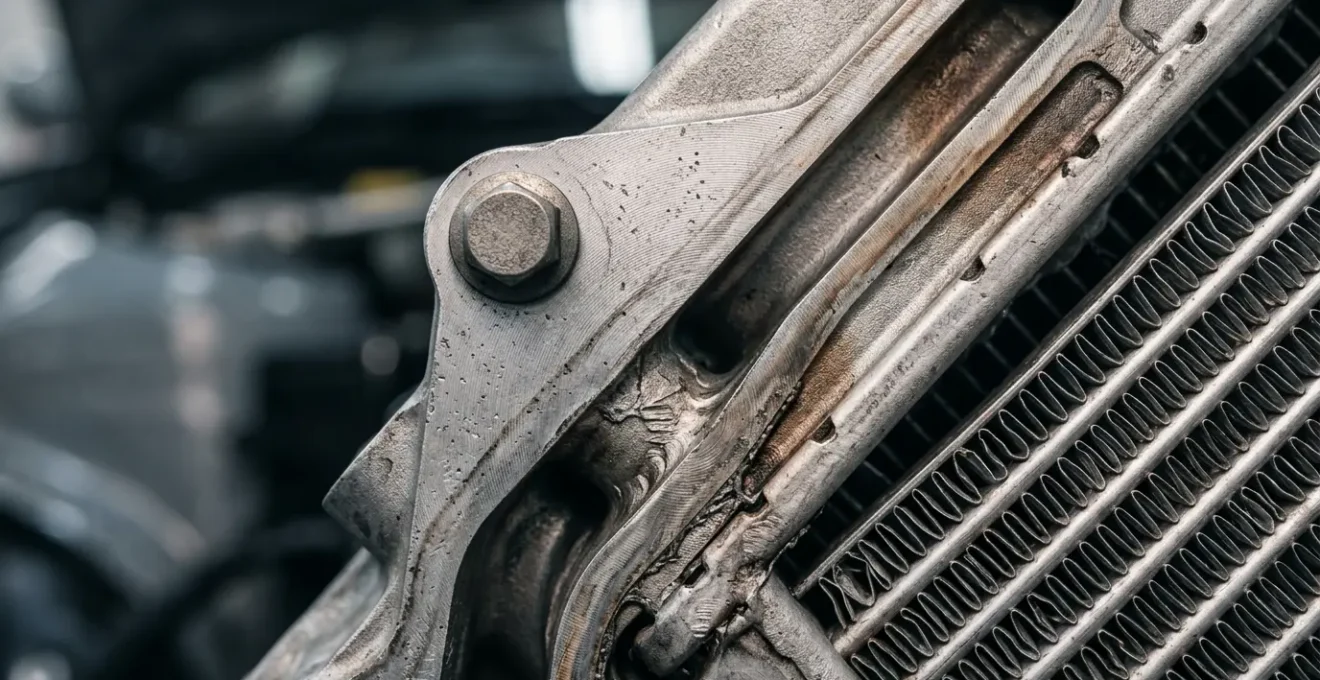
Most catastrophic engine failures are not sudden events but the predictable end-point of minor, diagnosable cooling system symptoms that were ignored.
- Mixing coolant types or using water initiates a silent, irreversible internal corrosion process that clogs the system from within.
- Symptoms like a slow-to-warm heater are not minor inconveniences but critical signs of a failing thermostat, a precursor to major engine wear and overheating.
Recommendation: A pre-summer visual hose check and a system pressure test are the most effective actions to prevent the vast majority of potential roadside breakdowns and thermal damage.
The dreaded red thermometer icon on your dashboard is more than a warning; it’s a final notice. For many UK drivers, it signals the moment a manageable issue transforms into a catastrophic, four-figure repair bill. While most car maintenance focuses on oil changes and tyre pressures, the cooling system operates as a silent, high-stakes component often overlooked until it’s too late. The common advice to « check your coolant » barely scratches the surface of the complex pressure dynamics and chemical balances at play.
The reality is that major engine damage rarely materialises out of nowhere. It is the culmination of a ‘cascade failure’—a chain reaction that often begins with a seemingly trivial fault, like a brittle hose or the wrong type of antifreeze. Modern aluminium engines, prized for their lightness and efficiency, possess a critical weakness: an extreme intolerance to heat. Understanding the early, subtle signs of distress is not just good practice; it is the most powerful form of mechanical and financial self-preservation available to a vehicle owner.
This guide moves beyond generic checklists to provide a forensic diagnosis of your engine’s circulatory system. We will dissect the precise mechanisms of failure, from the physics of a warped cylinder head to the chemistry of internal corrosion. By learning to interpret these early warnings, you shift from being a passive passenger to an informed guardian of your engine’s health, capable of preventing the very disasters that leave others stranded and facing devastating repair costs.
To help you master this preventive approach, this article breaks down the most critical failure points and diagnostic checks. We’ll explore why every minute counts during an overheat, how to read the clues your coolant provides, and what simple tests can predict a failure months in advance.
Summary: Decoding the Signals of Impending Cooling System Failure
- Why Driving Just 2 Miles With a Hot Engine Warning Costs £4,000 in Damage?
- How to Spot the Rubber Hose Cracks That Predict Roadside Breakdowns?
- Orange or Green Coolant: Why Mixing Types Causes Internal Corrosion?
- The Stuck Thermostat Symptom That 80% of Drivers Misdiagnose as Heater Failure
- When to Pressure Test Your Cooling System: The Pre-Summer Check That Prevents Failures
- Why Do the First 5 Minutes of Every Journey Cause 70% of Your Engine Wear?
- The 4 Fluid Colour Changes That Signal Immediate Mechanical Problems
- Why Did Ignoring a Low Coolant Warning Destroy a £6,000 Engine in 15 Minutes?
Why Driving Just 2 Miles With a Hot Engine Warning Costs £4,000 in Damage?
The temptation to « just make it home » when a temperature warning light appears is a multi-thousand-pound gamble. In a modern aluminium engine, the journey from ‘running hot’ to ‘terminal damage’ is terrifyingly short. The core issue is thermal intolerance. Unlike older iron block engines, aluminium cylinder heads expand and warp dramatically when subjected to temperatures outside their narrow operating window. This warping is the primary cause of head gasket failure, a repair that involves extensive labour.
When the head gasket fails, the seal between the cylinder head and engine block is breached. This allows high-pressure combustion gases to force their way into the cooling channels and, conversely, for coolant to leak into the combustion chambers or mix with the engine oil. The consequences are immediate and severe: loss of compression, contaminated oil that loses its lubricating properties, and further, more rapid overheating. The cost of a head gasket replacement alone can be significant, with UK automotive repair data showing an average cost of £721, and often much more for complex engines.
This initial damage, however, is often just the beginning. The visualisation below highlights the kind of stress and distortion that occurs internally. If the engine continues to run, the intense heat can cause piston seizure or crack the engine block itself, rendering the entire unit irreparable.
As this a detailed analysis of certain BMW models shows, the design of some cooling systems means that a small crack can lead to rapid coolant loss, and the subsequent overheating can cause catastrophic engine failure in minutes. This is why that two-mile journey can easily escalate a £200 repair (like a new water pump) into a £4,000+ engine replacement, a cost that frequently exceeds the vehicle’s entire market value.
How to Spot the Rubber Hose Cracks That Predict Roadside Breakdowns?
The rubber hoses are the arteries of your cooling system, and they are also one of the most common failure points. Subjected to constant heat cycles, high pressure, and oil vapour, they degrade from both the inside and out. A burst hose results in a near-instantaneous loss of coolant, leading directly to the overheating scenarios discussed previously. Fortunately, failing hoses provide clear physical clues long before they rupture.
The key is performing a tactile inspection with the engine cold. A healthy hose feels firm yet pliable when you squeeze it. A failing hose will present in one of two ways: either it will feel rock-hard and brittle, indicating the rubber has perished and is prone to cracking, or it will feel soft and spongy. A spongy texture is particularly dangerous as it often signals internal delamination—the hose is breaking down from the inside, even if the exterior looks fine. You should also pay close attention to the connection points, checking the hose clamps for rust or weakness. Factory-style spring clamps are generally superior as they maintain consistent tension as the fittings expand and contract with heat.
Because this regular check is so critical to preventing roadside breakdowns, it’s the first step in any effective cooling system maintenance routine. Following a structured process ensures nothing is missed.
Action Plan: Your 5-Point Hose Inspection Checklist
- Visual & Tactile Check (Engine Cold): Inspect every visible hose for surface cracks, bulging, or obvious damage. Pay special attention to bends and connection points.
- Perform the ‘Squeeze Test’: Squeeze each accessible hose. A good hose is firm but flexible. Immediately flag any hose that feels brittle and hard, or alarmingly soft and spongy.
- Clamp Integrity Audit: Examine all hose clamps. Look for heavy rust, corrosion, or signs that they are no longer providing tight, even pressure. A loose clamp is a leak waiting to happen.
- Check for Internal Degradation: Feel for any ‘squishy’ or inconsistent spots along the hose’s length. This indicates the internal structure is failing, a common precursor to a burst.
- Preventive Replacement by Age: Consult your vehicle’s service history. Most rubber cooling hoses have a recommended service life of 5-8 years, regardless of mileage. If your hoses are older, plan for preventive replacement.
Orange or Green Coolant: Why Mixing Types Causes Internal Corrosion?
Many drivers assume that all coolant (or antifreeze) is the same, but this is a dangerously false assumption. The colour—typically orange, green, blue, or pink—denotes a specific chemical formulation. Mixing different types, or even topping up with plain water, can trigger a process of aggressive internal corrosion that silently destroys your engine and radiator from the inside.
Coolants are composed of ethylene glycol (for freeze/boil protection) and a package of corrosion inhibitors. The conflict arises from the different chemistries of these inhibitor packages. Older, typically green coolants use Inorganic Additive Technology (IAT). Modern, long-life coolants (often orange or red) use Organic Acid Technology (OAT). When these are mixed, the chemical inhibitors can react, effectively neutralizing each other. In some cases, they can ‘drop out’ of the solution, forming a thick, gel-like sludge that clogs the narrow passages of the radiator and heater core, leading to blockages and overheating.
Even a small amount of contamination can have a significant effect. As the experts at Dober Chemical’s Corrosion Inhibitor Technology Division state, this is a critical issue:
Mixing coolant formulations will reduce corrosion protection and will cause corrosion problem and inhibitors dropout in the coolant, which causes plugging and inadequate corrosion protection.
– Dober Chemical – Corrosion Inhibitor Technology Division, The Dober Difference in Coolant Corrosion Inhibitor Technology
This inhibitor dropout leaves the internal metal surfaces of your engine—particularly the aluminium components—vulnerable to galvanic corrosion. This is an electrochemical process that eats away at the metal, creating pitting and weakness that can eventually lead to leaks or complete component failure. For this reason, corrosion inhibitor technology research shows that mixing coolants should not exceed a 25% contamination limit to maintain adequate protection. If you don’t know what type of coolant is in your vehicle, the safest course of action is a complete system flush and refill with the manufacturer-specified type.
The Stuck Thermostat Symptom That 80% of Drivers Misdiagnose as Heater Failure
One of the most commonly misunderstood symptoms in a car is when the cabin heater stops blowing hot air. Many drivers assume a fault with the heater itself, but more often than not, it’s a critical warning sign from the cooling system: a failing thermostat. The thermostat is a simple valve, but it plays two vital roles. When the engine is cold, it stays closed to help the engine warm up quickly. Once at operating temperature, it opens to allow coolant to flow through the radiator to dissipate heat.
A thermostat can fail in two ways. If it fails ‘stuck closed’, coolant cannot reach the radiator, and the engine will overheat very rapidly. This is an immediate, drive-stopping emergency. More deceptively, it can fail ‘stuck open’. In this state, coolant circulates through the radiator constantly, even when the engine is cold. The engine therefore takes a very long time to reach its proper operating temperature, or may never reach it at all during short trips in cool weather.
This is where the heater symptom comes in. The cabin heater works by using a small, secondary radiator called a heater core, which transfers heat from the engine’s coolant to the air blown into the cabin. If the engine never gets properly hot because the thermostat is stuck open, the coolant is never hot enough to produce significant heat in the cabin. What feels like a mere inconvenience—a lukewarm heater on a cold morning—is actually a sign that your engine is running too cool, a condition that dramatically increases engine wear, fuel consumption, and emissions.
Diagnosing this issue is straightforward if you follow a logical process:
- First, with the engine cold, always check the coolant level. A low coolant level is the most common cause of no heat, as there isn’t enough fluid to circulate through the heater core.
- If the level is correct, monitor the temperature gauge from a cold start. If the engine takes more than 5-10 minutes of driving to reach the middle of the gauge, the thermostat is almost certainly stuck open.
- If the temperature is normal but you still have no heat, the problem may lie elsewhere, such as a faulty blend door actuator or a clogged heater core (often a result of the corrosion issues discussed earlier).
This simple diagnostic can save you from mistakenly paying for a heater repair when the root cause is a relatively inexpensive thermostat that is putting your engine’s long-term health at risk.
When to Pressure Test Your Cooling System: The Pre-Summer Check That Prevents Failures
Many of the most dangerous cooling system leaks are not the kind that leave a puddle on your driveway. These are insidious, internal leaks or small external leaks that only lose coolant under the high pressure and temperature of a running engine. The fluid evaporates on hot engine components before it can drip to the ground, making them virtually invisible. This is where a cooling system pressure test becomes an indispensable diagnostic tool.
A pressure test is a non-invasive procedure that involves attaching a special hand pump with a gauge to the radiator or expansion tank. The system is then pressurised to the level specified on the radiator cap, typically around 15 PSI. A healthy, sealed system should be able to hold this pressure with minimal loss (no more than 1-2 PSI over 15 minutes). A faster drop in pressure confirms a leak, and the mechanic can then visually and audibly trace its source without the engine needing to be hot and running.
This test is crucial for detecting several types of ‘invisible’ leaks:
- Hairline cracks in plastic radiator tanks or hose fittings.
- A failing water pump seal that only leaks when the shaft is spinning under pressure.
- The early stages of a head gasket failure, where combustion gas pushes into the cooling system, or coolant is consumed in tiny amounts.
The best time to perform this check is proactively, as part of a pre-summer service. Hot weather puts the maximum stress on a cooling system, and a small, manageable leak can quickly become a major failure during a summer traffic jam. It is also critical to test the radiator cap itself, as a faulty cap that releases pressure too early will lower the boiling point of the coolant, causing the engine to boil over even if the rest of the system is perfect.
Why Do the First 5 Minutes of Every Journey Cause 70% of Your Engine Wear?
The vast majority of an engine’s internal wear doesn’t happen on the motorway or during high-speed driving; it occurs during the first few minutes after a cold start. During this phase, the engine oil is cold and thick, and has not yet fully circulated to provide optimal lubrication to critical components like bearings and cylinder walls. Furthermore, the metal components have not yet expanded to their precise operating tolerances. This ‘cold engine’ period is a state of maximum mechanical stress.
The cooling system’s thermostat plays a central role in mitigating this damage. Its primary job is to help the engine warm up as quickly as possible. By remaining closed, it prevents coolant from circulating through the radiator, allowing the heat generated by combustion to be retained within the engine block. This enables the engine to reach its optimal operating temperature in a matter of minutes, ensuring oil flows correctly and components reach their designed clearances.
A faulty thermostat that is stuck open, as discussed earlier, sabotages this entire process. It dramatically extends the high-wear ‘cold engine’ period on every single journey. Instead of warming up in five minutes, the engine might take fifteen or twenty minutes, or never fully warm up at all. This means for every trip you take, the engine is spending significantly more time in its most vulnerable state. Over months and years, this cumulative effect leads to accelerated wear on piston rings, bearings, and camshafts, prematurely shortening the life of the engine.
Therefore, a properly functioning thermostat is not just about preventing overheating; it’s a critical component for ensuring engine longevity. The symptom of a slow-to-warm heater isn’t just an inconvenience, it’s a direct signal that your engine is being subjected to excessive wear every time you drive.
The 4 Fluid Colour Changes That Signal Immediate Mechanical Problems
Your coolant is a diagnostic fluid. Its colour and texture provide direct, unambiguous clues about the internal health of your engine and transmission. Ignoring a change in its appearance is like ignoring a critical blood test result. A regular check of the fluid in the expansion tank (when the engine is cold) can be the first warning of a developing mechanical catastrophe. While new coolant is bright and translucent, contaminated coolant tells a story.
There are four classic signs of contamination, each pointing to a specific and serious problem. Learning to recognise them is a core skill in forensic engine diagnosis. The chart below, based on diagnostic information from professional auto care centres, acts as a reference guide for interpreting these visual cues. Any deviation from the clean, bright colour of the correct coolant type for your car warrants immediate investigation.
| Coolant Appearance | Diagnostic Indication | Root Cause | Urgency Level |
|---|---|---|---|
| Milky/Mayonnaise-like texture | Head gasket failure | Oil mixing with coolant due to gasket breach | CRITICAL – Stop driving immediately |
| Rusty brown color | Severe internal corrosion | Use of water instead of proper coolant, depleted corrosion inhibitors | HIGH – Replace coolant and inspect components |
| Dark with black specks | Internal hose deterioration | Rubber delamination from aging hoses shedding particles | MEDIUM – Replace cooling hoses |
| Clear with oily rainbow sheen | Transmission fluid contamination | Automatic transmission cooler leak inside radiator | HIGH – Radiator replacement required |
The appearance of a milky, ‘mayonnaise’-like consistency is the most urgent warning sign, indicating that engine oil and coolant are mixing. This is a definitive symptom of a failed head gasket and requires the engine to be shut down immediately to prevent terminal seizure. Similarly, a rusty brown colour indicates that the corrosion inhibitors are completely depleted and the system is actively destroying itself from within.
Key Takeaways
- A ‘stuck open’ thermostat is not a minor issue; it dramatically increases engine wear on every journey by extending the cold warm-up period.
- Mixing different coolant types or using water neutralises corrosion inhibitors, leading to sludge formation and silent internal corrosion that destroys the engine from within.
- A cooling system pressure test is the only reliable way to find ‘invisible’ leaks that don’t leave puddles but can still cause catastrophic overheating under load.
Why Did Ignoring a Low Coolant Warning Destroy a £6,000 Engine in 15 Minutes?
The final, catastrophic failure of a cooling system is a perfect storm where all the previously discussed factors converge. It demonstrates how a single ignored warning light can initiate an unstoppable cascade of mechanical destruction. While many issues contribute, coolant analysis research suggests that an estimated 50 percent of all engine failures are directly associated with problems in the cooling system, making it the single biggest threat to your engine’s life.
To understand the speed of this destruction, consider this typical cascade failure timeline, which often unfolds in less than 15 minutes from the initial warning:
Case Study: The 15-Minute Cascade Failure
When a coolant level drops due to a small, undetected leak, air gets drawn into the system. An air pocket becomes trapped in the highest point of the engine—the cylinder head. This air pocket acts as an insulator, creating a super-heated ‘steam spot’ where metal temperatures soar, even before the dashboard temperature gauge shows a critical reading. In a modern aluminium engine with tight tolerances, this localized boiling is the point of no return. It causes the cylinder head to warp, breaching the head gasket. High-pressure combustion gas then blasts into the cooling system, instantly over-pressurizing it and blowing off a weak hose, causing a total loss of the remaining coolant. With no fluid to carry heat away, the oil overheats and loses its ability to lubricate. The final stage is metal-on-metal contact, leading to piston seizure and a destroyed engine.
This entire sequence highlights why immediate action is so critical. The initial warning light for low coolant is the driver’s one and only opportunity to intervene before the cascade becomes irreversible. Pulling over and shutting down the engine immediately halts the progression, potentially turning a £6,000 engine replacement into a far less costly repair of the initial leak.
Ultimately, your vehicle’s cooling system is not a ‘fit and forget’ component. It is a dynamic, high-pressure system that demands respect and proactive vigilance. By learning to perform these simple checks and understanding the meaning behind the symptoms, you arm yourself with the knowledge to stop a catastrophic failure before it begins. This preventive mindset is the most valuable tool in any driver’s arsenal, ensuring both your safety on the road and the long-term financial health of your investment.