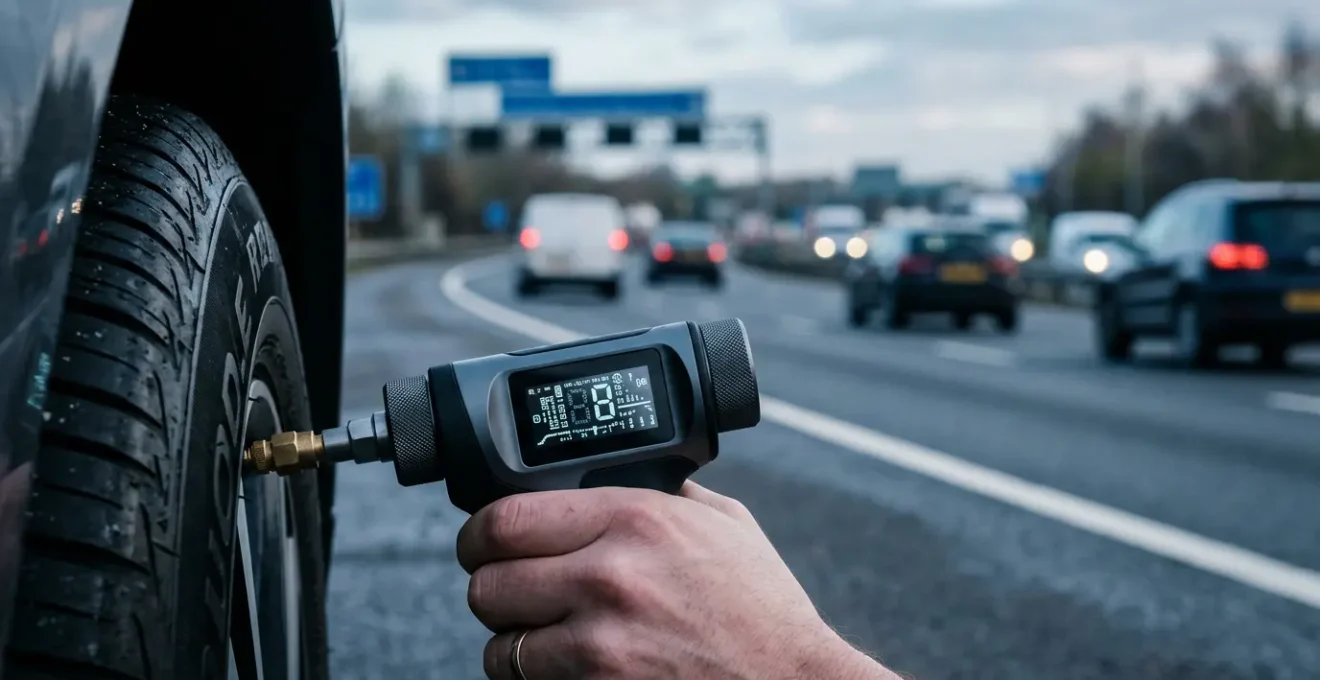
That 5 PSI drop in your tyres isn’t just a safety warning; it’s a direct £200 annual financial leak from your bank account.
- Your tyres naturally lose pressure as the temperature drops, a problem every UK driver faces in autumn.
- Your car’s TPMS is a warning light, not a precision gauge, and can be inaccurate by several PSI.
- Uneven tyre wear is a physical sign of chronic under-inflation, which can even jeopardise your insurance coverage in the event of a claim.
Recommendation: Invest £10 in a quality digital tyre gauge and adopt a monthly check. It is the single highest-return investment you can make for your vehicle.
That familiar, unwelcome orange icon illuminates your dashboard: the Tyre Pressure Monitoring System (TPMS) light. For many UK drivers, the reaction is a sigh of annoyance, a mental note to « sort it out later, » or a quick top-up at the next petrol station. We’re told to keep our tyres inflated for safety, and we vaguely know it affects fuel consumption. But this conventional wisdom dramatically understates the reality. It frames a critical financial issue as a simple maintenance chore.
The truth is, your tyres are a hidden financial liability. Relying on the TPMS light or inaccurate petrol station pumps is like letting £5 notes slip out of your wallet every month. The real key to unlocking significant savings and genuine safety isn’t just « checking your tyres »; it’s about adopting a mindset of pressure discipline. It’s about understanding that every pound-per-square-inch (PSI) has a direct, quantifiable impact on your annual running costs.
But what if the core problem isn’t just forgetfulness, but a misunderstanding of the forces at play? What if the real issue is that the tools we’re given are fundamentally inadequate for proper management? This article moves beyond the generic advice. We will dissect the physics and economics of tyre pressure, turning abstract PSI numbers into the real-world pounds and pence they represent for a typical UK motorist. We’ll explore why they lose pressure in the first place, why your car’s monitoring system can’t be fully trusted, and how the « premium » options often fail to deliver on their promises.
By understanding the ‘why’ behind the pressure drop, you can take precise, low-cost actions to stop this financial leakage and take genuine control of your vehicle’s efficiency and safety. Here is a breakdown of the critical knowledge you need.
Summary: The £200 Tyre Pressure Mistake: A Driver’s Guide
- Why Your Tyres Lose 3 PSI Every Autumn Without Any Puncture?
- How to Verify TPMS Accuracy With a £10 Digital Gauge?
- Nitrogen or Air: Does Premium Inflation Actually Maintain Pressure Longer?
- The Tyre Wear Pattern That Reveals You Have Been Running 10 PSI Low for Months
- When to Check Tyre Pressure: The Sunday Morning Habit That Saves £300 Yearly?
- Why Driving at 70 MPH Uses 25% More Fuel Than 60 MPH on the Same Journey?
- Why Does a 120 PSI Rating Mean Nothing Without Knowing the CFM Flow Rate?
- Why Does Your Cheap Tyre Inflator Take 15 Minutes to Add 5 PSI?
Why Your Tyres Lose 3 PSI Every Autumn Without Any Puncture?
It’s a frustratingly common scenario for UK drivers. The first crisp autumn mornings arrive, and suddenly your tyre pressure warning light is on. You haven’t hit a pothole or seen a nail, yet your tyres are low. This isn’t a fault; it’s physics. Air is a gas, and like all gases, it contracts when it gets cold. Your tyres, which are essentially flexible containers of air, are highly susceptible to ambient temperature changes. The crucial metric to understand is the direct relationship between temperature and pressure.
The science is simple: as the air inside your tyre cools, its molecules move less, creating less pressure against the tyre wall. For UK drivers, the seasonal drop from summer to autumn temperatures is more than enough to trigger this effect. Data shows a consistent 1-2 PSI loss for every 10°C drop in temperature. A car parked overnight during a 20°C summer day and then facing a 5°C autumn morning can easily see a pressure drop of 2-3 PSI across all four tyres, purely from the temperature change.
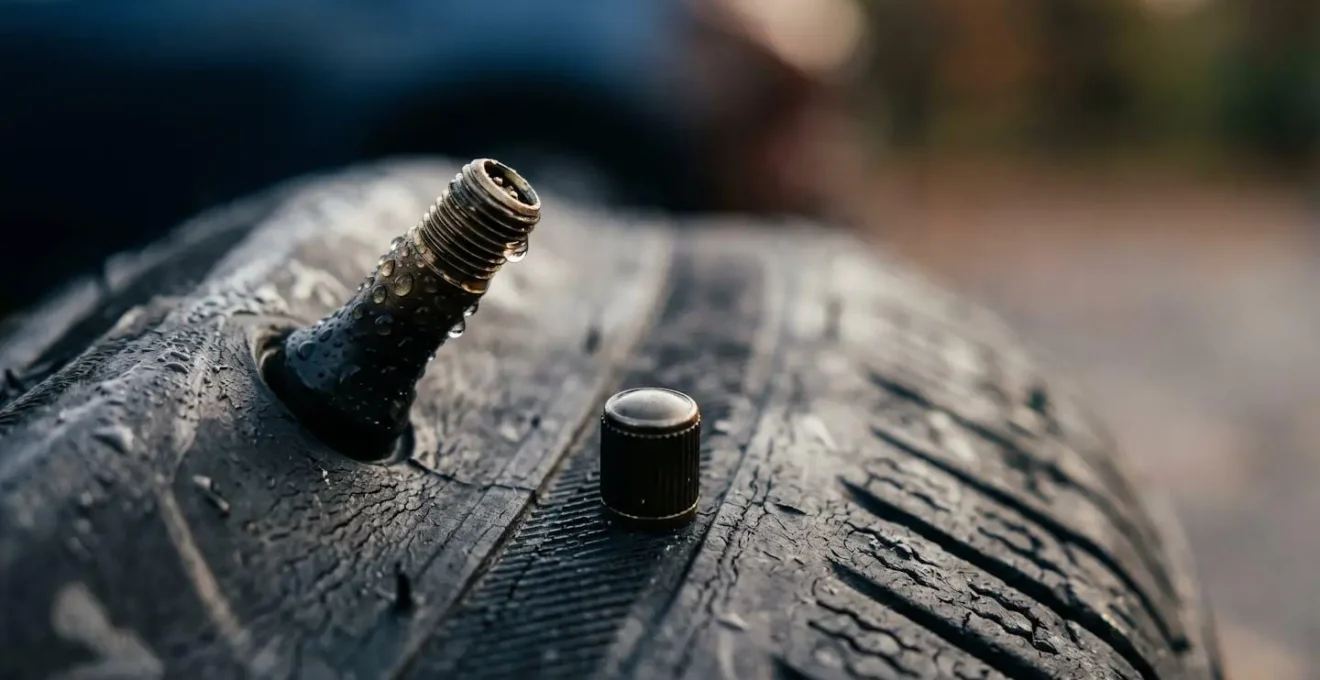
This isn’t a one-time event. Throughout autumn and winter, daily temperature fluctuations between a mild afternoon and a cold night cause this pressure cycle to continue. This is why a tyre checked and inflated on a warm afternoon might show as under-inflated the next cold morning. Understanding this phenomenon is the first step in breaking the cycle of reactive inflation and moving towards proactive pressure discipline. It’s not a puncture; it’s a predictable, seasonal financial leak that can be managed.
How to Verify TPMS Accuracy With a £10 Digital Gauge?
Your vehicle’s Tyre Pressure Monitoring System (TPMS) feels like a sophisticated safety net. However, it’s crucial to understand its limitations. For the vast majority of cars in the UK, the TPMS is a simple warning system, not a precision instrument. It’s designed to alert you to a significant pressure loss (often 25% below the recommended level), not to help you maintain the optimal pressure for fuel efficiency and tyre life. Relying solely on the TPMS is like only checking your bank balance when you get an overdraft alert; by then, the financial damage is already done.
The system can be inaccurate, influenced by temperature, and may not trigger until you’ve already lost a financially significant 5-7 PSI. The solution is simple and inexpensive: a reliable, personal digital tyre gauge, which can be bought for around £10. This single tool moves you from a passive recipient of a warning light to an active manager of your vehicle’s performance. It provides the ground truth, allowing you to calibrate your tyres to the exact specification recommended by the manufacturer (found on the placard inside the driver’s door jamb).
Verifying your TPMS and establishing a correct baseline is a straightforward process. It’s about creating a « golden standard » with your trusted gauge and then teaching your car’s system what « correct » looks like. This simple calibration ensures that when the TPMS light does come on, it’s for a genuine, significant issue, rather than just the background noise of its own inaccuracy.
Your Action Plan: The Golden Standard TPMS Calibration Method
- Check all four tires when cold (before driving or after 3+ hours parked). This is non-negotiable for an accurate reading.
- Use your reliable digital gauge to measure the actual pressure in each tire, noting the values.
- Compare these readings to the manufacturer’s placard pressure (found on the door jamb or in the owner’s manual).
- Inflate or deflate all tires to the exact placard pressure using your trusted gauge as the reference.
- Reset the vehicle’s TPMS system via the dashboard menu or a dedicated button (consult your manual for the specific procedure).
- Drive for 10-20 minutes at a consistent speed above 20 MPH to allow the system to complete its relearn cycle.
- Verify that the TPMS warning light has extinguished and that, if your system displays pressures, they now closely match the placard values.
Nitrogen or Air: Does Premium Inflation Actually Maintain Pressure Longer?
In the quest for optimal tyre performance, you may have been offered a « premium » nitrogen fill at a garage, often at a significant cost. The sales pitch is compelling: nitrogen is used in motorsports and aviation, its molecules are larger than oxygen’s, and it’s less reactive to temperature changes, leading to more stable pressure. But for the average UK driver, does this premium product deliver a return on investment, or is it a classic case of over-engineering?
The science is sound, but the real-world benefit is marginal. Nitrogen molecules are indeed slightly larger, so they permeate through the tyre’s rubber more slowly than the oxygen in regular compressed air (which is already 78% nitrogen). However, the difference is minimal. A comprehensive 12-month study found only a 1.3 PSI average difference in pressure loss between tyres filled with nitrogen and those filled with air over an entire year. That’s a tiny advantage for a service that can cost up to £120 for an initial fill.
Furthermore, the main benefit of nitrogen—its purity and lack of moisture—is easily compromised. For nitrogen to be effective, it needs to be at a concentration of 93% or higher. If you ever top up a nitrogen-filled tyre with regular air from a petrol station, you immediately dilute the mixture and negate the benefit you paid for. Given the limited availability of nitrogen pumps, this is a common scenario. For most drivers, the small gain in pressure stability doesn’t justify the high cost and inconvenience.
This comparative table breaks down the real-world cost-benefit for a typical UK driver, showing that the breakeven point is often years away, far outweighing any minor fuel savings from slightly more stable pressure.
| Factor | Nitrogen Fill | Regular Air |
|---|---|---|
| Initial Fill Cost (4 tires) | £20-£120 | Free – £2 |
| Refill Cost Per Tire | £5-£7 | Free – £0.50 |
| Pressure Loss Rate | 1.39% per month | 2.13% per month |
| Required Purity | 93-95% minimum | N/A (78% nitrogen naturally) |
| Availability UK | Limited (Costco, Kwik Fit select) | Universal (all petrol stations) |
| Annual Savings (7,400 miles/year) | Marginal (£10-£15 fuel) | Baseline |
| Breakeven Point | 3-5 years for average UK driver | Immediate |
The Tyre Wear Pattern That Reveals You Have Been Running 10 PSI Low for Months
Your tyres are constantly telling you a story about your car and your habits. While most drivers might glance at the tread depth, few know how to read the subtle but critical patterns of wear. One of the most common and costly signatures is excessive wear on both the inner and outer shoulders (edges) of the tyre, while the centre tread remains relatively deep. This isn’t random; it’s a direct physical manifestation of chronic under-inflation, and it’s a clear sign of a long-term financial leak.
When a tyre is under-inflated by 10 PSI or more, the centre of the tread bows upwards under the vehicle’s weight, lifting it away from the road surface. This forces the more rigid outer shoulders to bear the entire load and handle all the cornering and braking forces. Over thousands of miles, these edges wear down prematurely, dramatically shortening the life of the tyre. You might have 5mm of legal tread in the middle but be forced to replace the tyre because the shoulders are worn bald. You are essentially throwing away a third of the tyre’s value due to improper maintenance.
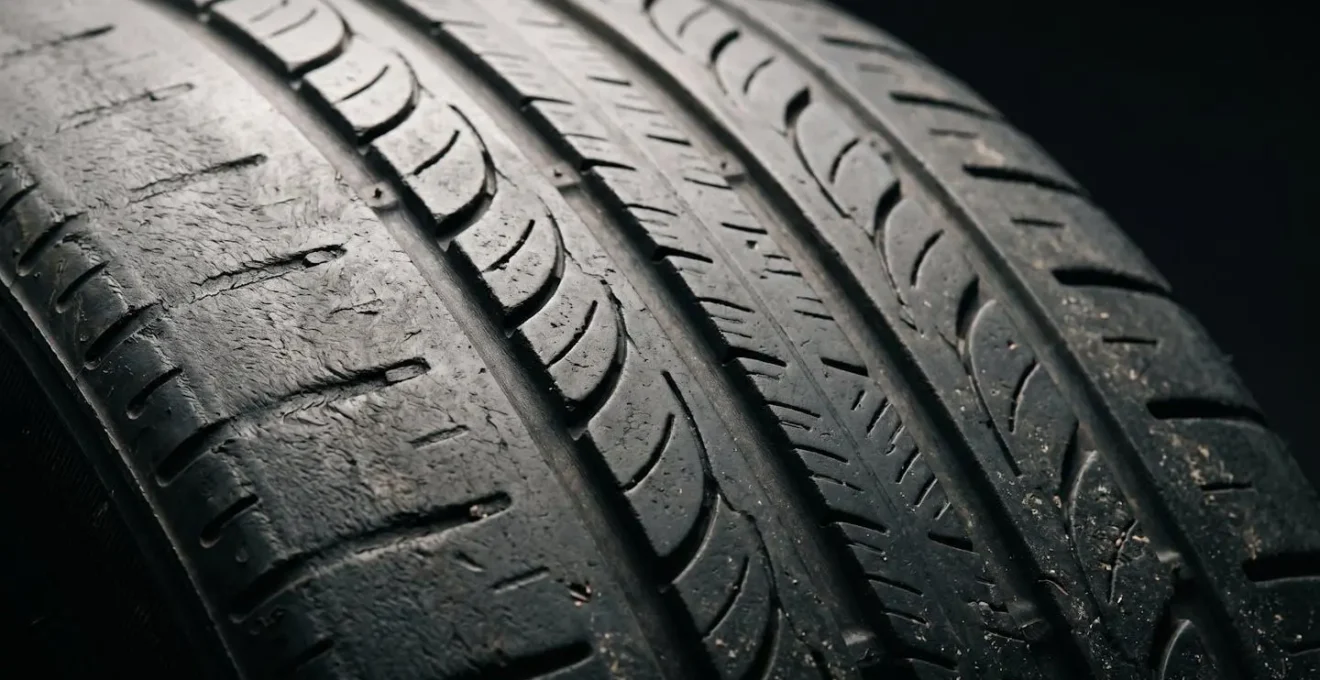
This wear pattern is more than just a waste of money on tyres; it’s a huge red flag for your safety and can have severe financial consequences. In the UK, insurance assessors routinely examine tyre condition when investigating accident claims. A vehicle must be deemed « road-worthy » for the insurance policy to be valid. Tyres showing the classic shoulder wear of chronic under-inflation can be, and often are, used as evidence of vehicle neglect. An insurer could argue that you failed to maintain your vehicle in a safe condition, potentially leading to a reduced payout or even complete invalidation of your claim. That visual pattern on your rubber is a financial document that can be read by experts.
When to Check Tyre Pressure: The Sunday Morning Habit That Saves £300 Yearly?
The advice to « check your tyres regularly » is too vague to be useful. What does ‘regularly’ mean, and what is the actual financial incentive? The key is to transform this chore into a simple, high-return habit. Let’s quantify the cost of inaction. According to the U.S. Department of Energy, for every 1 PSI drop in the average pressure of all four tyres, you can expect a 0.2% reduction in fuel economy. This might sound small, but the cumulative effect is a significant financial drain.
Let’s do the maths for a typical UK driver. Imagine your car’s recommended pressure is 35 PSI. If your tyres are running just 5 PSI low (at 30 PSI), that’s a 14% pressure drop. The fuel economy penalty isn’t linear, but a conservative estimate based on the 1 PSI rule would be at least a 1% loss in fuel efficiency (5 PSI * 0.2%). If you spend £2,000 a year on fuel, that’s £20 wasted. However, this model is too simple. The real-world impact of increased rolling resistance is much higher, with most experts agreeing a 10 PSI drop can reduce fuel economy by as much as 10%. For a driver with a £2,500 annual fuel bill, that’s £250 lost every year, not to mention the cost of replacing tyres that wear out 25% faster.
The solution is a simple, repeatable routine: the « Sunday Morning Habit ». Checking your tyre pressure once a month, on a Sunday morning before the car has been driven, takes less than five minutes. Doing it when the tyres are « cold » (parked for at least 3 hours) is the only way to get an accurate reading. This small investment of time pays huge dividends, potentially saving a combined £200-£300 annually in fuel and premature tyre replacement. It’s one of the few maintenance tasks with a clear and immediate return on investment.
Why Driving at 70 MPH Uses 25% More Fuel Than 60 MPH on the Same Journey?
On a UK motorway, the difference between driving at the 60 mph advisory speed and the 70 mph national speed limit feels negligible. The journey time is only marginally shorter, yet your fuel gauge tells a very different story. The reason for this disproportionate increase in fuel consumption isn’t your engine; it’s the air itself. The primary force your car has to overcome at high speed is aerodynamic drag, or air resistance.
Crucially, the force of aerodynamic drag doesn’t increase linearly with speed; it increases with the square of your velocity. This means that doubling your speed quadruples the air resistance your car has to push through. While the jump from 60 to 70 mph isn’t doubling your speed, the percentage increase is significant. A 17% increase in speed (from 60 to 70 mph) results in a roughly 36% increase in the aerodynamic force your engine must fight against. This extra work requires a substantial amount of extra fuel, with most studies showing a fuel consumption penalty of 20-25% for that 10 mph increase.

This « aerodynamic tax » is a fixed law of physics, but it’s compounded dramatically by incorrect tyre pressure. Under-inflated tyres create more rolling resistance, another force the engine has to overcome. So, when driving at 70 mph with under-inflated tyres, you are being hit with a double penalty: the high aerodynamic tax of the speed itself, plus the increased rolling resistance from the poorly maintained tyres. Research has shown that severely under-inflated tyres can worsen fuel economy by a further 10% at these speeds. Adhering to the speed limit and maintaining optimal tyre pressure are the two most effective strategies for controlling fuel costs on long journeys.
Why Does a 120 PSI Rating Mean Nothing Without Knowing the CFM Flow Rate?
When shopping for a portable tyre inflator, you’ll be bombarded with bold claims, with « 120 PSI » or even « 150 PSI » emblazoned on the packaging. This number, representing the maximum pressure the inflator can theoretically achieve, is a powerful but deeply misleading marketing tactic. For a UK car owner, it’s almost entirely irrelevant. Why? Because the tyres on your car, SUV, or van will rarely require more than 40-50 PSI. The 120 PSI capability is designed for niche applications like road bicycle tyres, not for topping up your Ford Focus.
The truly important specification that determines an inflator’s real-world performance—how fast and effective it is—is almost always hidden in the small print or omitted entirely. This metric is the flow rate, measured in CFM (Cubic Feet per Minute) or LPM (Litres Per Minute). This number tells you the volume of air the inflator can actually move at a given pressure. It represents the ‘speed’ of the inflator, while PSI represents its ‘strength’.
A high PSI rating with a low CFM flow rate is a recipe for frustration. It means the inflator has the strength to reach high pressures, but it moves such a tiny volume of air that it will take an excruciatingly long time to add even a few PSI to a car tyre. It’s like trying to fill a bathtub with a teaspoon. You need both adequate pressure (strength) and adequate flow (speed) for an inflator to be useful. As one technical analysis clearly states, focusing on PSI alone is a common trap for consumers.
PSI is the ‘strength’ (pressure it can reach) while LPM/CFM is the ‘speed’ (volume of air it can move). A 120 PSI rating is often a misleading marketing tactic for car tyre inflators, as car tyres rarely require more than 40-50 PSI. The crucial spec for speed and convenience is the flow rate.
– Tire Industry Technical Analysis, Understanding Tire Inflator Specifications
Key Takeaways
- A 5 PSI drop in tyre pressure can cost a typical UK driver over £200 annually in wasted fuel and premature tyre wear.
- Your car’s TPMS is an emergency warning, not a precision tool. A £10 personal digital gauge is essential for accurate, cost-saving inflation.
- Chronic under-inflation creates a distinct wear pattern on the tyre shoulders, a red flag that can be used by insurers to question a vehicle’s road-worthiness after an accident.
Why Does Your Cheap Tyre Inflator Take 15 Minutes to Add 5 PSI?
You’ve done the right thing. You’ve checked your tyres with a digital gauge and found them a few PSI low. You pull out the cheap, compact inflator you bought for emergencies, plug it into the 12V socket, and wait. And wait. The device buzzes and vibrates furiously, but the pressure reading on your gauge barely moves. After 15 minutes of noise, you’ve managed to add just 5 PSI. This frustrating experience isn’t because your inflator is faulty; it’s because it’s working exactly as its low-cost design intended.
The reason for the glacial pace is its dismally low flow rate (CFM/LPM). As we’ve established, this is the measure of the volume of air it can move, and it’s the single most important factor for performance. Cheap inflators prioritize a small size and a low price, which is achieved by using very small compressors with tiny pistons and weak motors. They can generate enough pressure (PSI) to eventually inflate a tyre, but they can only move a trickle of air. This is why they take so long and often overheat in the process.
This « false economy » has a direct financial impact. If your inflator is so slow and inconvenient that you put off topping up your tyres, you remain in a state of under-inflation. Every day you delay, the increased rolling resistance continues to chip away at your fuel efficiency. As UK tyre specialists confirm, this increased rolling resistance forces your engine to work harder just to maintain speed, directly burning more fuel. Investing in a slightly more expensive inflator with a decent flow rate (look for at least 35 LPM) turns a frustrating 15-minute ordeal into a quick 2-3 minute job. This convenience is what enables consistent pressure discipline, which in turn delivers hundreds of pounds in real savings.
Stop letting air—and money—leak away from your vehicle. Your journey to smarter, more efficient car ownership starts with a simple pressure check. Take five minutes this weekend to do it properly; it’s the best financial decision you’ll make for your car all year.