
The true ROI of a smart mobility platform is not in tracking vehicles, but in converting operational data into quantifiable financial decisions that eliminate hidden cost centres.
- Basic GPS tracking fails to identify the root causes of inefficiency, leaving significant savings on the table.
- Advanced platforms integrate live data to optimise routing, driver behaviour, and vehicle use in real-time.
- A phased, data-driven rollout strategy de-risks investment and builds a clear business case for full fleet deployment.
Recommendation: Shift your evaluation criteria from simple tracking features to a platform’s ability to provide actionable financial insights and integrate seamlessly with your existing systems.
For UK fleet managers overseeing 50 or more commercial vehicles, the dashboard is a source of constant pressure. Fuel prices continue to climb, customer delivery windows are shrinking, and the administrative burden of compliance, from tachograph laws to Clean Air Zones (CAZ), is ever-increasing. The common response has been to adopt basic GPS tracking, promising visibility over the fleet. However, this often results in a screen full of dots on a map, providing location data but failing to answer the most critical question: where is the money actually being lost?
Many believe the solution lies in simply finding shorter routes or telling drivers to idle less. While these are factors, they are symptoms, not the disease. The fundamental issue is that these basic systems lack the intelligence to connect vehicle activity to financial outcomes. They can show you *where* a van is, but not that its driver’s « throttle sawing » habit on the M1 is wasting 5% of its fuel, or that a recurring route is 20% longer than it needs to be during rush hour.
The paradigm shift, and the key to unlocking savings like the £12,000 annual figure, lies in moving beyond tracking and embracing a true smart mobility platform. The difference is profound. A smart platform acts as a data-to-decision pipeline, ingesting telematics, live traffic, and job data to expose the operational blind spots and financial leakages that are invisible to the naked eye. It’s not about watching your fleet; it’s about understanding its economic performance on a per-mile, per-hour, and per-job basis.
This guide will deconstruct how this is achieved. We will move past the generic benefits and delve into the specific mechanisms that turn data into profit. We will analyse the ROI of different ownership models, pinpoint the critical integration challenges that derail most projects, and provide a strategic framework for deploying this technology to maximise returns and minimise disruption.
To navigate these critical business decisions, this article breaks down the essential components of a high-ROI smart mobility strategy. The following sections provide a clear roadmap from identifying current system limitations to implementing advanced solutions that drive real financial results.
Summary: How to Unlock Fleet Savings with Smart Mobility
- Why Does Basic GPS Tracking Leave 40% of Route Inefficiencies Undetected?
- How to Cut 25 Minutes per Delivery Route Using Live Traffic Data Integration?
- Subscription or Purchase: Which Smart Mobility Model Delivers Better ROI Over 3 Years?
- The API Compatibility Error That Stalls 60% of Fleet Tech Implementations
- When to Deploy Smart Mobility Across Your Fleet: The 3-Phase Rollout Strategy
- How to Spot the Driving Habit That Costs Your Fleet £3,000 in Annual Fuel Waste?
- How to Cut 30% of Delivery Miles by Clustering Postcodes Intelligently?
- Why Does Fleet Telemetry Reveal That 20% of Your Mileage Generates No Revenue?
Why Does Basic GPS Tracking Leave 40% of Route Inefficiencies Undetected?
The core limitation of a basic GPS system is that it provides location data without context. A manager can see a vehicle is stationary or has deviated from a planned route, but cannot diagnose the underlying cause. Is the driver stuck in an un-reported traffic jam? Is the planned route itself flawed? Or is it an unauthorised stop? This lack of context creates operational blind spots, where significant financial leakage occurs undetected. In fact, research shows that manual route planning wastes 18% to 28% of a fleet’s mileage every single day, a problem basic tracking cannot solve.
A smart mobility platform, by contrast, layers multiple data sources. It combines GPS location with engine diagnostics (telemetry), live traffic feeds, and job management data. This creates a rich, contextualised view of operations. Instead of just seeing a dot stopped on the map, a manager sees the vehicle is stationary, the engine is idling, it’s located in a known congestion blackspot, and its ETA for the next delivery has been automatically updated. The problem is not just identified; it’s diagnosed.
As the experts at AccuGPS aptly state, this is the fundamental difference between data and intelligence.
Basic GPS systems tell fleets where a vehicle is, but not why things are happening or what to do next. Location data without context leads to dashboards full of dots on a map, but few actionable insights.
– AccuGPS, From GPS Tracking to Fleet Intelligence: The Missing Step
This failure to provide actionable insights is why so many fleets with basic tracking still struggle with high fuel costs and poor productivity. They have visibility of vehicle location but remain blind to the root causes of inefficiency—the very issues that a smart mobility platform is designed to expose and rectify. The goal is to transform the telematics feed from a reactive monitoring tool into a proactive cost-management engine.
How to Cut 25 Minutes per Delivery Route Using Live Traffic Data Integration?
A static route plan created at the beginning of the day is obsolete the moment a vehicle leaves the depot. Unforeseen traffic, accidents, or even minor roadworks can turn an « optimal » route into a costly, time-consuming journey. The ability to cut significant time—like 25 minutes per route—is not achieved through better initial planning alone, but through dynamic, real-time adaptation. This is the function of an intelligent routing engine powered by live traffic data integration.
This technology continuously pulls data from sources like Google Maps or Waze, understanding traffic flow, average speeds, and incidents as they happen. Instead of a driver making a reactive, and often suboptimal, decision to divert, the platform’s algorithm proactively recalculates the most efficient path to the next stop. It might redirect a driver onto a slightly longer A-road to bypass a standstill on a motorway, saving crucial time and fuel.

As the visualisation shows, modern platforms can process vast amounts of environmental data to optimise the flow of vehicles through complex urban networks. For example, the transit technology provider Spare developed a system that reshuffles an entire network of trips every 60 seconds based on live Google Maps traffic. This proactive recalculation, performed without any manual dispatcher input, ensures the entire fleet operates on the most efficient path possible at any given moment, keeping drivers and dispatch perfectly aligned.
For a UK fleet manager, this means fewer late deliveries, lower fuel consumption from avoiding stop-start traffic, and the ability to fit more jobs into a single shift. The cumulative time savings across a 50-vehicle fleet quickly translate into thousands of pounds in enhanced productivity and reduced operational costs.
Subscription or Purchase: Which Smart Mobility Model Delivers Better ROI Over 3 Years?
Once the value of a smart mobility platform is clear, the next critical decision is the acquisition model. The choice between a subscription-based Software-as-a-Service (SaaS) model and an upfront hardware purchase has significant implications for cash flow, scalability, and long-term Return on Investment (ROI). While the upfront purchase model appears cheaper over a long horizon, for most UK fleets, the SaaS model delivers superior financial and operational agility.
The SaaS model shifts the cost from a large capital expenditure (CapEx) to a predictable operating expense (OpEx). This has immediate benefits for UK businesses, as monthly subscription fees are typically fully tax-deductible against profits. Furthermore, with industry analysis revealing that software-based telematics can deliver an ROI of 500-700%, the payback period is often just a few months. The subscription also includes automatic software updates, ensuring the platform remains compliant with evolving regulations like London’s ULEZ or other regional Clean Air Zones without requiring new hardware.
The following table, based on industry data, breaks down the key financial differences over a three-year period for a fleet of 20 vehicles. As this comparative cost analysis shows, the flexibility and all-inclusive nature of SaaS often present a more compelling business case.
| Cost Factor | Subscription Model (SaaS) | Purchase Model (Upfront) |
|---|---|---|
| Initial Investment | £0-£50 per vehicle setup | £150-£300 hardware + installation per vehicle |
| Monthly Fee (per vehicle) | £15-£50 | £0 (after purchase) |
| 3-Year Total (20 vehicles) | £10,800-£36,000 | £3,000-£6,000 + maintenance costs |
| Software Updates | Automatic, included | Paid upgrades or obsolescence risk |
| Regulatory Compliance | Auto-updated for new zones (ULEZ, CAZ) | Manual updates or new purchase required |
| Tax Treatment (UK) | Fully deductible operating expense | Capital allowances spread over time |
| Scalability | Add/remove vehicles monthly | Fixed capacity, sunk cost |
| Payback Period | 1-3 months average | 6-12 months average |
While the total cost of a purchased system may appear lower on paper, it carries the hidden risks of technological obsolescence, unexpected maintenance costs, and inflexibility. A SaaS model provides a future-proofed solution that scales with your business and converts a large, risky capital outlay into a manageable, value-generating operating cost.
The API Compatibility Error That Stalls 60% of Fleet Tech Implementations
A smart mobility platform’s true power is only unleashed when it « talks » to your other business systems. The most common and costly mistake is selecting a platform based on its standalone features, only to discover it cannot integrate with existing Transport Management Systems (TMS), accounting software (like Sage), or HR platforms. This creates data silos, forces manual data entry, and ultimately stalls the project, turning a promising investment into a source of frustration. This challenge is widespread, as fleet management research indicates that up to 60% of companies are unaware of how to best leverage their fleet data, often due to poor integration.
The solution lies in scrutinising a vendor’s Application Programming Interface (API) capabilities *before* signing a contract. An API is the digital bridge that allows different software to exchange data automatically. A robust, well-documented API is the hallmark of a platform designed for a professional ecosystem. Without it, the data-to-decision pipeline is broken from the start. You might have excellent telematics data, but if it can’t flow into your routing or payroll systems automatically, its value is severely diminished.
To avoid this critical error, a fleet manager must act like a tech consultant and ask pointed questions during the procurement process. The focus should be on native integrations, data exchange protocols, and any hidden costs associated with API usage. The following checklist provides a framework for this essential due diligence.
Your Pre-Integration Vendor Checklist: 5 Critical API Questions
- Does the platform integrate directly with your existing business software (Sage, BrightHR, TMS) through native APIs, or does it require custom development work?
- Is the data exchange real-time or periodic sync-based? Real-time integration enables live routing decisions, while periodic syncs create operational lag.
- Does the API support two-way communication, allowing your TMS to push new jobs directly to driver devices, not just pull telematics data?
- Are there hidden API call limits or usage-based charges that could escalate costs as your fleet scales operations?
- What data format standards does the API use (JSON, XML, openLR)? Ensure compatibility with your accounting and HR systems to prevent data mismatch failures.
Treating API compatibility as a top-tier requirement, rather than an afterthought, is the single most effective way to de-risk a fleet technology implementation and ensure the platform becomes a central hub of business intelligence, not an isolated data island.
When to Deploy Smart Mobility Across Your Fleet: The 3-Phase Rollout Strategy
The prospect of deploying a new technology across a fleet of 50+ vehicles can be daunting. A « big bang » approach, where the entire fleet is equipped at once, is high-risk, capital-intensive, and can cause significant operational disruption. A far more effective and financially prudent method is a strategic, three-phase rollout. This approach allows you to prove the concept, build a data-backed business case, and secure driver buy-in before committing to full-scale deployment.
This phased strategy mitigates risk and demonstrates value at each stage. It starts with a small pilot group to test the technology and establish baseline savings, then expands to a larger segment to validate the ROI, and finally proceeds to a full fleet rollout armed with undeniable proof of its benefits. This methodical progression is crucial for getting stakeholders, from the finance department to the drivers themselves, on board.
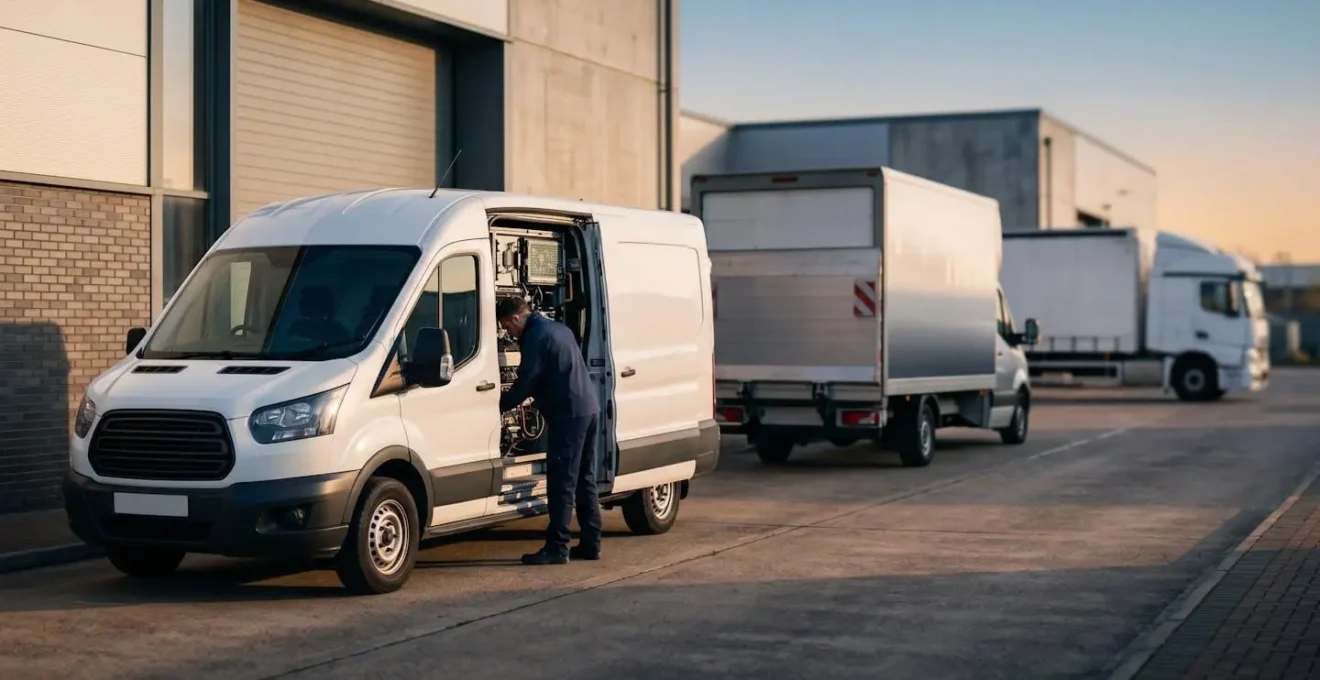
This approach is validated by UK market data. A Verizon Connect survey found that by 2025, 67% of UK fleet operators reported improved productivity through telematics integration. Critically, the report highlighted that a phased approach allowed these operators to build their business cases progressively, demonstrating ROI from a pilot group before seeking budget for a full fleet commitment. The three phases are:
- Phase 1: The Pilot (5-10% of Fleet). Select a small group of vehicles and drivers representing different routes and roles. The goal is to test the hardware/software, establish baseline KPIs (fuel usage, mileage, job completion times), and identify initial savings. This phase should last 30-60 days.
- Phase 2: The Validation (25-30% of Fleet). Expand the deployment to a larger, representative segment of the fleet. Use the learnings from Phase 1 to refine training and implementation. The goal is to validate the initial ROI calculations at a larger scale and build a robust, data-driven case for the final rollout.
- Phase 3: The Full Rollout (100% of Fleet). With a proven business case and refined processes, deploy the system across the remaining vehicles. At this stage, the project is no longer a speculative investment but a proven operational upgrade with predictable returns.
How to Spot the Driving Habit That Costs Your Fleet £3,000 in Annual Fuel Waste?
While poor routing is a major source of waste, a significant portion of a fleet’s fuel bill is directly influenced by driver behaviour. A single habit, like excessive engine idling, can cost a single vehicle over £1,000 per year in wasted fuel and unnecessary engine wear. When scaled across a fleet, these seemingly minor behaviours create major financial leakage. The most insidious habits are those that don’t trigger a standard « harsh driving » alert, making them invisible to basic telematics systems.
A smart mobility platform goes deeper, using telemetry data to identify these hidden, fuel-wasting behaviours. It analyses patterns in engine RPM, throttle position, and GPS data to build a detailed profile of each driver’s efficiency. It can distinguish between a driver braking hard to avoid a collision and a driver who consistently brakes late, or a driver accelerating smoothly versus one who engages in « throttle sawing »—rapidly varying the accelerator on a motorway. These are the behaviours that, when corrected, lead to substantial savings.
Identifying these habits is the first step; the second is using the data to coach drivers effectively. Instead of punitive measures, the data enables constructive, specific feedback. A manager can show a driver a report illustrating exactly how much fuel was wasted during a 45-minute break with the engine on, or compare their fuel efficiency on a specific route to the fleet average. Here are four examples of hidden behaviours a smart platform can uncover:
- Throttle Sawing Detection: By analysing inconsistent throttle application on motorways like the M1 or M6, the system can flag patterns that waste fuel without triggering standard harsh acceleration alerts.
- Engine-On Stationary Monitoring: Using geofences around UK motorway service areas, the platform can identify drivers leaving engines running during mandatory breaks, calculating the precise fuel cost of each incident.
- Gradient Gear Selection Analysis: Cross-referencing engine RPM with GPS elevation data on challenging A-roads (e.g., through the Pennines) reveals drivers labouring the engine in the wrong gear, a major cause of fuel waste and engine strain.
- Gamification for Efficiency: The data can power driver scoreboards and leaderboards, turning fuel efficiency into a competitive challenge with incentives for the most improved or most efficient UK driver.
By shifting the focus from generic alerts to specific, quantifiable behaviours, a fleet manager can foster a culture of efficiency and accountability, turning every driver into a partner in cost reduction.
How to Cut 30% of Delivery Miles by Clustering Postcodes Intelligently?
For fleets with multi-drop delivery schedules, one of the biggest sources of wasted mileage is inefficient sequencing. A driver may cross the same area multiple times in a day, creating overlapping, « spaghetti-like » routes that burn fuel and time. Manually planning an optimal sequence for 30+ stops is a near-impossible task, often resulting in routes that are significantly longer than necessary. The solution lies in automated route optimisation that uses intelligent postcode clustering.
This process goes beyond simply putting jobs in order. A sophisticated routing algorithm analyses the geographic distribution of all deliveries for the day across the entire fleet. It then groups jobs into dense, logical clusters based on UK postcode districts (e.g., all deliveries in SW1, SW3, and SW5). The system then assigns each cluster to the most appropriate vehicle and calculates the most efficient sequence of stops *within* that cluster, taking into account factors like delivery time windows, vehicle capacity, and live traffic.
The results of this automated approach are dramatic. Wishlist.Delivery, a company that adopted this technology, provides a compelling case study. They reduced their daily route planning time from hours to just minutes—an 83% reduction. More importantly, this efficiency allowed them to double their order fulfillment capacity without adding a single new driver, and they increased overall profitability by 15%. The system transformed their previously chaotic, overlapping routes into streamlined, logically sequenced paths.
For a UK fleet manager, implementing this technology means a direct reduction in total mileage, which cuts costs across the board: less fuel, lower maintenance from reduced wear and tear, and less driver time required per job. This directly boosts the Revenue-per-Mile (RPM) of the fleet, ensuring that more of the mileage driven is productive and profitable.
Key Takeaways
- Moving from basic GPS to a smart mobility platform is a shift from reactive tracking to proactive financial management.
- The highest ROI comes from using integrated data (telematics, traffic, jobs) to expose hidden inefficiencies like poor driver habits and suboptimal routing.
- A phased, pilot-driven deployment strategy is the most effective way to de-risk investment and build a robust business case for full fleet adoption.
Why Does Fleet Telemetry Reveal That 20% of Your Mileage Generates No Revenue?
One of the most sobering insights a smart mobility platform delivers is the concept of non-revenue mileage. This is any distance a vehicle travels that is not directly contributing to a billable job or core business function. It includes unauthorised personal use, inefficient trips back to the depot, or unnecessary movements within a yard. Analysis from firms like Frost & Sullivan has shown this can account for 20-30% of a fleet’s total annual mileage. For a 50-vehicle fleet, this is the equivalent of 10 to 15 vehicles driving all year without generating a single pound of income.
Basic tracking systems are ill-equipped to identify this waste. A manager might see a vehicle is moving, but has no way of knowing if that movement is productive. A smart platform, however, cross-references vehicle movements with job schedules, geofences, and defined work hours to automatically flag and quantify this unproductive travel. It separates the miles that make you money from the miles that cost you money.
Once identified, this non-revenue mileage can be systematically eliminated through targeted strategies. The telemetry data provides the evidence needed to implement and enforce policies that directly impact the bottom line. This is where the data-to-decision pipeline delivers its most direct financial return. Here are four strategies to turn this wasted mileage into profit:
- Unauthorised Use Detection: By implementing geofences around non-work locations and setting time-based rules (e.g., flagging all journeys after 7 pm on weekdays), the system can automatically highlight potential personal use. This not only cuts fuel costs but also helps manage potential UK Benefit-in-Kind tax liabilities.
- Empty Return Analysis: The platform can identify vehicles making consistent one-way trips and returning to the depot empty. This data allows dispatchers to find revenue-generating backhauling opportunities to fill those empty legs.
- Yard Management Optimisation: Telemetry can measure the « hidden » mileage accumulated from moving vehicles around large depots. This data can inform a redesign of the yard layout or parking plan to minimise these unproductive internal movements.
- Timesheet Validation: By cross-referencing driver overtime claims with actual vehicle telemetry data, the platform ensures that claimed hours match vehicle usage, eliminating payroll discrepancies and reducing labour costs.
Ultimately, transforming your fleet’s profitability requires a strategic shift in perspective. Moving beyond simple tracking to embrace a platform that provides deep, actionable financial insights is the definitive next step. By focusing on the principles of data integration, driver behaviour analysis, and the elimination of non-revenue mileage, you can build a resilient, efficient, and highly profitable operation. Begin by evaluating potential platforms not on what they track, but on the quality of the business decisions they enable.