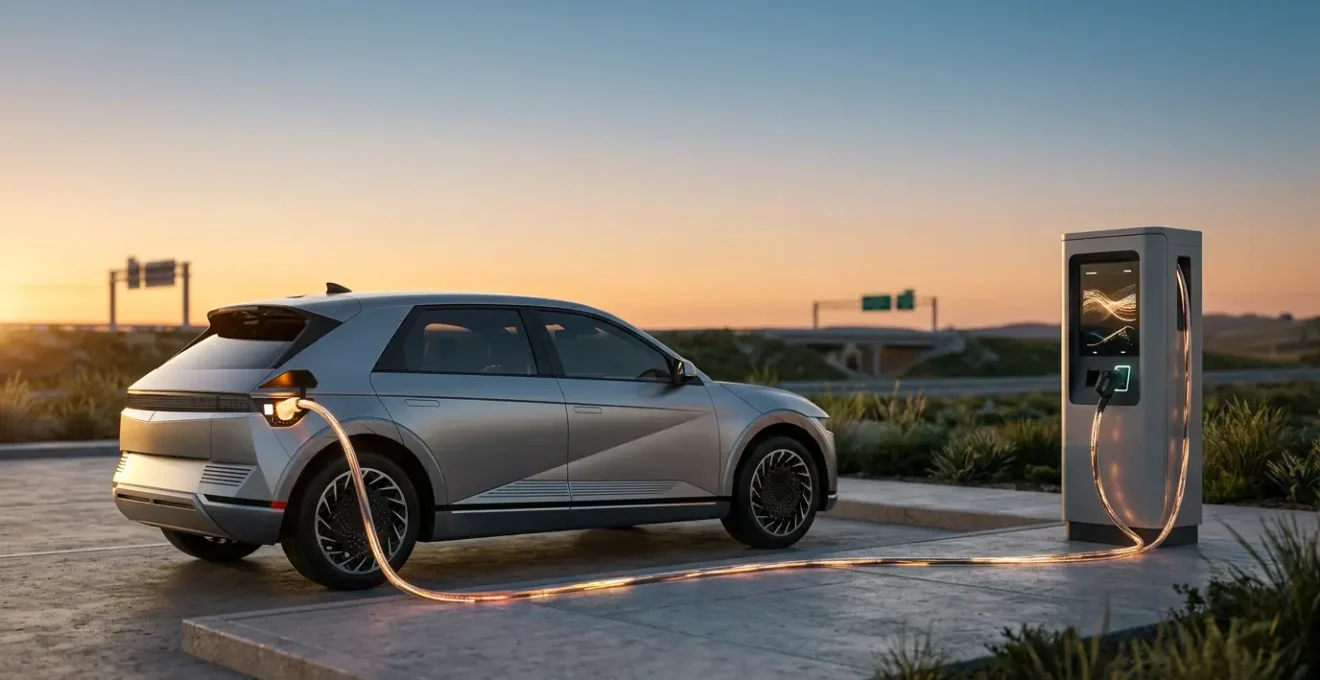
The frustrating inconsistency of UK rapid chargers isn’t random; it’s a predictable system that you can learn to master.
- Your car’s battery—not the charger—dictates the speed based on its temperature and state of charge, following a predictable ‘charging curve’.
- Network choice is a strategic trade-off between price, reliability, and location, with off-motorway options often providing significant savings.
Recommendation: Shift from reactive frustration to a proactive, analytical mindset. By understanding the core variables of battery chemistry, network economics, and infrastructure reliability, you can plan long-distance journeys with confidence.
You pull into a motorway service station, plug your EV into a gleaming 150kW ultra-rapid charger, and watch the screen. Instead of the blistering speed you were promised, the power trickles in at a frustrating 50kW. It’s a scenario familiar to almost every UK electric vehicle driver and a major source of anxiety on long journeys. The common advice—to check an app or blame the battery temperature—only scratches the surface. This response is technically correct but strategically useless, leaving you feeling powerless against the whims of the public charging network.
The reality is that charging speed is not a lottery. It’s a complex but predictable interplay of battery chemistry, network economics, and real-world infrastructure reliability. To navigate it successfully, you need to stop thinking like a frustrated driver and start thinking like a charging infrastructure analyst. This means moving beyond simply finding a charger and instead understanding the ‘unseen variables’ that govern its performance. It’s about knowing why your car will refuse a fast charge, which network offers the best value for your specific journey, and how to build a bulletproof plan that accounts for the inevitable faulty unit.
This guide demystifies the system. We will dissect the science behind your battery’s ‘charging curve’, compare the real-world value of the UK’s major networks, and provide a strategic framework for troubleshooting and planning. By mastering these principles, you can transform your long-distance EV travel from a game of chance into a predictable, efficient, and stress-free experience.
Contents: Decoding UK’s Rapid Charging Network
- Why Your EV’s Maximum Charging Speed Drops After the Battery Reaches 60%?
- Gridserve, Ionity, or Tesla Supercharger: Which UK Network Offers Best Value?
- How to Avoid Arriving at a Rapid Charger Only to Find It Broken or Occupied?
- CCS, CHAdeMO, or Type 2:How Did Post-Brexit Supply Chain Restructuring Save UK Distributors 18% on Cross-Border Costs?
- When to Charge at Motorway Services: The 2 PM Window That Saves 40%?
- The Rapid Charger Error That Turns a 30-Minute Stop Into a 90-Minute Wait
- Waze, Google, or TomTom Traffic: Which Predicts M25 Delays Most Accurately?
- Why Do 30% of UK EV Owners Wish They Had Known These Facts Before Buying?
Why Your EV’s Maximum Charging Speed Drops After the Battery Reaches 60%?
The single most misunderstood aspect of rapid charging is the belief that the charger dictates the speed. In reality, your car is in complete control. As Gridserve’s experts explain, « The car sets the charging power (not the charger) and adjusts it to the level that is just right for the battery cells, considering the temperature and condition of the battery at the time. » This managed process is known as the charging curve, a non-negotiable function of lithium-ion battery chemistry. Think of your battery as a large theatre and lithium ions as the audience. When the battery is empty (below 20% state of charge), there are endless empty seats, and the ions can rush in quickly without issue. This is when you’ll see the highest charging speeds.
As the battery fills up, typically past the 60% to 80% mark, the theatre becomes crowded. The Battery Management System (BMS)—acting as a team of ushers—must slow down the process to carefully guide the remaining ions to the few available seats. Forcing them in too quickly at this stage would cause chaos, leading to overheating and long-term cell degradation. The BMS prioritises battery health and longevity over raw speed, hence the dramatic drop-off in charging power you observe. This is not a fault; it’s a fundamental safety feature designed to protect your most expensive component.
The illustration below provides a macro view of the intricate structure within a battery cell, where this delicate process of ‘seating’ the ions (intercalation) takes place.

Understanding this curve is the first step to becoming a strategic EV driver. It means recognising that charging from 80% to 100% on a rapid charger is almost always a waste of time and money. The most efficient long-distance strategy involves multiple, shorter charging stops from a low state of charge (e.g., 10%) up to around 60-80%, always staying in the fastest part of your vehicle’s unique charging curve.
Gridserve, Ionity, or Tesla Supercharger: Which UK Network Offers Best Value?
Once you understand that charging speed is dictated by your car, the next variable to control is cost. The ‘best value’ network is not a one-size-fits-all answer but a strategic time-vs-money calculation for each journey. Motorway service stations offer unparalleled convenience and speed but command premium pricing. Off-motorway locations, such as supermarket car parks or town-centre hubs, often provide slower charging at a significantly lower cost. The analyst’s job is to weigh the cost of a few extra minutes of driving against the pounds saved on the charge itself. For drivers who rely on the public network, this calculation is critical; the 2024 Great EV Charging Report findings show that while 91% of home-charging drivers find EVs cheaper to run, this figure drops to just 50% for those dependent on public chargers.
The price per kilowatt-hour (kWh) can vary dramatically between networks, impacting the total cost of a ‘fill-up’ by over £10. To make an informed decision, you need up-to-date pricing data. The following table, based on recent UK network analysis, provides a snapshot of the current landscape.
| Network | Price per kWh (PAYG) | Speed Category | Notable Features |
|---|---|---|---|
| Tesla Supercharger (open access) | 57p | Rapid/Ultra-rapid | Plug-and-charge for Tesla owners (41p/kWh) |
| Sainsbury’s Smart Charge | 72p | Ultra-rapid | Nectar card rewards, high reliability rating |
| Ionity | 74p (53p with subscription) | Ultra-rapid (up to 350kW) | Optimal for 800V architecture vehicles |
| Weighted UK Average (Rapid/Ultra-rapid) | 76p | 50kW+ | Industry benchmark |
| bp pulse | 89p | Rapid/Ultra-rapid | Extensive network coverage |
| InstaVolt | 89p | Rapid/Ultra-rapid | No subscription required |
This data highlights key strategies. For owners of cars with 800V architecture (like the Hyundai Ioniq 5 or Porsche Taycan), an Ionity subscription can offer the best combination of speed and cost. For most others, Tesla’s open network often provides a competitive price point. However, the 72p/kWh rate at a reliable supermarket charger just a five-minute detour from the motorway could be the smartest financial move, especially if it coincides with a grocery stop.
How to Avoid Arriving at a Rapid Charger Only to Find It Broken or Occupied?
The greatest source of range anxiety isn’t the battery; it’s the unreliability of the infrastructure. Arriving at a crucial charging stop with low battery only to find all units are broken or in use is a nightmare scenario. And it’s a legitimate concern. A recent analysis by The Fast Charge reveals that as of April 2026, only 16 out of 38 rapid charging operators in the UK appeared to meet the government’s mandated 99% reliability standard. This means that simply navigating to the nearest charger shown on your car’s map is a high-risk gamble.
A strategic driver mitigates this risk through proactive planning and what we can call ‘charger clustering’. This approach involves identifying destinations that have multiple chargers, preferably from different networks, within a very short radius. A service station with eight chargers from two different providers is exponentially more reliable than a single, isolated unit in a pub car park. Your primary plan might be to use the Gridserve charger, but if it’s down, you have an immediate fallback to the InstaVolt unit across the car park without needing to reroute your entire journey. This creates a personal reliability buffer that the infrastructure itself often fails to provide.
To implement this strategy effectively, you must move beyond basic navigation and use specialised tools to vet your charging stops before you even set off. This pre-journey audit is non-negotiable for a stress-free trip.
Your Pre-Journey Reliability Checklist
- Identify Charger Clusters: Use apps like Zap-Map or Bonnet to find locations with multiple charging bays and, ideally, multiple networks in one place. Never rely on a single-charger location for a critical stop.
- Check Live Status & History: Look at the ‘last successful charge’ timestamp. If it’s more than 24 hours ago, consider the charger potentially out of service, even if the app says it’s available.
- Read Recent User Comments: Scan the latest user-submitted comments for reports of specific issues like ‘CCS handle broken’, ‘payment terminal frozen’, or ‘charging at reduced speed’. This provides real-world intel that live data misses.
- Prioritise High-Reliability Networks: Favour networks known for high uptime and rapid support, such as InstaVolt or Tesla Superchargers. Check network-specific reliability ratings on Zap-Map.
- Have a Payment Backup: Ensure you have a roaming card (like Paua) or Zap-Pay set up. This acts as insurance against app-specific payment failures or connectivity issues at the charger.
CCS, CHAdeMO, or Type 2:How Did Post-Brexit Supply Chain Restructuring Save UK Distributors 18% on Cross-Border Costs?
The mix of charging connectors—CCS, CHAdeMO, and Type 2—can be confusing, but for UK drivers of modern EVs, the story is simplifying rapidly. Type 2 is the standard for AC (slower) charging, while the battle for DC (rapid) charging has been decisively won by CCS (Combined Charging System). This connector is now the standard for virtually all new electric cars sold in the UK and Europe, with the notable exception of older Nissan Leafs which use CHAdeMO. This market consolidation has had significant, and surprisingly positive, post-Brexit implications for the UK’s charging infrastructure.
While Brexit introduced regulatory hurdles in many sectors, it also gave the UK the autonomy to double down on the CCS standard without needing to coordinate with broader EU-level legacy requirements. This strategic focus has been a boon for network operators, as detailed in an industry analysis on the UK’s charging market.
Case Study: Post-Brexit UK Charging Infrastructure Standardization
Following Brexit, UK charging networks faced trade uncertainties but gained regulatory agility. By independently prioritising CCS as the dominant rapid charging standard, operators could streamline their entire procurement and maintenance strategies. This focus allowed them to source specialised CCS components directly from global leaders in Taiwan, South Korea, and the US, often bypassing previous EU-centric tariff structures. According to a report from Next Move Strategy Consulting, standardising on a single connector type reduced inventory complexity, simplified technician training, and ultimately lowered operational costs, contributing to the UK EV charging market’s robust growth.
For the average EV driver, this strategic industry shift means greater reliability and a more consistent experience. As networks expand, they are overwhelmingly installing CCS-equipped chargers. While they will maintain CHAdeMO for legacy vehicles for some time, all future investment and innovation are centred on the CCS ecosystem. This means that if your car has a CCS port, you can be confident that it will be compatible with the vast majority of new rapid chargers being installed across the country.
When to Charge at Motorway Services: The 2 PM Window That Saves 40%?
The idea of a secret « 2 PM window » to get cheaper charging is an appealing myth, but the reality of saving money on the UK’s charging network is based on geography, not time. Unlike domestic electricity with off-peak tariffs, public rapid charging prices are generally fixed throughout the day. The significant price variation comes from the location of the charger itself. As EV Magazine highlights in its analysis, there’s a stark difference in what you pay.
Charging network pricing isn’t like domestic electricity. The cost of using these chargers varies; as of March 2024, charging on a public network costs an average of 56p per kWh for slow and fast chargers, while rapid and ultra-rapid chargers average 81p per kWh.
– EV Magazine, EV Charging Trends 2024 report
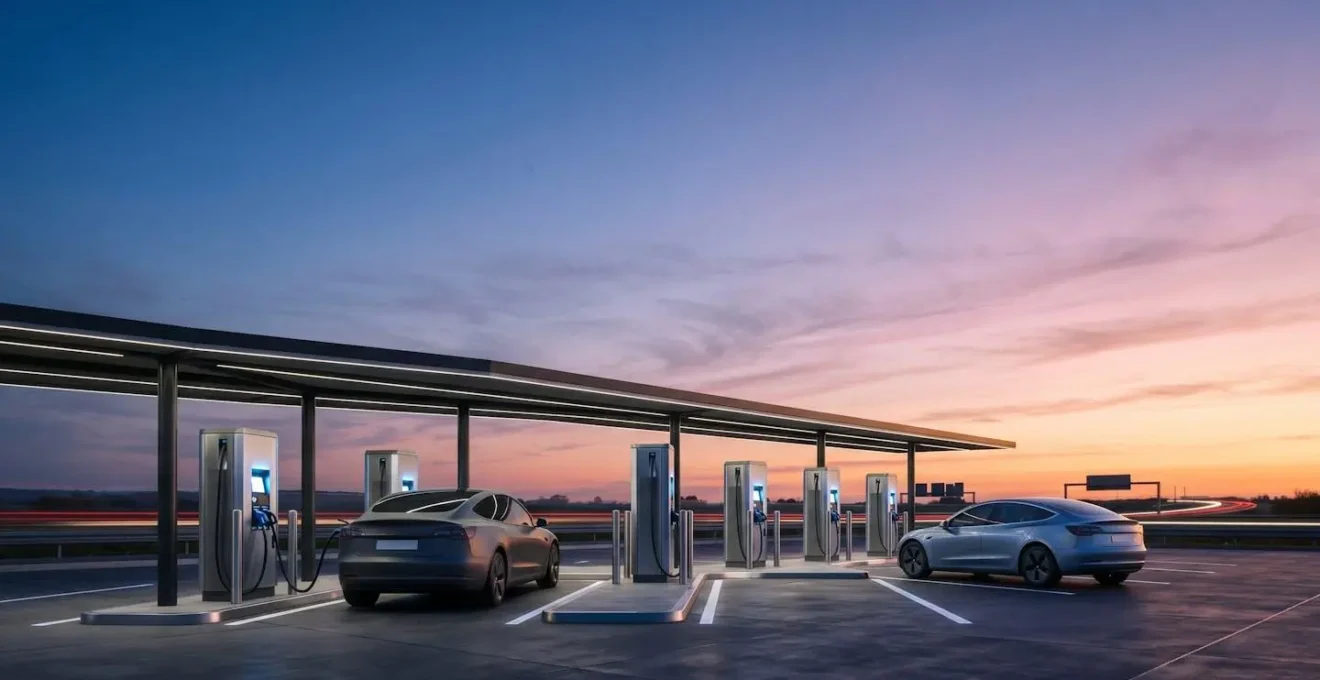
This price gap is most pronounced at motorway services, where you pay a premium for the convenience of not having to detour from your route. The strategic analyst, however, knows that a small detour can yield substantial savings. This « 5-Minute Detour » strategy is a powerful tool for cost-conscious drivers.
Case Study: The ‘5-Minute Detour’ Savings Strategy
An Auto Express case study comparing a full charge of a 52kWh battery illustrates this perfectly. At the UK’s weighted average rapid charging rate of 76p/kWh, a charge at motorway services costs £39.52. By taking a short detour to a supermarket retail park just one junction away, the cost drops to £28.08 (at 54p/kWh). This represents a saving of £11.44, or 29%, for the trade-off of an additional 15 minutes of journey time. For a driver regularly making long trips, this calculated decision can save hundreds of pounds per year.
Therefore, the real « 40% saving » isn’t found at a specific time, but by making a conscious choice: is the convenience of the motorway worth the premium, or does a short, planned detour to a cheaper, often slower, off-route charger make more financial sense? On a long journey where a meal break is planned anyway, timing your stop with a destination charger at a pub or supermarket is almost always the winning strategy.
The Rapid Charger Error That Turns a 30-Minute Stop Into a 90-Minute Wait
Even with perfect planning, you will eventually encounter a charging session that fails to start or unexpectedly stops. While frustrating, these failures are often caused by a few common issues that can be diagnosed and sometimes resolved without a lengthy call to a support centre. A startling Kempower’s comprehensive charging session analysis shows that 9.5% of over 13 million charging sessions ended abruptly due to user disconnections or errors. Knowing how to perform basic roadside triage can be the difference between a 5-minute fix and a 90-minute wait for remote support.
The most common failure point is the initial communication between the car and the charger, known as the ‘handshake protocol’. A glitch here can prevent the session from starting at all. Another frequent issue is a ‘derated charger’, where a specific charger post is functioning but at a fraction of its advertised speed, often due to a faulty internal power module. The key is to quickly identify the type of failure and follow a logical troubleshooting sequence.
Instead of repeatedly trying the same failed process, an analyst follows a diagnostic flowchart. The next time a charger refuses to cooperate, run through these steps in order:
- Verify Payment First: If a charge initiated via an app fails, try a physical contactless credit or debit card. Payment authorisation is a leading cause of session failure.
- ‘Reboot’ the Handshake: This is the most effective fix for communication errors. Unplug the cable from both the car and the charger. Wait 30 seconds. Lock and unlock the car. Then, plug the cable firmly back into the car first, and then into the charger. This forces a new communication attempt.
- Check Vehicle Settings: Quickly confirm that no charging schedule or maximum charge limit is accidentally active within your car’s infotainment system, which could be preventing the charge.
- Diagnose a Derated Charger: If the session starts but the speed is unexpectedly low (e.g., 22kW from a 150kW unit), stop the charge immediately. This is likely a hardware fault in that specific stall. Move to an adjacent charger rather than waiting.
- Handle a Stuck Cable Safely: If the cable won’t release after the session, do not use force. Try locking and unlocking your car again to cycle the locking pin. If it remains stuck, consult your car’s manual for the location of the emergency manual release lever. Only then, call the helpline number printed on the charger.
Waze, Google, or TomTom Traffic: Which Predicts M25 Delays Most Accurately?
For an EV driver on a long journey, navigation isn’t just about finding the quickest route; it’s about finding the most energy-efficient route and timing charging stops perfectly. When tackling unpredictable arteries like the M25, the accuracy of real-time traffic data is paramount. The choice between Waze, Google Maps, and TomTom depends on understanding their different data sources and how they align with an EV driver’s specific needs.
No single app is universally superior; each has a distinct strength. An analyst chooses the right tool for the job by understanding what’s ‘under the hood’.
Case Study: Navigation Data Source Comparison for EV Drivers
Each platform excels in different scenarios. Waze, with its crowdsourced data, is unbeatable for detecting sudden, unforeseen incidents like accidents or debris on the road, which are common on the M25. Its users act as real-time sensors. Google Maps leverages aggregated location data from millions of Android devices, giving it the most accurate model for predicting standard, recurring congestion patterns and traffic flow speed. TomTom uses a combination of dedicated GPS probes and deep historical data, making it particularly reliable for estimating journey times on routes with less traffic. The optimal EV strategy often involves a hybrid approach: using a dedicated EV routing app like A Better Route Planner (ABRP) for its superior battery and charging curve modelling, while simultaneously running Waze in the background for its best-in-class real-time hazard alerts.
The landscape is evolving, with Google Maps now integrating EV-specific features that suggest charging stops based on your current state of charge. While convenient, these all-in-one solutions currently lack the sophisticated thermal modelling and vehicle-specific charging curve data that dedicated apps like ABRP provide. Therefore, for the most critical long-distance journeys, the analyst’s choice remains a combination of tools: ABRP for the core energy plan and Waze for real-time tactical awareness. This dual-app strategy ensures your route is not only the fastest but also the most viable from a battery management perspective.
Key Takeaways
- Your Car is the Boss: The charging curve is determined by your car’s battery chemistry and temperature to protect its health. You can’t force it to charge faster than it deems safe.
- Value is a Calculation: The cheapest charge is rarely the most convenient. The best value comes from a conscious trade-off between motorway speed (high cost) and off-route location (lower cost, more time).
- Plan for Failure: Infrastructure is not 100% reliable. The only way to guarantee a smooth journey is through proactive planning: use apps to vet charger reliability and always choose charging locations with multiple units and networks.
Why Do 30% of UK EV Owners Wish They Had Known These Facts Before Buying?
The statistic that a significant portion of EV owners have regrets often points to a mismatch between expectation and reality, particularly concerning the total cost and convenience of ownership. For drivers who rely heavily on the public network for long journeys, these frustrations don’t fade after the initial purchase; they become a recurring part of the ownership experience. The core issues were succinctly identified in a 2024 inquiry into the UK’s EV strategy.
The House of Lords Environment and Climate Change Committee’s 2024 inquiry into EV strategy identified that demand for electric cars is being constrained due to three primary factors new buyers underestimate: upfront cost (purchase price premium over ICE equivalents), inadequate charging infrastructure (particularly for those without home charging access), and general consumer skepticism driven by range anxiety and total cost of ownership uncertainty including battery replacement fears, higher insurance premiums due to expensive specialist repairs, and accelerated tire wear from instant torque and vehicle weight.
– House of Lords Committee, Inquiry into Electric Vehicles
For the experienced EV driver, these « facts they wish they’d known » are not about the car itself, but about the ecosystem it operates in. The « inadequate charging infrastructure » is not just about a lack of chargers, but their inconsistent speeds and questionable reliability. The « total cost of ownership uncertainty » crystallises every time they are forced to pay a premium rate at a motorway charger. These are not one-time buyer’s remorse issues; they are ongoing operational challenges.
This entire guide has been about addressing that gap between expectation and reality. By understanding the non-negotiable science of the charging curve, making calculated decisions about network value, and implementing a robust, analytical approach to journey planning and troubleshooting, you move from being a victim of the system to a master of it. The frustration felt by many stems from treating public charging like filling up with petrol—a simple, predictable transaction. The reality is that it’s a dynamic system of variables. Learning to control those variables is the single most important skill for any long-distance EV driver in the UK today.
Now that you are equipped with an analyst’s mindset, the next logical step is to apply this knowledge to your next long journey. Plan it not just by destination, but by charging strategy, and transform your travel experience.