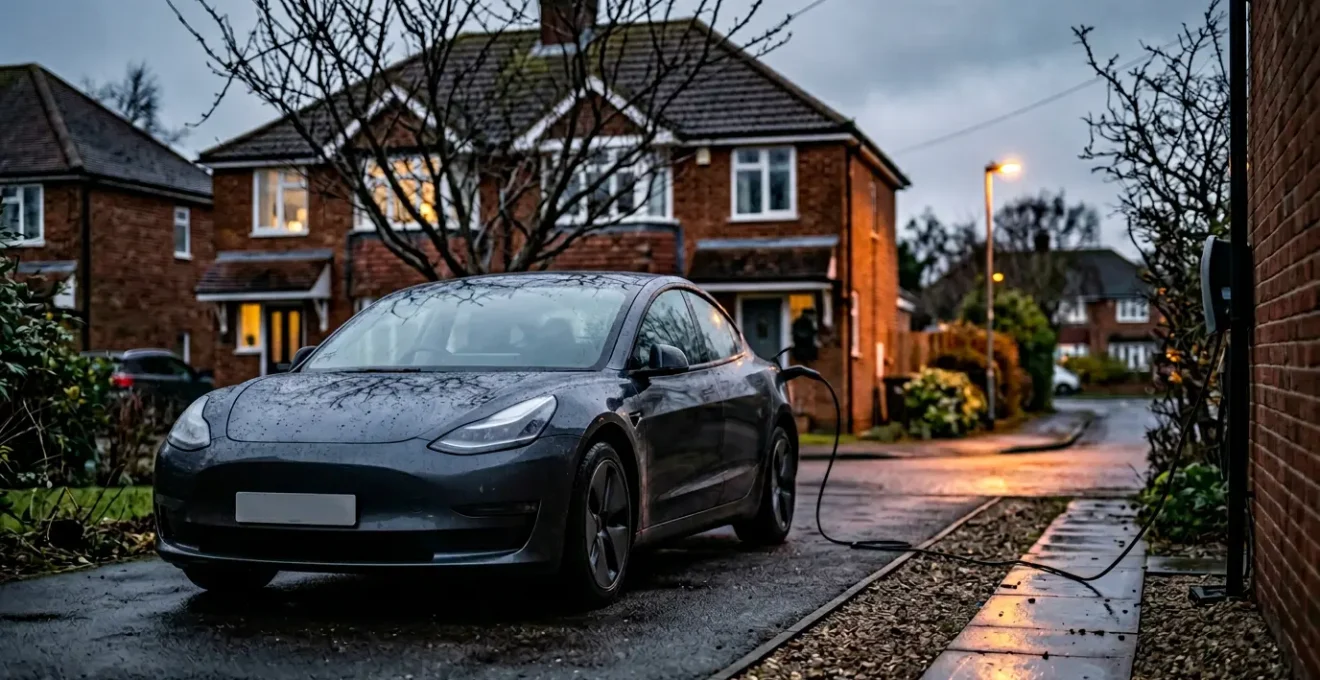
The key to a happy transition to electric driving isn’t the car’s spec sheet, but understanding the real-world rules of ownership that are never advertised.
- Your EV’s winter range is a psychological test, but technology like a heat pump is the answer.
- Public charging frustrations often stem from a simple « handshake error » that you can usually fix yourself in 30 seconds.
- How you charge (and to what percentage) has a bigger impact on your battery’s long-term health than how you drive.
Recommendation: Focus less on the maximum possible range and more on the car’s battery chemistry and thermal management system—these are the true indicators of long-term value and usability in the UK.
The glossy brochures and slick dealership presentations paint a simple picture of electric vehicle ownership: silent, cheap to run, and effortlessly green. For many, that dream becomes a reality. Yet, a significant portion of new EV drivers in the UK find themselves grappling with a reality gap—a collection of quirks and characteristics they wish someone had explained upfront. This isn’t about scaremongering; it’s about shifting from a petrol mindset to an electric one, a process that involves more than just swapping the pump for a plug.
You’ve likely heard the common advice: « range drops in the cold » or « get a home charger. » While true, these are just headlines. They lack the depth and context that five years of daily EV driving in the UK provides. The real confidence comes from understanding the *why* behind these statements. It’s about knowing how to interpret your car’s range estimate on a frosty January morning, why a plug-in hybrid might cost you more than you think, and the simple trick to solve the most common public charging error without calling for help.
But what if the key to a successful transition wasn’t just knowing the problems, but understanding the underlying systems? This guide is built on that premise. We’re going beyond the generic advice to reveal the unwritten rules of EV ownership. We will dissect the nuances of battery chemistry, the realities of the UK’s charging network, and the market signals that tell you the best time to buy. This is the conversation you have with a seasoned EV owner, not a salesperson.
This article will guide you through the essential facts that transform a first-time EV buyer from anxious to empowered. By exploring these real-world scenarios, you’ll gain the practical knowledge needed to choose the right car and enjoy a seamless ownership experience from day one.
Summary: The Unwritten Rules of UK Electric Car Ownership
- Why Your EV Shows 250 Miles but Delivers Only 180 in a British Winter?
- How to Claim £350 Off Your Home Charger Installation Through the UK Government Grant?
- Full Electric or Plug-In Hybrid: Which Suits a 15-Mile Commute With Monthly Motorway Trips?
- The Rapid Charger Error That Turns a 30-Minute Stop Into a 90-Minute Wait
- When to Buy Your First EV: Reading the UK Market Signals for Best Value?
- Why Charging to 100% Every Night Shortens Your Battery Life by 10%?
- Gridserve, Ionity, or Tesla Supercharger: Which UK Network Offers Best Value?
- Why Do Some EV Batteries Retain 90% Capacity After 100,000 Miles While Others Degrade to 70%?
Why Your EV Shows 250 Miles but Delivers Only 180 in a British Winter?
This is the first psychological hurdle for any new EV owner in the UK. You leave home with a range display showing a healthy 250 miles, but as the temperature drops, that number plummets faster than expected. This isn’t a fault; it’s physics. The two main culprits are battery chemistry, which is less efficient in the cold, and cabin heating. Unlike a petrol car that generates waste heat, an EV must use precious battery power to warm you up. This can lead to a significant range reduction; indeed, research from WhatCar? testing found a typical range loss of 15-20% in UK winter conditions.
However, not all EVs are created equal in this regard. The single most important piece of technology for mitigating winter range loss is a heat pump. Instead of using a simple resistive heater (like a toaster element), a heat pump works like an air-conditioning unit in reverse, efficiently gathering ambient heat and moving it into the cabin. It uses significantly less energy, preserving your driving range.
The difference is stark. Analysis from Recurrent, which monitors thousands of vehicles, found that on average, EVs with heat pumps retain 83% of their range in freezing conditions, compared to just 75% for those without. When you’re considering two similar models, the one equipped with a heat pump will offer a much more predictable and less stressful winter driving experience. It’s an option box worth ticking or a feature to seek out on a used model.
How to Claim £350 Off Your Home Charger Installation Through the UK Government Grant?
One of the biggest misconceptions currently is who can access government support for home charging. While homeowners with driveways were previously the main beneficiaries, the scheme has evolved. Today, the OZEV (Office for Zero Emission Vehicles) grant is specifically targeted at renters and people who own or live in flats. This initiative provides up to 75% off the cost of a home charger installation, capped at £350. It’s a crucial incentive designed to remove the charging barrier for those without a private house.
Navigating the process requires a methodical approach, as eligibility is strict. You can’t simply buy a charger and claim the money back; the grant is handled by your approved installer. It’s also important to note that the government is planning to increase the support, with a UK Government announcement stating the grant will rise from £350 to £500 per socket from April 1, 2026, making it even more valuable in the near future.
To ensure you qualify, you must follow a clear set of steps. The most critical points involve proving you have dedicated off-street parking and using certified equipment and installers. For renters, getting written permission from a landlord is an absolute prerequisite.
Action Plan: Securing Your UK EV Charger Grant
- Verify you are a renter or flat owner with dedicated off-street parking. The grant is no longer available for most homeowners in houses.
- Confirm your property is in the UK (excluding the Channel Islands and Isle of Man) and that you have legal rights to the private parking space (e.g., in your rental agreement or deed).
- Choose both an OZEV-approved installer and an OZEV-approved chargepoint model from the official government registers. Your installer can guide you on this.
- Let your chosen installer submit the application on your behalf. They will discount the £350 directly from your final invoice.
- If you are a renter, you must obtain formal written permission from your landlord or the property management company before any installation work can begin.
Full Electric or Plug-In Hybrid: Which Suits a 15-Mile Commute With Monthly Motorway Trips?
For a driver with a short daily commute and occasional long journeys, the Plug-In Hybrid (PHEV) seems like the perfect, anxiety-free solution. You get silent, electric-only driving for your 15-mile round trip to work, with a petrol engine as a backup for that monthly 200-mile motorway run. In theory, it’s the best of both worlds. In practice, the reality depends entirely on your charging discipline. A PHEV only delivers its promised efficiency if you treat it like a full EV and plug it in every single night.
If you fail to charge, you’re essentially driving a heavy petrol car with a complex, expensive-to-service dual powertrain. The small electric motor and battery become dead weight, and fuel economy on the motorway can be worse than a conventional hybrid. This is reflected in real-world running costs. A study by the Energy and Climate Intelligence Unit found that the UK’s best-selling PHEVs cost around £500 more per year to fuel than manufacturers’ official claims suggest, precisely because many owners don’t charge them diligently.
For the specified driving pattern, a full Battery Electric Vehicle (BEV) with a modern range of 200+ miles often makes more financial and practical sense. The daily commute costs pennies, and the monthly long trip requires just one 30-minute stop at a rapid charger. A BEV simplifies ownership with one fuel source and far lower servicing costs, removing the « dual-fuel burden » of a PHEV.
| Factor | Battery Electric Vehicle (BEV) | Plug-In Hybrid (PHEV) |
|---|---|---|
| Daily 15-mile commute cost | £1-£2 (home charging at 7p/kWh off-peak) | £1-£2 if charged daily, £4-£5 on petrol if not |
| Monthly 200-mile motorway trip | 30-40 min rapid charge stop, £15-£25 public charging | No charging needed, £25-£35 in petrol |
| Annual fuel cost (real-world) | £400-£600 | £900-£1,200 (blended) |
| Servicing complexity | Low (no engine, fewer moving parts) | High (dual powertrain – engine + electric system) |
| Electric-only range | 200-300+ miles | 20-40 miles |
| Mental load | Single fuel system, plan charging | Two fuel systems, must charge daily for efficiency |
The Rapid Charger Error That Turns a 30-Minute Stop Into a 90-Minute Wait
You pull into a motorway service station, plug in the rapid charger, and… nothing happens. The screen displays a vague « Communication Error » or « Handshake Failed » message. You try again. Still nothing. This frustrating experience is one of the biggest sources of public charging anxiety, and it’s surprisingly common. Data suggests that these digital communication failures occur in up to 25% of failed charging attempts. It’s often not the charger or the car that’s broken, but simply a glitch in the digital protocol as they try to connect.
From my experience, the first instinct is to move to another charger or give up entirely. However, a simple, methodical sequence of steps can solve the problem over 90% of the time without you ever needing to call a support line. The issue can be caused by anything from software glitches to a small amount of moisture or debris on the charging pins, interrupting the delicate data exchange.
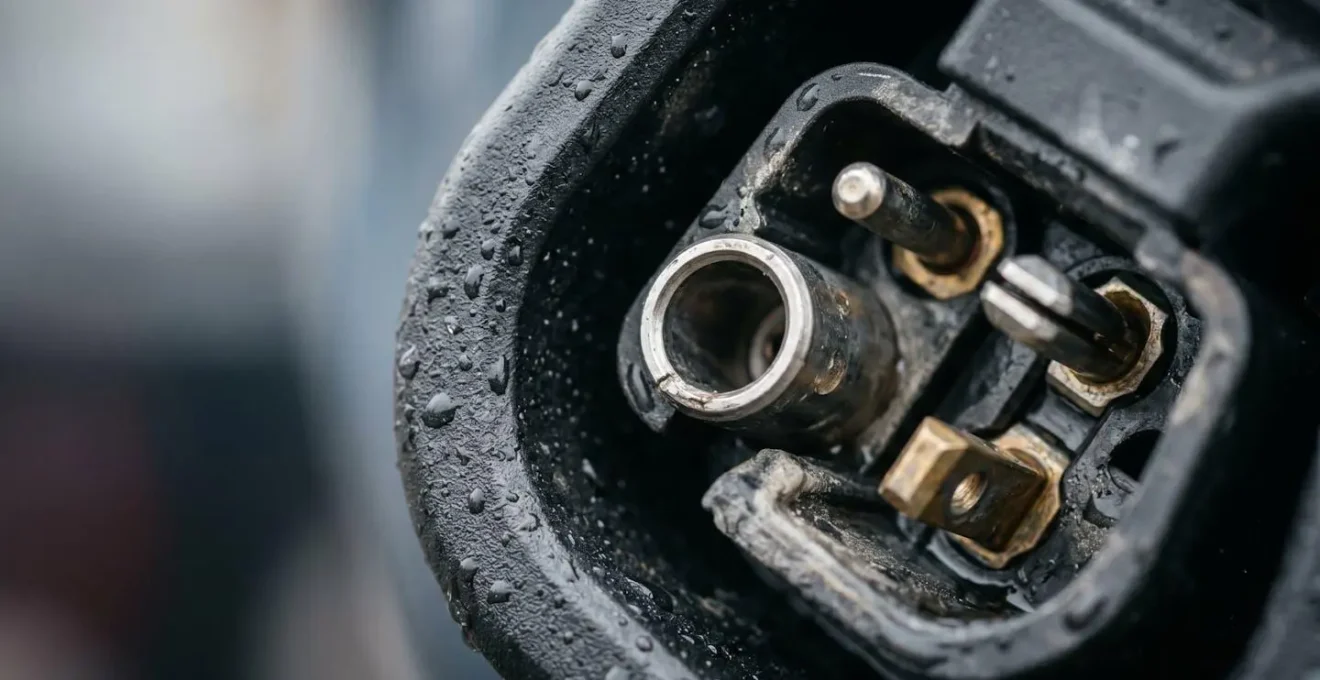
As the image above suggests, even a small amount of condensation can be enough to interfere with the connection. Before panicking, follow this proven troubleshooting sequence. Most often, the solution is as simple as Step 1.
- Unplug and Wait: Disconnect the cable from your vehicle completely. Wait a full 30 seconds. This allows the software on both the charger and the car to reset. Then, plug it back in firmly. This fixes the majority of handshake errors.
- Check Vehicle State: Ensure your car is in the correct mode for DC charging. For many EVs, this means being in « Ready » mode (as if you were about to drive), not fully powered off or in accessory mode. Check your car’s manual for specifics.
- Clean the Contacts: Visually inspect the charging port on your car and the connector on the cable. If you see any debris or moisture, wipe it carefully with a dry cloth.
- Precondition the Battery: If you’re arriving with a very cold battery (a « cold-soak »), the car may limit charging speed or refuse to start. Use your car’s navigation to set the charger as a destination; this often triggers automatic battery preconditioning, warming it to an optimal temperature on the way.
- Try Another Stall: If the issue persists, move to a different charging unit at the same location. Sometimes, one unit may have a firmware issue or be part of a derated bank of chargers.
When to Buy Your First EV: Reading the UK Market Signals for Best Value?
Trying to « time the market » for any car purchase is difficult, but with EVs, it’s not just about guessing. You can make an informed decision by understanding the regulatory pressures and product cycles that influence pricing. The most powerful force in the UK market right now is the Zero Emission Vehicle (ZEV) mandate. This government regulation forces manufacturers to ensure a certain percentage of their total sales are electric each year. The UK Zero Emission Vehicle Mandate requires that 22% of new car sales must be electric in 2024, a figure that rises steeply each year towards the 100% target in 2035.
What does this mean for you as a buyer? If a manufacturer is falling behind on its target towards the end of a sales quarter (end of March, June, September, December), they may be forced to offer significant discounts or incentives on their EV models to avoid hefty fines. This makes the last two weeks of any given quarter a prime window for negotiating a better deal. As an experienced consultant, I’ve seen some of the best offers appear in late March and late December as brands rush to meet their annual goals.
Beyond the ZEV mandate, there are other classic signals to watch for. Look for deals when a model is about to be « facelifted » or replaced by a new generation; dealers will be keen to clear out old stock. Pay attention to the announcement of new battery technologies. When a new, more efficient battery is announced for a model, the existing version on the forecourt often sees a price reduction. By combining these signals, you move from a passive buyer to a strategic one, letting market forces work in your favour.
Why Charging to 100% Every Night Shortens Your Battery Life by 10%?
We are all conditioned by our smartphones: plug them in at night, wake up to 100%. Applying this logic to an electric car is one of the most common and damaging mistakes a new owner can make. A lithium-ion battery in an EV undergoes stress when it’s held at a very high (or very low) state of charge. Routinely charging to 100% and leaving it there overnight accelerates a process called calendar degradation, permanently reducing its capacity over time. The « sweet spot » for daily battery health is keeping it between 20% and 80%.
This doesn’t mean your battery will fail. EV batteries are incredibly durable. A large-scale study by Geotab found that the average EV retains around 90% of its original capacity after five years. However, good charging habits can be the difference between retaining 92% and 82% over the long term, which has a real impact on the car’s usability and resale value. The 80% rule is your best tool for maximising that lifespan.
This advice gets more nuanced with different battery chemistries, a crucial detail often missed.
- NMC (Nickel Manganese Cobalt) batteries, common in many long-range and premium EVs, are most sensitive to being held at a high state of charge. For these cars, adhering to the 80% daily limit is critical.
- LFP (Lithium Iron Phosphate) batteries, found in models like the standard range Tesla Model 3 and many BYD or MG cars, are more robust. In fact, they require being charged to 100% periodically (e.g., once a week) to help the Battery Management System (BMS) calibrate itself and provide an accurate range estimate.
Regardless of chemistry, use your car’s « scheduled departure » feature. This allows you to plug in when you get home, but the car will time the charging to finish just before you need to leave. This minimises the time spent sitting at a high state of charge, which is the real enemy of battery health.
Gridserve, Ionity, or Tesla Supercharger: Which UK Network Offers Best Value?
The narrative of a sparse and unreliable UK charging network is rapidly becoming outdated. The infrastructure is growing at an incredible pace. As of June 2024, there were 12,551 rapid or ultra-rapid chargers across the UK, a 46% increase in just one year. The question for a new owner is no longer « Will I find a charger? » but « Which network offers the best experience and value? » As a daily driver, my experience is that the « best » network depends on your priorities: coverage, speed, or cost.

The UK’s motorway service areas are now dominated by three major players, each with a distinct personality. Choosing the right one for your journey can make a huge difference in time and money.
Gridserve Electric Highway: The Reliable Workhorse. Found at the vast majority of motorway services, Gridserve is the backbone of the UK network. Their chargers are modern, typically offer both CCS and CHAdeMO connectors, and support contactless payment. Speeds are generally reliable, though they may not always be the absolute fastest. Their pricing is competitive and transparent. For most journeys, Gridserve is the safest, most dependable bet.
Ionity: The Speed King. If your car can handle ultra-rapid charging (200kW+), Ionity is your go-to for speed. Their chargers are capable of adding 100 miles of range in as little as 10-15 minutes. However, this performance comes at a premium. Without a subscription, Ionity is often the most expensive network. It’s the best choice when you are in a hurry and willing to pay for the convenience.
Tesla Superchargers: The Gold Standard Ecosystem (Now Opening Up). For years, the Tesla network was the undisputed champion for its seamless reliability and integration. You simply plug in, and it works. While historically exclusive to Tesla owners, many Supercharger sites are now open to other brands via the Tesla app. If you’re near an open site, they often provide a fantastic experience and competitive pricing, though it can feel a bit more crowded than it used to.
Key Takeaways
- An EV’s real-world winter range is dictated by cabin heating needs and battery chemistry; a heat pump is the most effective technology to combat this.
- Good battery health is not about mileage, but about disciplined habits: limit daily charging to 80% (for NMC) and minimise both rapid charging and time spent at a 100% state of charge.
- The single most important hardware factor for long-term battery longevity in a climate like the UK’s is an active liquid thermal management system.
Why Do Some EV Batteries Retain 90% Capacity After 100,000 Miles While Others Degrade to 70%?
The ultimate question for any potential EV owner is about longevity. Will the most expensive component of the car, the battery, last? The reassuring answer is yes. Stories of high-mileage EVs are now common, with data showing that some EVs lose only about 10% of their battery capacity after 200,000 miles. However, there’s a significant variance in degradation rates between different models. This difference isn’t down to luck; it’s primarily determined by one crucial piece of engineering: thermal management.
A battery is like an athlete; it performs best within a narrow temperature range. It dislikes being too hot or too cold, especially during high-stress activities like rapid charging or hard acceleration. The difference between a battery that lasts 200,000 miles and one that degrades significantly faster often comes down to how well the car can manage its temperature. This is the most critical « unwritten rule » to understand when buying a used EV or comparing new ones.
Case Study: The Tale of Two Cooling Systems
The difference between passive air-cooling and active liquid-cooling systems represents the single most important hardware factor for battery longevity in temperate climates like the UK’s. Early models of the Nissan Leaf used a passive air-cooling system, which made them notorious for accelerated battery degradation, especially if rapid-charged frequently. In contrast, almost all modern EVs (including later Leafs) employ sophisticated liquid thermal management systems. These systems circulate a coolant through the battery pack to maintain its optimal temperature during both charging and driving, preventing the thermal stress that causes rapid capacity loss. This active cooling is the primary reason why a modern, high-mileage EV can retain over 90% of its capacity while an older, air-cooled model might struggle to hold 70%.
This single factor—liquid cooling—is more important than the brand, the size of the battery, or the claimed maximum range. When you’re assessing an EV for long-term ownership, confirming it has an active thermal management system should be your number one priority. It’s the secret to ensuring your investment remains healthy and capable for years to come.
By understanding these unwritten rules—from the psychology of winter range to the science of battery health—you are no longer just a potential buyer. You are an informed driver, ready to make a confident decision and fully embrace the benefits of electric mobility in the UK.