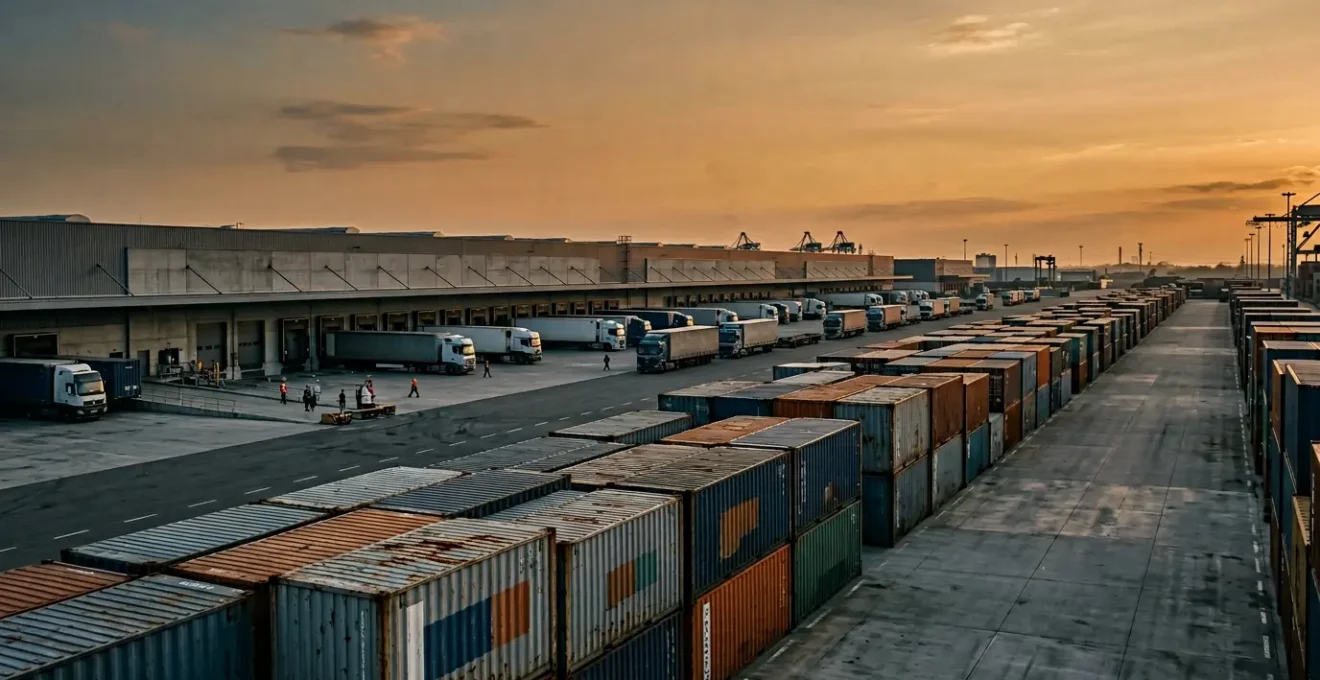
The critical reason your stock is late isn’t a single delay; it’s the invisible data gaps between your supplier, carriers, and your warehouse that make your supply chain fundamentally unpredictable.
- Reactive tracking only tells you where a shipment was, not where it’s going or when it will fail. Predictive visibility uses data to forecast delays before they happen.
- True control isn’t about owning trucks; it’s about owning the data. The choice between 3PL and in-house operations hinges on which model provides superior data integration and exception management for your specific volume.
Recommendation: Shift your focus from watching dots on a map to building a system of predictive alerts and pre-defined responses. This transforms you from a worried spectator into a proactive operator of your supply chain.
The email notification was clear: « Your shipment has left the supplier. » Yet, three days after the expected arrival, you’re staring at a tracking status that has been frozen on « In Transit » for what feels like an eternity. For a UK business owner, this isn’t just an annoyance; it’s a cascade of broken promises to customers, production line halts, and cash flow frozen in a container somewhere in the ether. You’re told to get « better tracking » or that it’s just the « new normal » in a post-Brexit world. You might even blame a single carrier or a specific port.
But what if those are just symptoms of a deeper, systemic issue? The common advice focuses on observing the problem with more clarity, but it rarely equips you to prevent it. The truth is that most supply chains are not a single, seamless flow but a series of handoffs between disconnected systems. It’s in these « data black holes »—between the supplier’s warehouse and the first carrier, between one logistics partner and the next—that visibility dies and delays are born. The key to regaining control isn’t just watching the breakdown happen in higher definition.
The real solution lies in shifting from a reactive to a predictive mindset. It’s about understanding the underlying mechanics of your supply chain so you can anticipate failures before they occur. This article will deconstruct the journey of your goods, moving beyond the frustrating « In Transit » message. We will explore how to build a proactive alert system, weigh the true cost of control between in-house and third-party logistics, dissect the fatal dependency on a single supplier, and reveal the costly mistakes in forecasting and customs that silently sabotage your business. It’s time to stop chasing late shipments and start engineering a system that delivers predictability.
To navigate this complex journey from reactive frustration to proactive control, this article is structured to methodically dismantle each problem and provide a strategic framework for a solution. The following sections will guide you through the critical control points of your supply chain.
Summary: A UK Business Owner’s Guide to Mastering Supply Chain Predictability
- Why Your Tracking Shows « In Transit » for 5 Days Without Any Location Updates?
- How to Build an Alert System That Warns You 24 Hours Before Delivery Failures?
- Third-Party Logistics or Own Operations: Which Model Gives Better Control at 500 Shipments Monthly?
- The Sole-Supplier Dependency That Cost UK Retailers £50 Million During the Suez Blockage
- How Many Days of Safety Stock Do You Actually Need for Chinese Suppliers?
- The Demand Forecasting Mistake That Leaves 30% of Your SKUs in the Wrong Location
- The 5 Customs Form Mistakes That Flag Your Shipment for Physical Examination
- How Did Post-Brexit Supply Chain Restructuring Save UK Distributors 18% on Cross-Border Costs?
Why Your Tracking Shows « In Transit » for 5 Days Without Any Location Updates?
That stagnant « In Transit » status is the most visible symptom of a supply chain’s greatest vulnerability: data black holes. Your shipment doesn’t cease to exist between scans; it simply enters a part of the journey where no single party’s system is responsible for reporting its status. This often happens during inter-carrier handoffs, at consolidation warehouses, or while waiting for a port slot. Each entity (the supplier’s forwarder, the shipping line, the port authority, the trucking company) has its own tracking system, but they rarely speak the same language in real time. The « In Transit » message is a default placeholder used to mask this lack of integrated visibility.
The problem is that traditional tracking is event-based and reactive. It tells you a package was scanned at Point A, but gives you no information about the journey to Point B, including the risks and potential delays along that path. True visibility isn’t about more scan data; it’s about closing the gaps between the scans. Modern logistics platforms achieve this by integrating data from multiple sources—carrier milestones, GPS trackers, and even port traffic data—to create a single source of truth. Implementing such digital tools is not just a marginal improvement; it can lead to a 30% increase in efficiency and a 35% drop in operational costs by replacing uncertainty with actionable information.
Case Study: Bridging the Tarmac Black Hole
In December 2024, a pharmaceutical logistics firm faced a critical visibility gap when a temperature-sensitive vaccine shipment was stranded on a tarmac during an un-scanned carrier handoff. Traditional tracking showed the shipment as « departed » from the origin airport but not « arrived » at the next hub. Using AI-powered trackers with live GPS and temperature monitoring, the logistics team received a real-time alert that the shipment was stationary and its temperature was approaching the stability limit. This allowed them to dispatch a team to relocate the shipment before catastrophic loss occurred, demonstrating how milestone-based monitoring systems bridge the exact visibility gaps where traditional tracking fails.
The illusion of « in transit » hides a multitude of potential failures. By focusing on systems that bridge these data gaps, you move from passively watching a tracking page to actively managing the flow of your goods.
How to Build an Alert System That Warns You 24 Hours Before Delivery Failures?
The difference between a manageable issue and a full-blown crisis is often 24 hours. A truly resilient supply chain doesn’t just track shipments; it anticipates failures. Building a proactive alert system requires a fundamental shift from monitoring location to monitoring risk. This is the domain of predictive visibility, a system that uses data science to identify shipments that are on a trajectory to fail, long before the delivery date is missed.
This system operates on several layers. First, it ingests data far beyond carrier scans: GPS feeds, traffic patterns, port congestion indices, weather forecasts, and historical performance data for specific lanes and carriers. Second, machine learning algorithms analyze this data in real time to calculate a dynamic and accurate Estimated Time of Arrival (ETA). The power of this approach is staggering; research on predictive logistics accuracy reveals that AI-powered ETA prediction achieves 90-96% accuracy, compared to the 55-70% accuracy of traditional carrier estimates which are often static and fail to account for real-world variables.
This paragraph introduces the concept of a predictive logistics control center. For a business owner, this isn’t just about software; it’s about a new way of managing operations, where data, not intuition, drives decisions. The illustration below visualizes this nerve center of proactive control.

As the visual suggests, the goal is to transform streams of abstract data into a clear operational picture. An effective alert system is triggered not by a missed scan, but by the *probability* of a future failure. For example, if a shipment’s AI-calculated ETA suddenly shifts 24 hours later than the promised delivery date, the system flags it immediately. This gives your team a full day to react—by rerouting another shipment, notifying the customer with a clear explanation, or arranging alternative transport. You are no longer discovering a problem; you are intercepting it.
Third-Party Logistics or Own Operations: Which Model Gives Better Control at 500 Shipments Monthly?
The debate between using a Third-Party Logistics (3PL) provider and running in-house operations is often framed as a simple cost-versus-control trade-off. However, at a volume of 500 shipments per month, the question becomes more nuanced. This is precisely the point where the economics begin to shift decisively. According to industry analysis from fulfillment cost comparisons, 500 orders per month is the economic threshold where a 3PL often becomes more cost-effective, with potential cost reductions of 10-15% due to scale.
But what about control? The modern definition of « control » in logistics is not about physical ownership of warehouses and trucks; it’s about data ownership and operational agility. An in-house team provides direct physical oversight, but a sophisticated 3PL offers access to enterprise-grade technology and data integration that would be prohibitively expensive to build from scratch. At 500 shipments, you are large enough to be a valuable client to a 3PL, but likely too small to achieve their level of technological and freight-negotiating leverage on your own. The decision matrix below breaks down the dimensions of control at this critical volume.
| Control Dimension | 3PL Model (500+ shipments/month) | In-House Operations |
|---|---|---|
| Visibility & Data Latency | Real-time dashboards via integrated WMS platforms; typical data lag under 15 minutes | Immediate physical oversight; custom reporting on proprietary systems |
| Cost Structure | Variable costs scaling with volume; 15-40% carrier rate advantage through aggregated negotiation | Fixed costs (lease, payroll, equipment); economies only at high sustained volume |
| Exception Management | Proactive alerts via predictive systems; standardized escalation protocols | Direct staff intervention; flexible but labor-intensive resolution |
| Technology Access | Enterprise-grade TMS, AI route optimization, multi-carrier integration included | Requires separate capital investment; typically 18-24 month implementation cycles |
| Scalability at Volume Spikes | Absorbs seasonal peaks without infrastructure investment; proven at 500-5000 shipment range | Requires temp staffing, overtime costs, or underutilized capacity in slow periods |
The table reveals that at this scale, a 3PL doesn’t represent a loss of control, but a *change* in the type of control you wield. You trade direct physical management for systemic, data-driven oversight. The key is choosing a 3PL not as a mere outsourcer, but as a technology partner whose platforms integrate seamlessly with your own, providing the predictive visibility discussed earlier. This gives you the control that truly matters: the ability to make informed decisions based on real-time, accurate data.
The Sole-Supplier Dependency That Cost UK Retailers £50 Million During the Suez Blockage
The story of the Ever Given blocking the Suez Canal became a global headline, but for many UK businesses, it was a brutal lesson in the fragility of sole-supplier dependency. While you might have multiple suppliers, if they are all located in the same industrial region or rely on the same port, you are effectively operating with a single point of failure. When a chokepoint like Suez closes, it doesn’t just delay one shipment; it creates a domino effect. As ships rerouted, international freight forwarders reported that longer routings around Africa added substantial transit time and caused « vessel bunching, » creating unprecedented congestion at downstream ports like Felixstowe and Southampton for weeks.
The £50 million figure represents the estimated cost to UK retailers not just from delayed goods, but from the inflated cost of emergency air freight, lost sales due to stock-outs, and production line stoppages. This illustrates a critical principle: geographical concentration is a hidden risk. Mitigating this risk requires a disciplined approach to supplier diversification that goes beyond simply having more than one name on your supplier list. It demands a strategic framework for building resilience.
The following steps outline a robust process for de-risking your supply base:
- Risk Assessment: The first step is to identify your true dependencies. Map all your Tier 1 suppliers geographically. If multiple key suppliers operate from the same industrial park or use the same primary port, you have not achieved true diversification, but have merely created the illusion of it. This represents a single-point-of-failure risk.
- Alternative Supplier Vetting: Actively research and qualify suppliers in geographically distinct regions. If your primary source is China, explore alternatives in Turkey, Vietnam, or Mexico. The key is to balance cost, quality, and reliability. Prioritizing only the lowest cost often leads to a new set of delays and quality issues that negate any savings.
- Nearshoring vs. Offshoring Analysis: A crucial part of your analysis should be evaluating the trade-offs of location. Nearshoring to suppliers in closer markets can significantly reduce transportation lead times and risk, while offshoring may offer lower unit costs but introduces vulnerability from longer and more complex shipping routes.
- Contract Fortification: Your supplier agreements are a critical control lever. Embed clauses that give you ‘route diversification rights’ and establish pre-agreed premiums for emergency air freight. This creates contractual tools to use during a crisis, preventing you from having to negotiate from a position of weakness when disaster strikes.
Building this diversified network is not an overnight task, but it is the only way to insulate your business from the next inevitable global disruption. The cost of proactive diversification is always lower than the cost of reactive crisis management.
How Many Days of Safety Stock Do You Actually Need for Chinese Suppliers?
The conventional wisdom for managing long-distance supply chains, particularly from regions like China, is to simply hold more safety stock. But this is a blunt and expensive instrument. The critical question isn’t just *how much* safety stock you need, but what *kind* of risk you’re trying to mitigate. The most common mistake is calculating safety stock based on average lead times, when the real enemy is lead time variability.
Consider this: a supplier with a 30-day average lead time but a tight 2-day variance is far more reliable and requires less safety stock than a supplier with a shorter 28-day average but a chaotic 15-day variance. As supply chain planning experts emphasize, a supplier with a 30-day average and 2-day variance is safer than one with a 28-day average and 15-day variance. The latter’s unpredictability will force you to carry significantly more inventory to cover potential stock-outs, tying up valuable cash and warehouse space.
Therefore, the first step in right-sizing your safety stock is to obsessively track and measure the lead time variability of each supplier. Your goal is to work with suppliers to reduce their variance, not just their average delivery time. This might involve collaborating on their production planning, understanding their raw material sourcing, or ensuring they use more reliable freight forwarders. The inventory in your warehouse is a direct reflection of the predictability—or lack thereof—of your suppliers.

The correct amount of safety stock is not a fixed number of days but a dynamic calculation based on three factors: the historical variability of your supplier’s lead time, the variability of your own customer demand, and your desired service level (e.g., being in-stock 99% of the time). Modern inventory management systems can calculate this automatically, but the principle is universal: tame the variability, and you can reduce the stock. This transforms inventory from a costly buffer into a strategic asset.
The Demand Forecasting Mistake That Leaves 30% of Your SKUs in the Wrong Location
Even with perfect on-time delivery from your suppliers, your supply chain can fail if the goods arrive at the wrong place. The most common and costly demand forecasting mistake is treating national demand as a single, monolithic number. A business might correctly forecast the need for 1,000 units of a SKU nationwide, but if 70% of the demand is in London and 70% of the stock is sent to a warehouse in Manchester, you will simultaneously face stock-outs in one region and costly overstock in another. This geographical mismatch is a primary reason why up to 30% of inventory can be effectively « lost » within a company’s own network.
This error stems from a failure to forecast demand at a more granular, regional level and align inventory deployment accordingly. As the Bergen Logistics Operations Team notes in their analysis of predictive fulfillment systems, « Predictive analytics enables you to anticipate what’s coming—before it arrives. By analyzing historical data, sales patterns, external variables, and operational metrics, 3PLs can help brands move from reactive to proactive. » This proactive approach extends beyond shipment tracking to demand anticipation.
Predictive analytics enables you to anticipate what’s coming—before it arrives. By analyzing historical data, sales patterns, external variables, and operational metrics, 3PLs can help brands move from reactive to proactive.
– Bergen Logistics Operations Team, Bergen Logistics predictive fulfillment systems analysis
The ultimate expression of this strategy is anticipatory shipping, a model pioneered by companies like Amazon. They don’t just wait for an order; they predict it and move inventory closer to the expected customer *before* the buy button is even clicked.
Case Study: Amazon’s Anticipatory Shipping Model
Amazon’s predictive logistics system uses AI to evaluate the purchase probability for each user in every region. When this probability crosses a certain threshold, it triggers the movement of products through the logistics network toward anticipated demand hotspots. This means inventory might travel hundreds of miles to a regional fulfillment center before a customer places an order. This « anticipatory » model is how Amazon achieves near-instant delivery: the fulfillment process begins before the customer has even made a decision, shifting the paradigm from reactive order fulfillment to predictive demand satisfaction.
For a growing UK business, this means investing in systems (or partnering with a 3PL that has them) capable of analyzing sales data by postal code, not just nationally. By understanding where your customers are, you can position your inventory intelligently, reducing both lost sales from stock-outs and the high cost of express shipping products across the country to meet misplaced demand.
The 5 Customs Form Mistakes That Flag Your Shipment for Physical Examination
In the post-Brexit trading environment, customs clearance has become a major potential bottleneck for UK businesses. A shipment being flagged for physical examination is not a random event; it is almost always triggered by automated systems that detect inconsistencies or red flags in your documentation. A physical inspection can delay a shipment by days or even weeks and add significant costs. Avoiding this requires a meticulous, almost paranoid, approach to paperwork. Getting it right is a powerful control lever.
Your commercial invoice, packing list, and bill of lading must be perfectly harmonized. Any discrepancy, no matter how small, is a signal to customs authorities that something might be wrong. The goal is to make your shipment so administratively perfect that it sails through automated clearance without human intervention. This means understanding and avoiding the common errors that act as tripwires for customs systems. These systems are particularly sensitive to declarations that seem anomalous compared to historical data for similar goods.
Your 5-Point Customs Documentation Audit
- Data Mismatch Between Documents: Does the item count on the commercial invoice exactly match the bill of lading? Customs systems cross-reference all documents, and any variance in quantities, values, or descriptions is an automatic trigger for a hold.
- Anomalous Declared Value: Is your declared value a significant outlier? Customs systems use statistical models to flag shipments where the value is unusually low for that product/country combination. Undervaluing goods is a larger red flag than slight overvaluation.
- Vague Goods Descriptions: Are you using generic terms like « spare parts » or « samples »? This is an immediate flag. Descriptions must be specific and align with the terminology of the relevant tariff chapter for your chosen Harmonized System (HS) code.
- Ambiguous HS Code: Are you using an HS code that could be challenged? If so, do you have justification? The best practice is to obtain a Binding Tariff Information (BTI) ruling from HMRC to prove due diligence in your classification.
- Cargo Compliance Issues: Is your cargo physically clean? Physical contamination (like soil on used equipment) or improper labeling can trigger agricultural lab testing, leading to massive delays. New shippers should expect heavier scrutiny on these issues.
Treating customs documentation as a final, rushed step is a recipe for disaster. By embedding a rigorous audit of these five points into your pre-shipment process, you can significantly reduce the risk of costly delays and take control of one of the most unpredictable stages of international shipping.
Key Takeaways
- The root cause of most delivery failures is not a single event but the « data black holes » between disconnected logistics systems.
- Shift from reactive tracking to predictive visibility by using data to forecast failures before they happen, giving you time to act.
- True supply chain control comes from system design, data integration, and strategic frameworks—not just physical ownership or generic advice.
How Did Post-Brexit Supply Chain Restructuring Save UK Distributors 18% on Cross-Border Costs?
For many UK businesses, Brexit introduced a mountain of customs complexity and cost. However, the most agile distributors didn’t just see a barrier; they saw an opportunity to re-engineer their supply chains. By leveraging specific customs procedures, they have been able to turn what seems like a tax burden into a significant cash-flow advantage, in some cases saving up to 18% on cross-border costs. This strategy hinges on moving from a simple « import and pay » model to a more sophisticated « import, store, and defer » approach.
The core of this strategy is the use of customs-bonded warehouses. This is a secure area where goods can be imported and stored without the immediate payment of import duties and VAT. This simple deferral has profound financial implications. It transforms a huge upfront cash outlay into a variable cost that is only incurred when the goods are actually sold or moved into free circulation within the UK. This is a powerful tool for improving working capital. As freight forwarding analysis confirms, documentation errors and cargo noncompliance remain among the most common preventable causes of international shipment delays, making a streamlined, professional approach essential.
Case Study: The Bonded Warehouse Duty Deferral Strategy
A strategic UK electronics distributor imports high-value components from Asia. Instead of paying duties and VAT upon arrival at Felixstowe, the goods are transferred to a customs-bonded warehouse. From this single inventory pool, the company fulfills orders. For units sold to UK customers, the distributor pays the required duties only on those specific items as they are dispatched. For a large order from a customer in Germany, the goods are re-exported directly from the bonded warehouse to the EU without any UK duties ever being paid. This approach not only optimizes cash flow by deferring tax payments but also eliminates unnecessary duty payments on re-exported goods, creating a significant competitive advantage.
Executing this strategy requires flawless documentation and a deep understanding of customs regulations, which is why it is often done in partnership with an experienced global logistics partner. By centralizing inventory in a bonded warehouse, distributors can serve both UK and EU markets efficiently from a single stock pool, deferring significant tax liabilities and leveraging their shipping volume for better carrier rates. This is the ultimate example of regaining control: turning a regulatory requirement into a strategic financial lever.
Stop chasing late deliveries and start engineering your supply chain for predictability. By focusing on closing data gaps, building predictive systems, and using strategic levers like bonded warehousing, you can transform your supply chain from a source of stress into a competitive advantage. The tools and strategies exist; the next step is to implement them.