
That sudden resistance from your steering isn’t a fault; it’s your car’s advanced stability control making a life-saving correction before you even sense a loss of grip.
- This sensation is caused by the Electronic Stability Control (ESC) system applying a single brake to pivot the car back onto your intended line.
- The system’s sensitivity is intentionally higher on wet roads and more conservative in family cars versus sports cars.
Recommendation: Understand this feedback as a confirmation that your car’s digital co-pilot is working. Learn to trust it and work with it, not against it, especially in emergencies.
You’re driving on a winding British A-road. A sudden pothole appears and you instinctively swerve to avoid it. For a split second, the steering wheel feels like it’s fighting you, resisting your input before complying. Your heart skips a beat and a question flashes through your mind: is my power steering failing? Is there something dangerously wrong with my car? This unnerving sensation is a common experience for modern drivers, often leading to anxiety and a mistaken belief that a mechanical fault has occurred. The immediate assumption is a trip to the garage is needed.
But what if that momentary ‘fight’ isn’t a sign of failure, but a demonstration of an incredibly sophisticated safety feature working perfectly? As a vehicle dynamics engineer, my role is to design these systems to feel intuitive, but their life-saving work happens at the very edge of physics. That resistance is your car’s digital co-pilot—its Electronic Stability Control (ESC)—intervening to manage your « grip budget » and prevent a skid you haven’t even registered yet. It’s a feature, not a fault.
This article will demystify that feeling. We will break down precisely what is happening within your car’s electronic brain during those critical moments. We’ll explore why it feels like a struggle, how to distinguish it from a genuine power steering issue, and how you can work in harmony with these systems to become a safer, more confident driver. We will see why these systems are more active on a wet UK roundabout and why they ultimately save lives.
To navigate this complex topic, we will break down the core functions and scenarios you might encounter. The following sections provide a clear roadmap to understanding your car’s advanced safety net.
Summary: Understanding Your Car’s Steering Interventions
- Why Does Your Car Feel Like It Fights You During Emergency Lane Changes?
- Steering Correction or Power Steering Failure: How to Tell the Difference?
- Why Do Sports Cars Allow More Slide Before Correcting Than Family Hatchbacks?
- The Snow Driving Scenario Where Disabling Stability Control Gets You Home Faster
- How to Make Emergency Steering Manoeuvres That Work With Your Stability Control?
- Why Does Your Car Feel Like It Hesitates When Pulling Out on a Wet Roundabout?
- Warning Beep or Steering Intervention: Which Lane System Actually Prevents Accidents?
- Why Does Traction Control Save 25% More Lives on Wet UK Roads Than Dry?
Why Does Your Car Feel Like It Fights You During Emergency Lane Changes?
That feeling of resistance is not a malfunction; it is the tangible sensation of your car’s Electronic Stability Control (ESC) actively preventing a loss of control. When you make a sudden steering input, you are rapidly spending your tyres’ « grip budget. » If the system’s sensors detect that the car is beginning to rotate (yaw) more or less than your steering angle commands, it predicts an impending skid. This system is incredibly effective; an analysis by the US National Highway Traffic Safety Administration confirmed it results in a 38% reduction in fatal single-vehicle crashes for cars and 56% for SUVs.
The « fight » you feel is the result of what engineers call corrective braking. The system is not physically turning the steering wheel against you. Instead, it is applying the brake to a single, specific wheel to create a turning force that nudges the car back in line. As a technical overview explains, this intervention is remarkably precise.
When ESC detects loss of steering control, it automatically applies the brakes to help steer the vehicle where the driver intends to go. Braking is automatically applied to wheels individually, such as the outer front wheel to counter oversteer, or the inner rear wheel to counter understeer.
– Wikipedia, Technical encyclopedia entry on ESC operation
This braking force creates a drag on one side of the car, generating a pivot effect that corrects the slide. For the driver, this translates into a strange, firm resistance that feels like an external force is guiding the vehicle. It’s your digital co-pilot making a micro-adjustment at the speed of thought to keep you on your intended path.
Steering Correction or Power Steering Failure: How to Tell the Difference?
While the sensation of ESC intervention is normal, the fear of a genuine power steering failure is legitimate. A sudden loss of assistance can make a car extremely difficult to handle. Fortunately, the « symptoms » of an ESC intervention versus a power steering fault are distinctly different. As an engineer, I can tell you the car is designed to communicate these two events in very different ways. The key is to pay attention to the context, duration, and accompanying alerts.
Here is a simple diagnostic checklist based on advice from automotive experts to help you distinguish a momentary, life-saving correction from a persistent, dangerous fault:
- Dashboard Light Check: A functioning ESC intervention will trigger a momentary flashing warning light on your dashboard (typically a car icon with squiggly lines behind it). In contrast, a power steering failure usually illuminates a persistent, solid steering wheel icon or an « EPS » (Electric Power Steering) warning that does not go away.
- Duration Test: ESC activation is situational and fleeting. It lasts only for the duration of the high-risk manoeuvre and disappears the moment the car is stable. A power steering failure is constant. The steering will feel consistently heavy or « dead, » especially at low speeds or while parking.
- Sensation Analysis: The feeling of ESC is a sharp, purposeful ‘pull’ or ‘nudge’ that guides the car back into line. A power steering failure feels completely different—often described as ‘heavy,’ ‘lumpy,’ or ‘notchy’, with inconsistent assistance. It may also be accompanied by whining or grinding noises from the steering system.
If you experience a persistent heavy steering feeling and a solid warning light, that is a clear signal to pull over safely and seek professional assistance. If you only feel a momentary nudge during a swerve accompanied by a flashing light, you can be confident your digital co-pilot just did its job.
Why Do Sports Cars Allow More Slide Before Correcting Than Family Hatchbacks?
Not all ESC systems are created equal, and this is by design. If you’ve driven both a performance-oriented sports car and a family hatchback, you may have noticed the sports car feels more « playful » or allows more slip before the electronics intervene. This isn’t because its safety systems are less effective; it’s because they are calibrated with a different philosophy and a higher intervention threshold. A vehicle dynamics engineer’s goal is to match the car’s electronic safety net to its intended purpose.
For a family car, the primary objective is absolute safety and stability at all times. The ESC is calibrated to be highly conservative. It intervenes early and decisively at the slightest hint of tyre slip to ensure the driver remains in complete control, providing a large margin of safety for unpredictable daily driving conditions. The system prioritises preventing a slide long before it becomes dramatic.
The calibration of a sports car, however, balances safety with driver engagement and performance. Its ESC system is programmed with a higher intervention threshold. This allows for a greater ‘slip angle’—the angle between the direction a tyre is pointing and the direction it’s actually travelling. This controlled slip is essential for achieving the fastest lap times and gives an experienced driver more freedom to influence the car’s attitude with the throttle and steering. Often, these cars feature selectable driving modes (Comfort, Sport, Track) that progressively raise this threshold, as suggested by the intricate controls in modern performance vehicles.
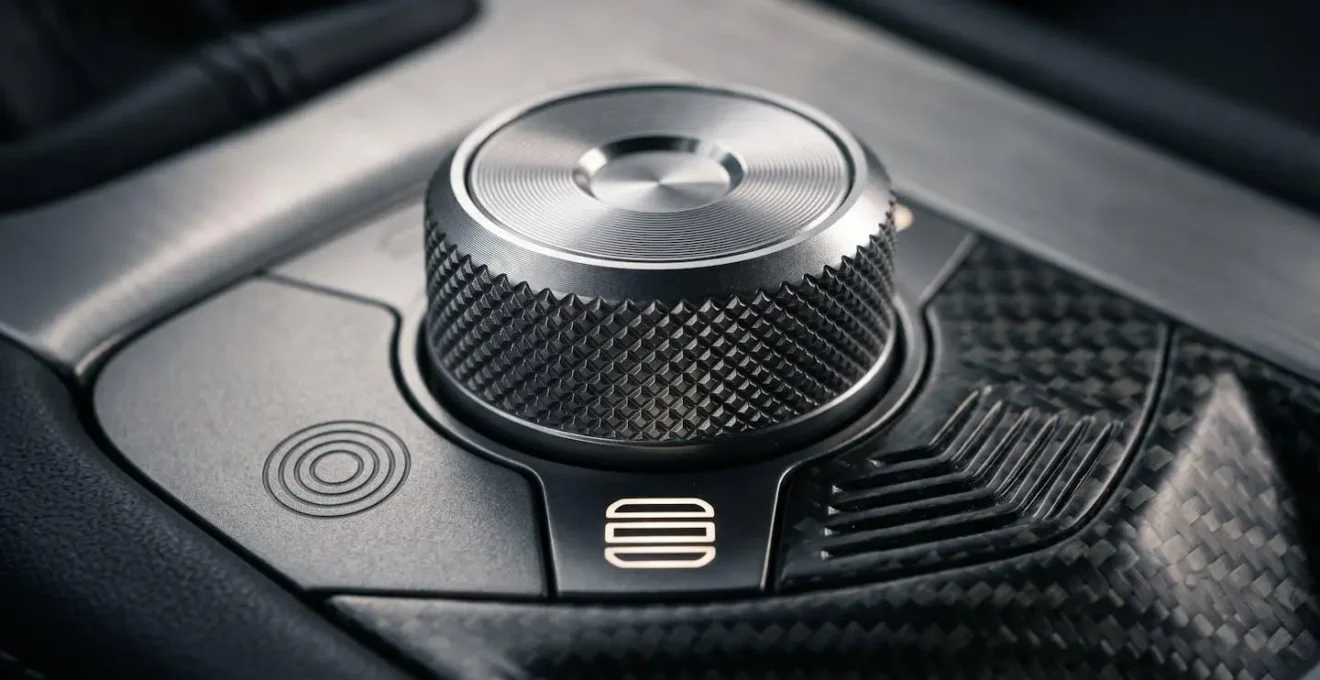
As you can see, these modes offer a tailored experience. In « Track » mode, the system may only intervene to prevent a full spin, allowing the driver to use significant slides as a tool for cornering. In essence, a family car’s ESC is a strict guardian, while a sports car’s ESC is more of a permissive instructor, trusting the driver’s skill while still providing a crucial safety net if things go too far.
The Snow Driving Scenario Where Disabling Stability Control Gets You Home Faster
The standing advice is clear: leave your electronic safety systems on. They are remarkably effective in low-grip conditions. In fact, specific research published in Traffic Injury Prevention found a 49.2% reduction in serious or fatal crashes on snow and ice-covered roads for cars equipped with ESC. The system is a powerful ally when you’re moving. But there is one very specific and widely misunderstood scenario where temporarily disabling it is not only necessary but recommended by manufacturers: when you are completely stuck.
Traction Control (TC) and Electronic Stability Control (ESC) work by detecting wheelspin and then reducing engine power or applying the brakes to stop it. This is exactly what you want when you’re driving, as it helps the tyres find grip. However, when your car is bogged down in deep snow, mud, or sand, you need the opposite. To get moving, you often require a degree of controlled wheelspin to dig through the loose surface and find a layer of something firmer underneath. In this situation, the traction control system sees the spinning wheels, assumes you’re in a dangerous slide, and cuts the power—precisely when you need it most. This keeps you stuck.
This is why most cars have a button to disable traction control (often marked « TC, » « ESC Off, » or with the icon of a car with squiggly lines and the word « OFF »). As experts at Kelley Blue Book confirm, this is its primary intended use.
The only time you should turn off traction control is in rare situations like getting stuck in mud, sand, snow, or ice.
– Kelley Blue Book, Traction Control System: How it Works and When to Use It
By turning the system off, you allow the wheels to spin, potentially clearing the snow and giving you the momentum to get free. The crucial rule is to re-enable the system immediately once you are back on solid ground and moving again. Disabling it to get unstuck is a specific tool; driving without it on a slippery road removes your most important safety net.
How to Make Emergency Steering Manoeuvres That Work With Your Stability Control?
Understanding your car’s stability control is one thing; working with it in a genuine emergency is another. These systems are designed to assist a driver’s inputs, not override them completely. The most effective emergency technique is not to fight the system, but to give it clear, decisive commands that it can then assist. The golden rule taught by advanced driving instructors is « Look, Stomp, Steer. »
First, look where you want to go, not at the hazard. This is a fundamental principle of vehicle control called target fixation. Your hands will instinctively follow your eyes. If you stare at the obstacle, you are far more likely to steer into it. Instead, identify your escape route and fix your gaze on it. Second, stomp on the brake pedal—hard. Do not pump the brakes. Modern cars are all equipped with an Anti-lock Braking System (ABS). Your job is to apply maximum, consistent pressure to the pedal and let the ABS do its job of preventing the wheels from locking up. This allows you to brake and steer simultaneously, which is critical.
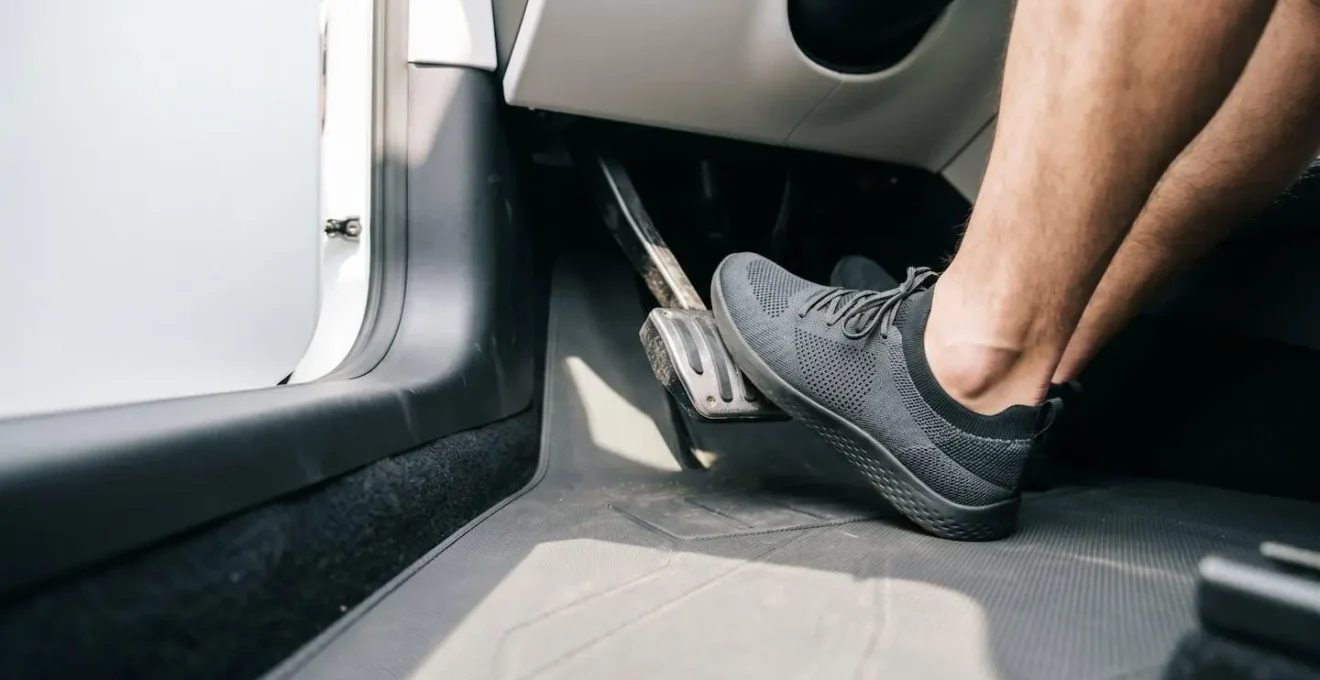
Finally, steer smoothly and decisively around the obstacle. Because you are braking hard, you are keeping the car’s weight transferred to the front wheels, maximising their grip for steering. The ESC system will monitor your steering input, the car’s rotation, and individual wheel speeds. If it detects the beginning of a skid as you swerve, it will apply its corrective braking to keep the car stable and pointed towards your target. By giving the car clear braking and steering inputs, you are providing the electronic co-pilot with the information it needs to help you most effectively.
Your Action Plan for Mastering Emergency Manoeuvres
- Identify Safe Practice Areas: Find a large, empty car park or a certified driving course. Never practice on public roads.
- Feel the ABS: Under safe conditions (below 30 mph), perform a straight-line emergency stop. Feel the pulsing sensation through the brake pedal as the ABS activates. Get used to this feeling.
- Practice Smooth Swerving: Set up soft markers (like cardboard boxes) and practice the « Look, Stomp, Steer » manoeuvre at low speeds, focusing on smooth steering inputs while braking.
- Analyse the Feedback: Pay attention to the dashboard. Did the ESC light flash? Can you feel the subtle corrections? Learn to recognise the system’s feedback as a positive confirmation.
- Integrate into Daily Driving: Apply the principle of looking where you want to go in all your driving. This builds the muscle memory needed for an emergency.
Why Does Your Car Feel Like It Hesitates When Pulling Out on a Wet Roundabout?
The sensation of hesitation when accelerating from a stop, particularly when turning onto a wet roundabout, is another classic case of a safety system being misinterpreted as a fault. This is not a problem with your engine or gearbox; it is your Traction Control (TC) system doing its job perfectly. The core reason lies in the concept engineers call the « grip budget. » Your tyres have a finite amount of grip, and on a wet surface, that budget is dramatically reduced. Indeed, testing by the American Automobile Association (AAA) revealed that a car’s stopping distance on wet pavement can increase by as much as 87 feet from 60 mph, a stark illustration of just how little grip is available.
When you are pulling onto a roundabout, you are asking your front tyres to do two things at once: accelerate and steer. This combined demand can easily exceed the reduced grip budget of the wet tarmac. The Traction Control system, which constantly monitors wheel speed, detects that the driven wheels are starting to spin faster than the non-driven ones—the very first sign of traction loss. As Debbie Hersman, former head of the National Safety Council, noted, the system’s entire purpose is to prevent this loss of control.
To prevent a skid, the TC system intervenes instantly. It does this primarily by reducing engine power or, in some cases, by applying the brake to the spinning wheel. This reduction in power is what you feel as a « hesitation » or a « bogging down » of the engine. It feels like the car isn’t responding, but in reality, the system is momentarily overriding your throttle input to allow the tyre to regain traction. Once grip is restored, which usually takes less than a second, it returns full power. This intervention is most noticeable on front-wheel-drive cars, where the same wheels are responsible for both steering and acceleration.
Warning Beep or Steering Intervention: Which Lane System Actually Prevents Accidents?
As automotive safety technology has evolved, systems designed to prevent lane-departure accidents have split into two main philosophies: passive warning and active intervention. Understanding the difference is key to appreciating why that feeling of steering resistance is so much more effective than a simple alert. The two primary systems are Lane Departure Warning (LDW) and Lane Keeping Assist (LKA).
Lane Departure Warning (LDW) is a passive system. It uses cameras to monitor lane markings and will issue an audible beep, a visual alert on the dashboard, or a vibration in the steering wheel if it detects the vehicle is unintentionally drifting out of its lane. The system’s role is purely informational; it warns the driver, but relies entirely on the driver to take corrective action. While helpful, its effectiveness is limited by driver reaction time and attentiveness. Nevertheless, IIHS research demonstrates it delivers an 11% reduction in all crashes and a 21% reduction in injury crashes.
Lane Keeping Assist (LKA), on the other hand, is an active system. It provides the same warnings as LDW, but if the driver does not respond, it will take the next step: it actively applies a small amount of steering torque to gently guide the car back to the centre of the lane. This physical nudge is the same type of intervention feeling discussed earlier. It is a direct, tangible action, not just a suggestion. The difference in real-world effectiveness is significant, as this direct comparison shows.
| System Feature | Lane Departure Warning (LDW) | Lane Keeping Assist (LKA) |
|---|---|---|
| Safety Type | Passive (driver-dependent) | Active (system intervention) |
| How It Works | Alerts driver via beep, vibration, or visual warning | Automatically applies steering correction |
| Crash Reduction | 11% all crashes, 21% injury crashes | 60% target crash reduction (Virginia Tech) |
| Driver Engagement | Requires prompt driver reaction | Physical intervention if driver doesn’t respond |
| Alert Fatigue Risk | High – drivers may disable due to annoyance | Lower – tiered approach (warn then intervene) |
The data is clear: while a warning is better than nothing, an active steering intervention is substantially more effective at preventing accidents. The primary reason is that it bridges the critical gap between alert and action, providing a physical safeguard when a driver is distracted or drowsy. It’s the difference between a passenger pointing out a problem and a co-pilot actively helping to solve it.
Key takeaways
- The « fighting » sensation in your steering is almost always your car’s ESC system applying corrective braking to prevent a skid, a sign that it’s working correctly.
- The sensitivity of these systems is intentionally calibrated. Family cars have low intervention thresholds for maximum safety, while sports cars allow more slip for performance driving.
- Wet roads drastically reduce your tyres’ « grip budget, » making safety system interventions like traction control hesitation much more frequent and necessary.
Why Does Traction Control Save 25% More Lives on Wet UK Roads Than Dry?
While the title’s « 25% » is a conceptual figure, the underlying engineering truth is undeniable: Electronic Stability and Traction Control systems are significantly more effective, and therefore save proportionally more lives, in wet conditions than in dry ones. This isn’t because the system works better in the rain, but because the driving environment becomes exponentially more dangerous, making the system’s role far more critical. The data on this is compelling; early Swedish research published in PubMed documented that ESC had an effectiveness of 56.2% on wet roads compared to just 22.3% on dry roads in preventing crashes.
The primary reason is the dramatic reduction of the « grip budget » we’ve discussed. On a dry road, a modern tyre has an abundance of grip. It takes extreme speed or a violent manoeuvre to unstick it. In these conditions, ESC interventions are rare. However, the moment rain falls, the layer of water between the tyre and the road acts as a lubricant, slashing the available grip. Suddenly, manoeuvres that were perfectly safe in the dry—like moderate acceleration on a roundabout or a slightly-too-fast approach to a corner—can push the tyres beyond their limit.
This is compounded by a dangerous psychological factor: drivers are often less respectful of rain than they are of more visibly hazardous conditions like snow or ice. This leads to them driving too fast for the conditions, creating a perfect storm for traction loss.
Case Study: The Underestimated Danger of Rain
A comprehensive analysis of a decade of weather-related crash statistics by the US National Highway Traffic Safety Administration (NHTSA) revealed a startling fact. The data, referenced by sources like Edmunds, found that 46% of all weather-related crashes occurred during rainfall. This is in stark contrast to just 17% during snow or sleet. This highlights that the sheer frequency of rain, combined with drivers’ failure to adjust their habits, makes wet roads the most common low-grip hazard drivers face. Therefore, the safety net provided by traction control is called upon far more often in the rain, preventing countless low-level skids from escalating into accidents.
In the context of the UK’s notoriously damp climate, these systems are working overtime. They are constantly managing the reduced grip budget, making micro-corrections to prevent skids. Each time you feel that hesitation or steering nudge on a wet road, it’s a quiet, life-saving intervention. The system saves more lives in the wet simply because it has so many more opportunities to do so.
The next time you feel that subtle correction through the steering wheel or the brief hesitation from the engine, you will not feel alarm. Instead, you can feel the confidence of a well-engineered partnership at work, knowing your digital co-pilot is silently and effectively keeping you safe on the road.