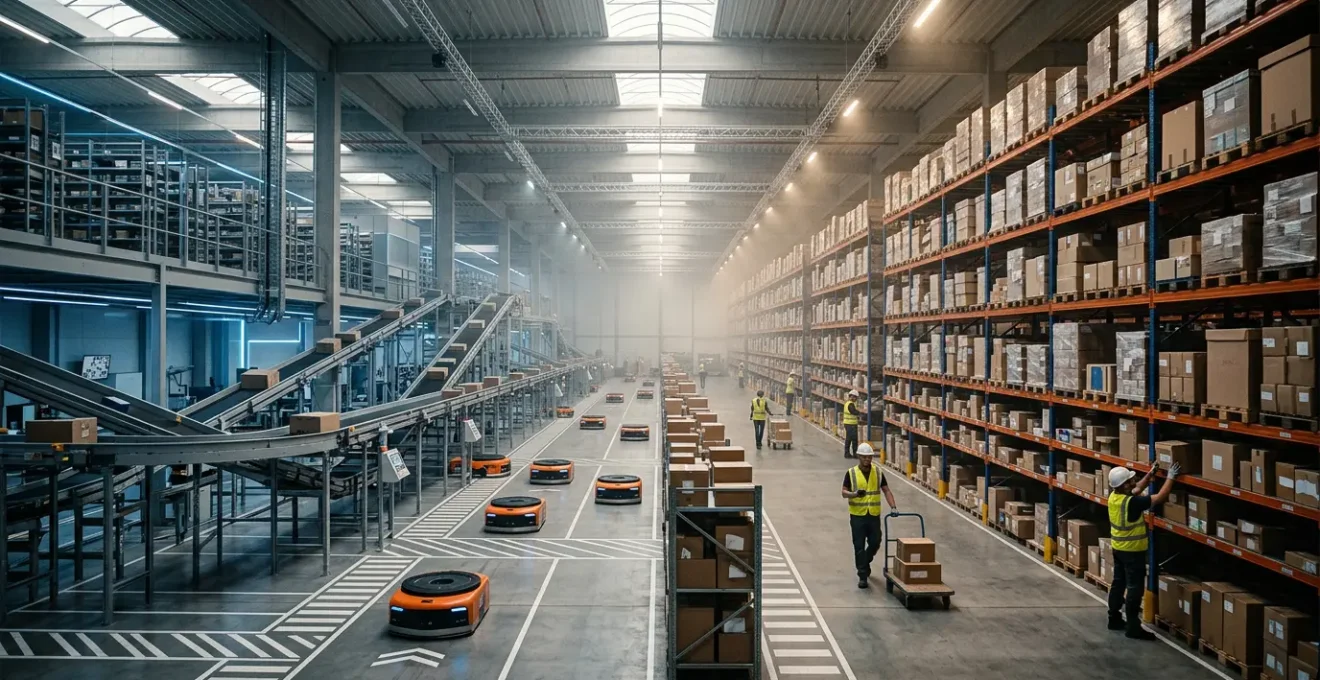
Closing the ‘Amazon Gap’ is achieved not by replicating their budget, but by surgically applying automation to your single biggest operational bottleneck.
- Return on investment is fastest when automation directly targets a measurable weakness, such as pick accuracy or picker travel time.
- Significant gains are possible with targeted, low-cost technologies before committing to six-figure, facility-wide systems.
Recommendation: Begin with a data-driven audit to identify your primary bottleneck, then deploy a phased automation strategy starting with the highest-impact, lowest-risk solution.
It’s a familiar frustration for any UK warehouse operator. You place a personal order on Amazon in the morning, and the package arrives that evening. Meanwhile, an order placed with your own company two days ago is still sitting in the ‘awaiting picking’ queue. This performance disparity, the ‘Amazon Gap’, feels insurmountable, a chasm created by billions in technology investment. The common advice is to « invest in automation, » a vague platitude that often conjures images of multi-million-pound robotic systems, a daunting prospect for most distribution centres.
The conversation quickly turns to a binary choice: either remain in the manual, slower-paced world or find the capital for a complete technological overhaul. But this framing is flawed. It overlooks the strategic, incremental path that most successful operations take. The goal is not to become Amazon overnight, but to methodically close the efficiency gap by making intelligent, data-driven decisions about technology.
The key isn’t a blank cheque for robotics. The true breakthrough comes from shifting perspective: from « we need automation » to « where is our single biggest bottleneck, and what is the most precise, cost-effective tool to solve it? » This is the principle of bottleneck-specific automation. It’s about identifying whether your primary issue is picking accuracy, travel time, order sorting, or packing speed, and applying a solution with a clear and rapid return on investment.
This guide moves beyond the generic advice. We will dissect the financial thresholds where automation pays for itself, compare the right technologies for your facility’s footprint, uncover the low-cost strategies that yield major accuracy gains, and expose the hidden operational risks—like training—that can derail even the most promising projects. We’ll explore how your network strategy impacts delivery speed and, finally, break down why that last mile is so costly, providing a clear roadmap for your own automation journey.
This article provides a comprehensive framework for evaluating and implementing warehouse automation. Explore the sections below to understand the critical decision points that can transform your operational efficiency.
Summary: Why Does Amazon Ship Same-Day When Your Warehouse Takes 3 Days to Pick the Same Order?
- When Does a £500,000 Automated Storage System Pay Back Faster Than Hiring 10 Pickers?
- Goods-to-Person Robots or Conveyor Systems: Which Fits a 10,000 Sq Ft Facility?
- How to Triple Pick Accuracy for £15,000 Without Full Warehouse Automation?
- The Training Gap That Causes 40% of Warehouse Automation Projects to Underperform?
- When to Start Your Warehouse Automation Project: The April Installation Window?
- One Mega-Warehouse or Five Regional Hubs: Which Cuts Delivery Times by 40%?
- How to Cut 30% of Delivery Miles by Clustering Postcodes Intelligently?
- Why Does Last-Mile Delivery Account for 53% of Total Shipping Costs?
When Does a £500,000 Automated Storage System Pay Back Faster Than Hiring 10 Pickers?
The decision to invest in an Automated Storage and Retrieval System (ASRS) versus continuing to hire manual labour pivots on a critical financial metric: the ROI threshold. This isn’t just about comparing the system’s cost to annual salaries. A comprehensive analysis reveals a much faster payback when you factor in the hidden costs of manual operations and the compounding benefits of automation. Ten pickers might cost around £250,000-£300,000 annually in salaries, national insurance, and recruitment fees, suggesting a simple two-year payback. However, this calculation is incomplete.
The true cost of manual picking includes picking errors (requiring costly reverse logistics), lower throughput during peak times, workplace injuries, and high staff turnover. An ASRS addresses these issues directly. It can operate 24/7 with near-perfect accuracy, dramatically increasing order fulfillment capacity within the same physical footprint. The system doesn’t get sick, require training for new SKUs, or slow down at the end of a shift. These efficiency gains directly translate into higher revenue potential and lower operational risk.
The payback accelerates significantly when you reach a certain order volume and inventory complexity. For a facility processing thousands of orders per day with a large number of SKUs, the speed and accuracy of an ASRS unlock efficiencies that are simply unattainable with a manual workforce. While many businesses report achieving a return on investment within 18-24 months, the true ‘faster than hiring’ threshold is crossed when the cost of *inaccuracy* and *inefficiency* from your manual team exceeds the amortized monthly cost of the automated system. It’s a shift from viewing labour as an asset to viewing manual repetition as a liability.
Goods-to-Person Robots or Conveyor Systems: Which Fits a 10,000 Sq Ft Facility?
For a compact 10,000 sq ft facility, the choice between Goods-to-Person (GTP) robotics and traditional conveyor systems is a classic battle of flexibility versus fixed infrastructure. Conveyors are powerful for moving high volumes of uniform items along a predictable, unchanging path. They are the arteries of a mass-production environment. However, their permanence is also their greatest weakness in a smaller, dynamic warehouse where product lines change, and layouts may need to adapt to seasonal demand.
This is where Autonomous Mobile Robots (AMRs), a primary form of GTP technology, offer a decisive advantage. Instead of bolting a rigid system to the floor, AMRs navigate using sensors and digital maps. This provides unparalleled flexibility. If your business pivots to a new product category, you don’t need to rip out and reinstall conveyor lines; you simply update the robots’ software and adjust the layout of your mobile shelving units. For a smaller facility, this adaptability is crucial for future-proofing your operation.
As the illustration highlights, the AMR operates within an open, adaptable space, while the conveyor creates a fixed, rigid structure. Financially, the case for AMRs in this context is compelling. They can be deployed in phases, starting with a small fleet and scaling up as your order volume grows. This avoids a massive upfront capital expenditure. In suitable deployments, it’s not uncommon for autonomous mobile robots to deliver payback in under 24 months with a 250%+ ROI. For a 10,000 sq ft facility, where space is a premium and agility is a competitive advantage, the flexible, scalable nature of GTP robots almost always outweighs the rigid efficiency of a traditional conveyor system.
How to Triple Pick Accuracy for £15,000 Without Full Warehouse Automation?
The pursuit of 99.9% pick accuracy doesn’t have to begin with a six-figure investment. The ‘Amazon Gap’ can be narrowed significantly by deploying targeted, low-cost technologies that augment your existing workforce, not replace it. This is the essence of phased deployment: securing immediate, high-impact wins that build the operational and financial case for future, larger-scale projects. For an investment under £15,000, you can implement a combination of tools that directly attack the root causes of picking errors: misidentification, distraction, and fatigue.
Instead of thinking about full robotics, consider technologies that act as a « digital co-pilot » for your pickers. Systems like voice-picking direct workers via headset with clear, verbal instructions, confirming each action with a spoken code. This keeps their hands and eyes free, boosting both speed and accuracy. Similarly, ring scanners or pick-to-light systems guide staff directly to the correct bin and confirm the right item has been picked with a simple scan or button press. These are not revolutionary concepts, but their cumulative impact on accuracy is profound.
The secret is to apply these tools surgically. Use the 80/20 rule: identify the 20% of your SKUs that account for 80% of your picking activity and focus your initial investment there. A targeted pick-to-light installation in your fast-mover aisle can have a greater impact on overall accuracy than a thinly spread, facility-wide system. By combining these hardware upgrades with better data management, you can achieve dramatic improvements in a single quarter. Industry data shows that such systems can improve fulfillment speeds by up to 300%, and the effect on accuracy is just as significant.
Action Plan: Low-Cost Accuracy Boosts Under £15,000
- Implement Voice-Picking or Ring Scanners: Augment picker accuracy and reduce fatigue by deploying hands-free systems. This keeps eyes on the product, not on a paper list or screen. (Typical Investment: £5,000-£8,000).
- Deploy Basic Slotting Software: Reorganize inventory based on sales velocity using an affordable SaaS tool. This dramatically reduces picker travel time and the chance of picking from incorrect adjacent locations. (Typical Investment: £200-£500/month subscription).
- Install Targeted Pick-to-Light Systems: Focus on high-velocity zones, covering the 20% of SKUs that account for 80% of sales, to guide pickers with light-up displays. (Typical Investment: £8,000-£12,000 for a targeted zone).
- Invest in Data Hygiene: Clean and validate product and location data within your existing WMS. A one-time consultancy can eliminate the data errors that lead to mis-picks down the line. (Typical Investment: £3,000-£5,000 fee).
The Training Gap That Causes 40% of Warehouse Automation Projects to Underperform?
The most sophisticated robotic system is destined to become expensive warehouse sculpture if the team on the floor doesn’t have the skills to operate, maintain, and adapt to it. The focus of many automation projects is almost entirely on the technology’s capabilities, with training treated as an afterthought—a one-day session on « how to press the green button. » This creates a dangerous operational readiness gap, a primary reason why, according to MHI research, a staggering 76% of logistics transformation projects fail to deliver their expected ROI.
The training gap is not just about basic operation. It’s a chasm that covers three critical areas. First is maintenance and first-line support. When a robot has a minor fault, do you have to wait four hours for an external technician, or do you have an on-site team member trained to diagnose and resolve common issues in minutes? This difference is the margin between seamless operation and crippling downtime. Second is process adaptation. Automation changes workflows. Your team needs to understand not just the robot, but how their role *around* the robot has changed—from how they prep goods to how they handle exceptions.
The third, and most overlooked, area is data interpretation. Modern automation systems generate a wealth of performance data. The real value is unlocked when your supervisors and managers can interpret this data to identify emerging bottlenecks, optimize system performance, and make informed decisions. Without this skill set, you are only using a fraction of the system’s intelligence. Bridging this training gap requires a continuous development mindset, moving from one-off training events to an ongoing program of upskilling.
Investing in your people is as critical as investing in the hardware. Creating « super-users, » developing in-house maintenance skills, and fostering a culture of data-driven process improvement are the intangible assets that ensure your automation project lands in the successful 24%, not the underperforming majority.
When to Start Your Warehouse Automation Project: The April Installation Window?
In warehouse operations, timing is everything—and this applies as much to project implementation as it does to order fulfillment. Choosing when to begin a major automation project is a strategic decision that can significantly impact its cost, timeline, and ultimate success. While there’s no single universal date, the period immediately following the first quarter, particularly around April, often presents a strategic « installation window » for many UK businesses, especially in e-commerce and retail.
The logic is rooted in the annual operational rhythm of the logistics industry. Quarter 4 is the Black Friday and Christmas peak, a period where any disruption is catastrophic. Quarter 1 is often dedicated to managing the aftermath: processing returns, conducting stocktakes, and recovering from the peak season burnout. During this time, operational teams have little bandwidth for a major system overhaul. This makes Q2, and specifically April, an ideal moment to act. The post-peak chaos has subsided, but the ramp-up for the summer and the next peak season hasn’t yet begun.
Starting in April allows for a more controlled implementation. Your internal team is more available to participate in planning and training. Vendors and installers often have better availability outside of the year-end rush. Crucially, it provides a buffer period of several months to install, test, and troubleshoot the new system during a period of relatively stable order volume. This allows you to work out any kinks and get your team fully proficient with the technology long before the pressure of the next Q4 peak begins to build. Launching a new system in September or October is a high-risk gamble; launching it in April is a calculated, strategic move.
One Mega-Warehouse or Five Regional Hubs: Which Cuts Delivery Times by 40%?
The structure of your fulfillment network is a fundamental lever for controlling delivery speed and cost. The debate between a centralized « mega-warehouse » and a decentralized network of smaller, regional hubs is a core strategic choice. A single, massive facility offers economies of scale: consolidated inventory, streamlined management, and the potential for large-scale automation. However, it also means that a parcel destined for Scotland might start its journey in the Midlands, adding significant time and mileage to its transit.
A network of five regional hubs fundamentally changes this dynamic. By positioning inventory closer to the end customer, you drastically reduce the final transit leg, making next-day or even same-day delivery a viable reality without relying on expensive express air freight. This model directly addresses the modern consumer’s expectation of speed. While it introduces the complexity of managing inventory across multiple sites, the payoff in delivery time reduction—often in the range of 40% or more for distant postcodes—can be a powerful competitive advantage.
From an automation perspective, the regional hub model is increasingly viable. It’s a common misconception that automation is only for vast, million-square-foot facilities. In fact, medium-sized facilities are a hotbed for automation investment. As Mordor Intelligence points out, these sites are the sweet spot for many technologies.
These facilities are large enough to justify the capital investment and see meaningful throughput gains, but not so large that complexity overwhelms project teams.
– Mordor Intelligence Market Analysis, Warehouse Automation Statistics, Market Size & ROI Data
This makes the regional hub strategy more powerful than ever. You can equip each hub with targeted, right-sized automation—like AMRs or pick-to-light systems—to ensure high efficiency without the colossal capital outlay required for a single, hyper-automated mega-warehouse. The result is a network that is both fast and efficient, optimized for the new era of e-commerce.
How to Cut 30% of Delivery Miles by Clustering Postcodes Intelligently?
Reducing delivery miles isn’t just about finding the shortest path between two points; it’s about fundamentally re-engineering how orders are grouped and sequenced before a single van leaves the depot. Intelligent postcode clustering is the process of using data to group geographically close orders together into the most efficient delivery routes. This goes far beyond a driver’s intuition or a simple A-to-Z drop sequence. It’s a data science problem that, when solved, can slash fuel costs, increase the number of drops per shift, and significantly reduce your carbon footprint.
The core issue that this strategy solves is delivery density. A poorly planned route might see a driver crisscross the same town multiple times, covering miles unnecessarily. This is incredibly inefficient, with some research indicating that out-of-route miles typically account for 10% of total mileage. Modern route optimization software tackles this by using algorithms to analyze all of the day’s orders simultaneously. It considers not just location but also traffic patterns, delivery time windows, and vehicle capacity to create the optimal cluster of drops for each route.
The impact is substantial. By ensuring that vans are packed in the correct drop sequence and that routes are geographically tight, companies can eliminate wasted mileage and time. This efficiency allows drivers to complete more deliveries in the same amount of time, directly boosting productivity. The financial benefits are clear; for instance, data from DHL’s Greenplan dynamic routing algorithm demonstrates a 20% reduction in delivery costs and associated CO2 emissions. For any operation running its own delivery fleet, investing in intelligent clustering and routing software offers one of the fastest and most significant returns on investment in the entire logistics chain.
Key Takeaways
- Focus on bottleneck-specific ROI; apply automation surgically to your biggest pain point for the fastest payback.
- Begin with low-cost, high-impact wins in areas like picking accuracy to build momentum and a financial case for larger projects.
- The success of any automation project depends as much on operational readiness—team training, data skills, and maintenance—as on the technology itself.
Why Does Last-Mile Delivery Account for 53% of Total Shipping Costs?
The final journey of a parcel—from the local distribution hub to the customer’s front door—is disproportionately the most complex and expensive stage of the entire supply chain. It’s the moment where the efficiencies of bulk transport are lost. Instead of one lorry carrying 2,000 parcels to a single address, you have dozens of vans making individual stops, each one a unique logistical event. This fragmentation is the primary reason why, according to MIT Sloan Management Review research, last-mile expenses can account for up to 53% of total shipping costs.
Several factors converge to create this high cost. The single largest component is labour; with industry analysis revealing that labor accounts for roughly 50% of last-mile expenses. Unlike a highly automated warehouse, the final delivery is heavily reliant on a driver navigating traffic, finding parking, and locating the correct address. This is a time-consuming, manually intensive process. Add to this the cost of fuel, vehicle maintenance, and insurance, and the expense per parcel quickly escalates.
Furthermore, the last mile is fraught with potential for failure, and each failure carries a significant price tag. A customer not being home to receive a package is not a minor inconvenience; it’s a costly breakdown in the process. The parcel must be returned to the depot, re-processed, and scheduled for another delivery attempt, effectively doubling the cost for that order. In fact, operational data shows that one failed delivery can cost retailers an average of $17.20 per order. When you multiply this by hundreds or thousands of orders, it becomes clear why taming last-mile costs is a top priority. Every efficiency gained upstream—in the warehouse through automation, better slotting, and intelligent routing—is ultimately an investment in making this final, most expensive leg of the journey as smooth and successful as possible.
To begin closing your own efficiency gap, the next logical step is a detailed audit of your specific operational bottlenecks. Evaluate your current processes to identify the single greatest opportunity for a targeted automation investment.