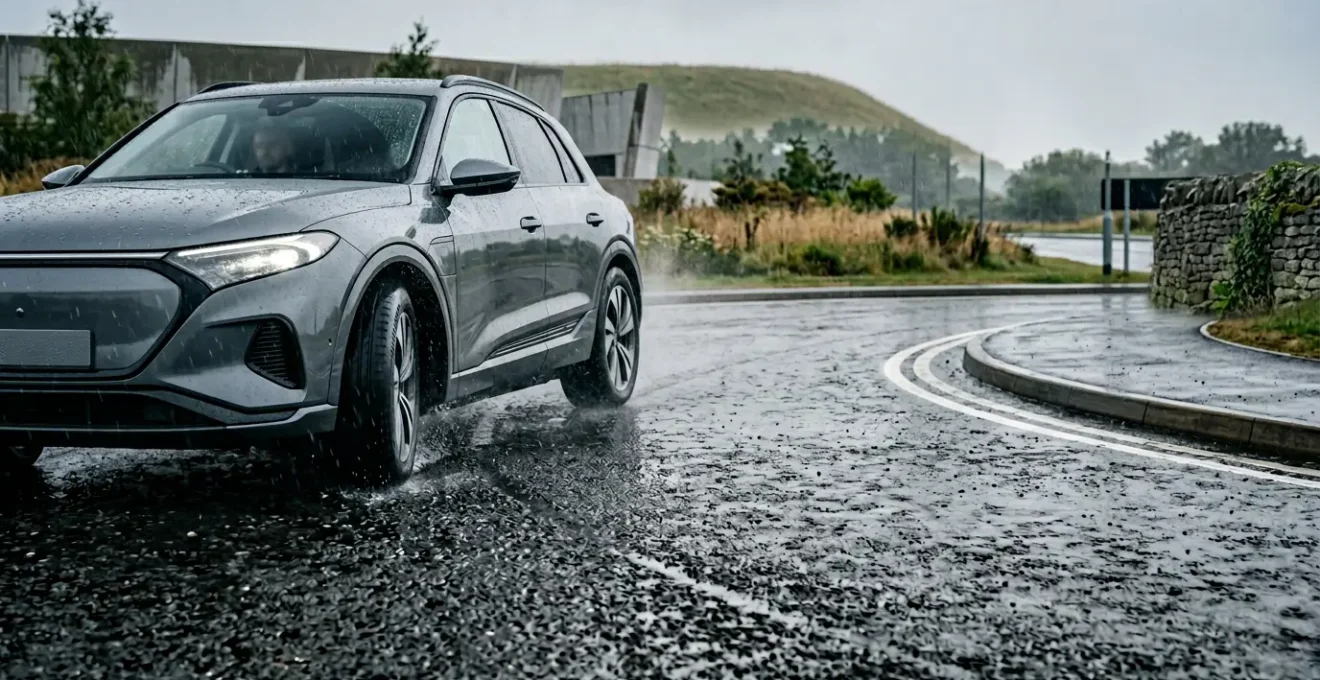
That unnerving hesitation from your car when accelerating on a wet roundabout isn’t a fault; it’s the most critical moment of a life-saving intervention. Many drivers mistake this calculated power reduction for a system failure. This article explains, from an engineering perspective, that traction control is not simply preventing wheelspin—it’s actively managing your tyre’s ‘grip budget’ every millisecond to keep you from losing control, making it an indispensable co-pilot in British weather.
You feel it every time. You’re at the give-way line of a typically slick British roundabout, a gap in traffic appears, and you press the accelerator. Instead of a smooth pull-away, the car bogs down, hesitates, and feels like it’s lost all power for a critical second. Your first thought is often « What’s wrong with this car? ». This feeling, this perceived flaw, is one of the most misunderstood and important safety interactions in modern motoring. It’s the moment your car’s traction control system acts as a digital co-pilot, making a split-second decision to save you from a potential loss of control.
The common understanding is that traction control is just a feature for snow. While true, this simplifies its most vital role, especially on the perennially damp roads of the UK. We often fail to appreciate the complex physics at play. Every tyre has a finite amount of grip—a ‘grip budget’—that it can spend on accelerating, braking, or turning. On a wet surface, that budget is drastically reduced. The hesitation you feel is the system making a crucial executive decision: it’s a calculated intervention to prevent you from overspending your grip budget on acceleration, which would leave you with nothing for steering, leading directly to a skid.
But if this system is so smart, why does it feel so intrusive? And when, if ever, should you override its decisions? This article moves beyond the simple « it stops wheelspin » explanation. We will decode the ‘thinking’ process of your car’s electronic stability systems. We will explore why that hesitation is a sign of it working perfectly, when you might genuinely need to disable it, and how the technology differs from a budget hatchback to a premium saloon. By understanding the unseen engineer in your car, you transform from a passive occupant into an informed driver who collaborates with the technology for ultimate safety.
To navigate this complex but crucial topic, this guide breaks down the functions, nuances, and real-world applications of your car’s stability systems. The following sections provide a clear roadmap to understanding the electronic guardians that watch over every drive.
Summary: The Unseen Engineer: Your Guide to Vehicle Stability Systems
- Why Does Your Car Feel Like It Hesitates When Pulling Out on a Wet Roundabout?
- Snow, Mud, or Gravel: When Should You Actually Turn Off Traction Control?
- Budget Car or Premium: Does More Expensive Traction Control Actually Work Better?
- The Dashboard Light That Means Your Traction Control Stopped Working Last Month
- How to Drive Safely After Switching From a Modern Car to One Without Stability Control?
- Why Does Your Car Feel Like It Fights You During Emergency Lane Changes?
- Why Does Your Car Beep Aggressively When the Vehicle Ahead Brakes Sharply?
- Why Does Your Steering Wheel Suddenly Resist When You Change Lanes Quickly?
Why Does Your Car Feel Like It Hesitates When Pulling Out on a Wet Roundabout?
That feeling of hesitation is not a sign of engine trouble; it is the traction control system (TCS) performing its primary function with surgical precision. On a wet surface, your tyres have significantly less grip. When you accelerate to join traffic, the system’s wheel speed sensors detect that one of the driven wheels is beginning to spin fractionally faster than the others—the very first sign of a loss of traction. Before this spin can develop into a skid or a slide, the system intervenes. This is not a guess; it’s a calculation based on hard data from the sensors.
The intervention itself has two forms. Primarily, the engine control unit (ECU) is instructed to reduce engine torque. This is the « hesitation » you feel—a deliberate, temporary reduction in power to a level the tyres can actually handle without slipping. It feels slow, but it’s infinitely faster and safer than the alternative: the car lurching sideways into another lane. In more advanced systems, the brakes may also be applied to the single spinning wheel to redirect power to the wheel with grip. This entire process happens in milliseconds, far quicker than any human could react. This is not a system for novices; it’s a system that out-performs even professional drivers in preventing low-grip incidents.
The extreme effectiveness of these systems, especially in wet conditions, is undeniable. While the 25% figure in the title highlights the difference, the overall impact is even more profound. In fact, research from Sweden demonstrates that ESC reduced serious and fatal loss-of-control crashes by 56%. That hesitation you feel is the system actively placing your car on the right side of those statistics.
The component responsible for this instantaneous detection is a marvel of engineering, the wheel speed sensor. Its precision allows the system to react before a skid even begins.
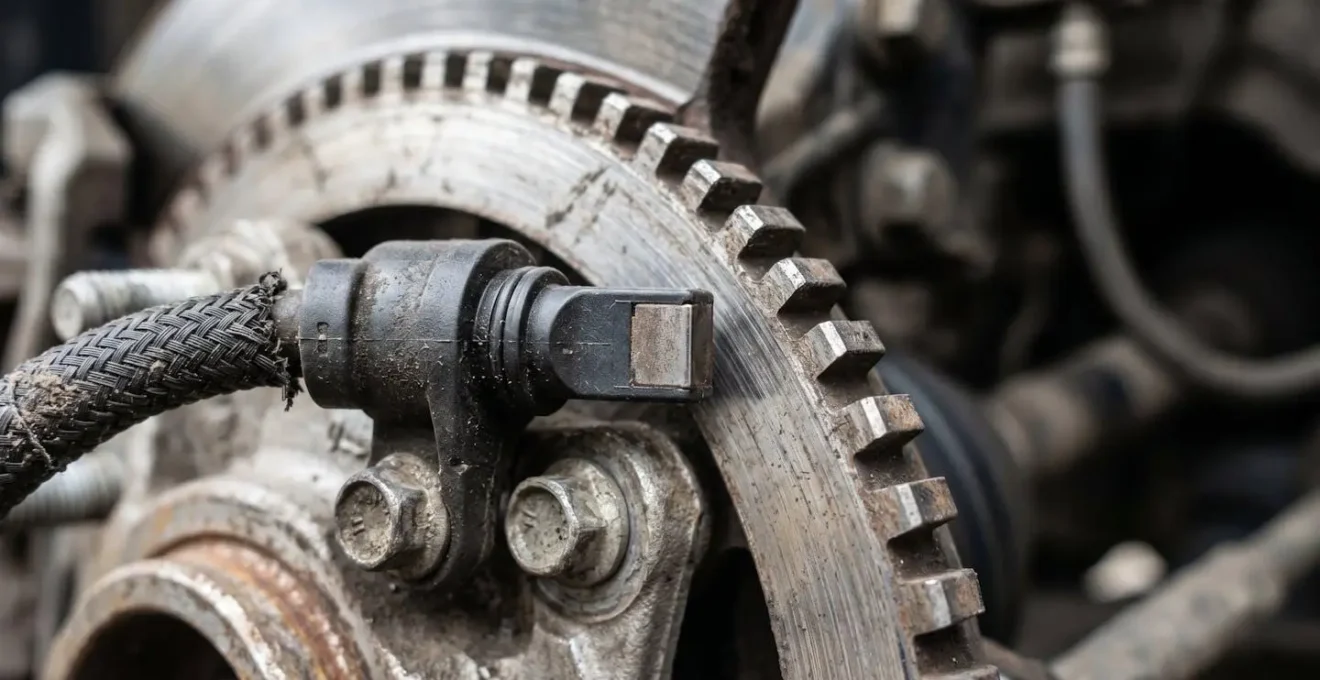
As you can see, the sensor works in close proximity to the rotating components of the wheel assembly. It constantly monitors rotational speed, providing the data that forms the basis of every decision the traction and stability control systems make. It’s the car’s sense of touch, feeling the road surface through the tyre.
Snow, Mud, or Gravel: When Should You Actually Turn Off Traction Control?
The default advice is to never touch the traction control button, often depicted with an icon of a car with squiggly lines behind it. For 99% of on-road driving, this is correct. Disabling the system on a public road is removing a vital safety net. However, the system is designed for paved surfaces where wheelspin is always the enemy. There are specific, low-speed, off-road situations where controlled wheelspin is not just acceptable, but necessary. These are the rare moments when you, the driver, have more context about the situation than the car’s computer.
The most common scenario is trying to get unstuck. Imagine your car is in deep snow or thick mud. The traction control system detects wheelspin and, doing its job, cuts power. The result is that you sit there, motionless, with the engine barely ticking over. In this instance, you need the wheels to spin to dig through the soft top layer to find a firmer surface below, or to use momentum by rocking the car back and forth. By turning off the traction control, you authorise this controlled wheelspin.
As Wikipedia contributors note in their technical article on the subject, this is a fundamental limitation of the system’s logic in specific edge cases.
There are instances when traction control is undesirable, such as trying to get a vehicle unstuck in snow or mud. Allowing one wheel to spin can propel a vehicle forward enough to get it unstuck, whereas both wheels applying a limited amount of power will not produce the same effect.
– Wikipedia contributors, Traction control system article
The critical rule is to only disable the system to get moving from a standstill in these conditions and to re-enable it immediately once you are back on a stable surface. Driving at speed on a slippery road without traction control is extremely dangerous, as you no longer have that digital co-pilot to catch a slide.
Your Action Plan: When Disabling Traction Control is the Right Move
- Deep snow: When stuck in deep snow where wheels need to dig down to a firmer layer beneath the powder
- Thick mud: In situations where controlled wheelspin is necessary to clear tire treads and find traction
- Getting unstuck: When rocking the vehicle back and forth to build momentum for extraction from stuck positions
- Loose surfaces: On gravel or sand where higher slip ratios are optimal for forward progress
- After extraction: Re-enable traction control immediately once the vehicle returns to normal road surfaces
Budget Car or Premium: Does More Expensive Traction Control Actually Work Better?
Yes, unequivocally. While all new cars must have a form of stability control, the sophistication, speed, and capability of these systems vary enormously. A basic system in an entry-level city car and an advanced system in a premium executive saloon are fundamentally different, even if they share the same goal. The difference lies in the quantity and quality of the data the system receives and the range of interventions it can perform.
A basic traction control system primarily relies on comparing wheel speeds. If one wheel spins faster than the others, it cuts power or brakes that wheel. It’s a reactive system. A premium Electronic Stability Control (ESC) system is far more proactive. It’s not just looking for wheelspin; it’s trying to predict a loss of control before it happens. To do this, modern stability control systems add multiple additional sensors including steering position, yaw, and three-axis accelerometer. This suite of sensors provides a complete picture of the car’s state: where the driver is steering, how fast the car is turning (yaw), and its lateral and longitudinal movements.
The system compares the driver’s intended path (from the steering angle sensor) with the car’s actual path (from the yaw rate sensor). If there’s a mismatch—the car is starting to understeer or oversteer—it can intervene before the driver is even aware of the problem. These interventions are also more nuanced. Instead of just cutting power, it can brake a single, specific wheel to create a pivot effect that brings the car back into line. This is the difference between a blunt instrument and a surgical tool.
Premium systems also offer a level of adaptability that budget systems lack, often integrating the stability control into selectable drive modes.
Case Study: The Lincoln MKZ’s Multi-Mode System
The 2017 Lincoln MKZ illustrates how premium cars elevate traction control technology beyond basic systems. The MKZ provides a multi-mode drive system that fine-tunes stability control functions for specific driving scenarios, allowing owners to benefit from performance optimized for comfort, sport, or normal driving conditions—a level of adaptability not found in budget systems.
The Dashboard Light That Means Your Traction Control Stopped Working Last Month
There are two traction control lights, and understanding the difference is critical. The first is a flashing amber icon of a car with squiggly lines. This light is your ‘co-pilot’ telling you it’s actively intervening to prevent a skid. It’s a good thing to see on a slippery road, confirming the system is working. The second is a solid, steady amber light, often with the text « TRAC OFF, » « ESC OFF, » or a similar warning. This light is a cause for concern. It signifies that the traction and stability control systems have been disabled due to a fault.
The most common culprit behind this fault light is not a complex computer failure, but a surprisingly simple component: a faulty wheel speed sensor or its wiring. These sensors live in a harsh environment near the wheels, exposed to water, salt, and debris. A failure here is common. Because the entire stability system relies on accurate data from all four wheels, if one sensor fails, the computer can no longer trust the information it receives. In the interest of safety, its only option is to shut the entire system down to prevent making a wrong, and potentially dangerous, intervention based on bad data.
As the technical team at RepairPal highlights, the failure of this one sensor has a cascading effect across multiple vehicle safety systems.
If it detects a bad wheel speed sensor, the ABS computer will usually disable the stability and traction control systems, as well. On some vehicles, a bad wheel speed sensor may affect other functions as well, such as hill-start assist and roll stability.
– RepairPal Technical Team, Signs of a Bad ABS Wheel Speed Sensor
You might notice the light comes on intermittently at first, perhaps only after hitting a bump, before it eventually stays on permanently. This is why the solid light today could mean the system has been intermittently failing for weeks. Diagnosing it can be simple, as diagnostic testing shows that most ABS sensors measure between 1.28-1.92 K ohms, making a faulty one easy for a technician to spot. Ignoring this light means you are driving without one of your car’s most important safety features.
How to Drive Safely After Switching From a Modern Car to One Without Stability Control?
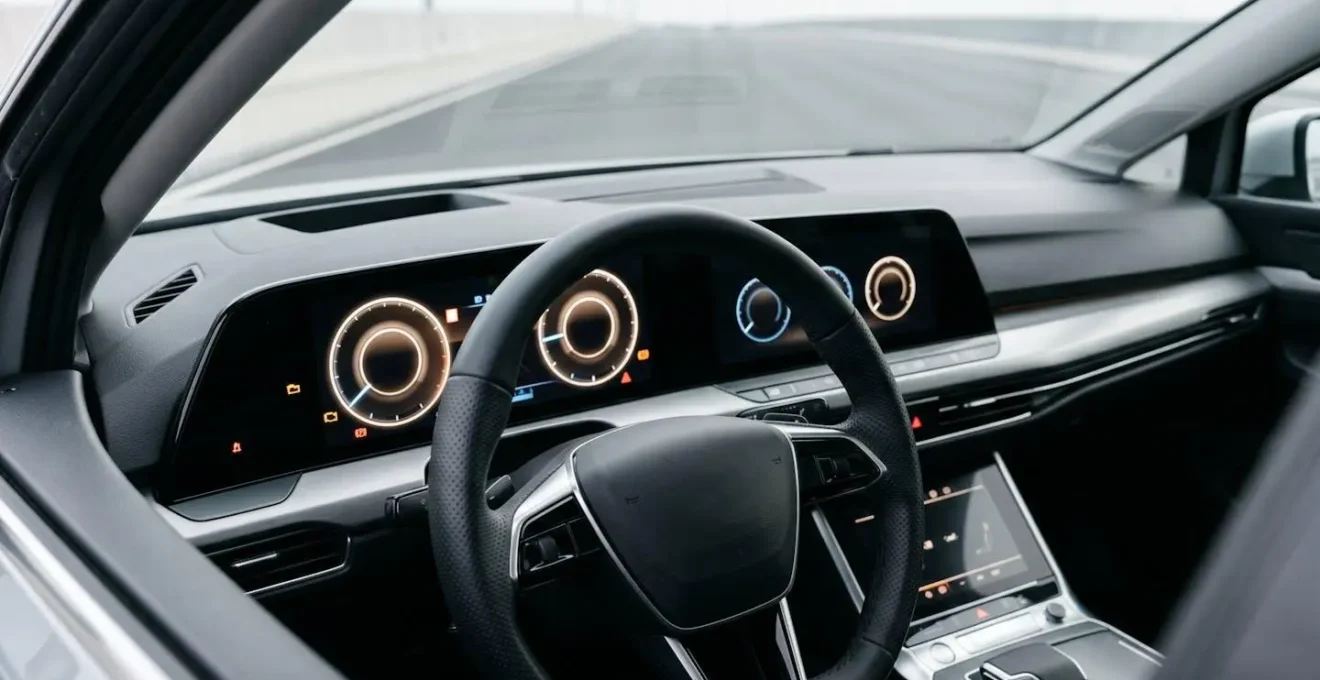
Driving a car without modern electronic safety aids like ABS, traction control, and stability control is not just like driving an older car; it’s like speaking a different dialect of the language of driving. The muscle memory and emergency reactions you’ve built up in a modern car, where you can rely on the computer to manage grip, are not just unhelpful in a classic or older vehicle—they can be actively dangerous. You must consciously un-learn these habits and re-learn the fundamental physics of car control.
The first and most critical adjustment is to your perception of speed and your safety margins. Without a digital safety net, your primary safety system becomes space and time. You must increase your following distances, approach corners at a lower speed, and be far gentler with your inputs. Every movement of the steering, throttle, and brake must be smoother and more deliberate. The abrupt, ‘stomp and steer’ emergency maneuvers that a modern car can handle will almost certainly result in a loss of control in a car without these aids.
Re-learning manual vehicle control techniques is essential. These are skills that electronic systems have made redundant for most drivers, but they are vital in an older vehicle. Key skills to practice in a safe and controlled environment include:
- Threshold Braking: This is the manual version of ABS. It involves applying maximum brake pressure right up to the point of the wheels locking, and then slightly releasing to maintain steering control. It requires a delicate touch that most modern drivers have never had to develop.
- Counter-Steering: When the rear of the car begins to slide (oversteer), the correct response is to steer into the skid. ESC does this automatically by braking an individual wheel, but in an older car, it’s a manual skill you must execute instantly and precisely.
- Throttle Modulation: Without traction control, your right foot becomes the sole arbiter of grip during acceleration. You must learn to feed in power smoothly and progressively, especially on wet or loose surfaces, to avoid overwhelming the tyres.
Why Does Your Car Feel Like It Fights You During Emergency Lane Changes?
That feeling of resistance or « fighting » during a sudden, sharp maneuver like an emergency lane change is the hallmark of the Electronic Stability Control (ESC) system at work. It’s the most sophisticated layer of your car’s safety systems, and it’s a direct intervention to prevent a catastrophic loss of control, such as a fishtail or spin. What you perceive as a fight is actually your digital co-pilot saving the car from an impending rotation that you may not have even sensed yet.
During a rapid lane change, you turn the steering wheel sharply. The ESC’s brain—a powerful computer—is monitoring your steering input, the car’s speed, and, most importantly, its yaw rate. The yaw rate sensor measures how quickly the car is rotating around its vertical axis. An aggressive steering input at speed can cause this yaw rate to increase dramatically, a precursor to the rear of thecar overtaking the front—a classic spin. The system’s predictive models know that if this rotation continues unchecked, a crash is imminent.
Before the spin can fully develop, the ESC intervenes. It applies a sharp, powerful brake pulse to a single, specific wheel—typically the outside front wheel in an oversteer situation. This action creates a powerful pivoting force that counters the car’s rotation, pulling it back into line with your intended direction of travel. This braking force is what you feel as the car « fighting » you. It feels unnatural because it’s an external force acting on the car’s dynamics, one that you did not command. It’s a forceful but life-saving correction.
The effectiveness of this intervention is staggering. According to official research, its impact on preventing the most severe types of accidents is immense. The data shows that according to NHTSA research, vehicles equipped with ESC are approximately 75% less likely to be involved in fatal single-vehicle crashes. That feeling of being fought is the system keeping you out of that statistic.
Why Does Your Car Beep Aggressively When the Vehicle Ahead Brakes Sharply?
The aggressive beeping and flashing dashboard lights you experience when a car ahead brakes suddenly is the first stage of your Forward Collision Warning (FCW) and Autonomous Emergency Braking (AEB) system. This is not just a simple alert; it’s the start of a carefully orchestrated escalation protocol designed to prevent a rear-end collision. The system uses radar, cameras, or a combination of both to constantly measure the distance and closing speed to the vehicle in front.
When the car ahead brakes hard, the closing speed increases dramatically. The system calculates the ‘Time to Collision’ and if this drops below a critical threshold, it triggers Stage 1 of its protocol: the warning. The aggressive nature of the audible and visual alerts is intentional. It’s designed to break through your distraction—whether you’re adjusting the radio or talking to a passenger—and bring your full attention back to the road and the immediate hazard.
If you don’t react immediately to the warning by braking, the system doesn’t just wait. It’s already moving to Stage 2 in the background. It assumes you will brake eventually and prepares the car for the most effective emergency stop possible. This often involves pre-charging the brake lines, moving the brake pads closer to the discs, and increasing brake pressure. This means that when your foot finally does hit the brake pedal, the response is instant and maximally powerful, shaving critical feet off your stopping distance.
This graduated intervention strategy is crucial. It gives the driver the first opportunity to resolve the situation, but ensures the vehicle is prepared for autonomous action if the driver fails to respond adequately.
Case Study: The Forward Collision Warning Escalation Protocol
Modern Forward Collision Warning systems operate through a three-stage escalation protocol designed to progressively engage driver attention and vehicle safety systems. Stage 1 delivers audible and visual warnings when Time to Collision drops below critical thresholds. Stage 2 pre-charges the brake system by pressurizing brake lines for faster emergency response. Stage 3 activates Autonomous Emergency Braking if driver response is insufficient. This graduated intervention gives drivers maximum opportunity to respond while ensuring the vehicle can take autonomous action if needed.
Key takeaways
- Traction Control « hesitation » is a calculated, life-saving torque reduction, not a fault.
- Only disable traction control when stuck at low speed in snow or mud; re-enable it immediately after.
- Premium ESC systems use more sensors (yaw, steering angle) for proactive, surgical interventions, unlike basic reactive systems.
Why Does Your Steering Wheel Suddenly Resist When You Change Lanes Quickly?
The sensation of the steering wheel resisting or nudging you as you change lanes is not related to traction or stability control, but is the work of a different set of driver aids: Lane Keeping Systems. While often bundled together under the umbrella of ‘safety features’, their function is distinct. They are designed to prevent unintentional lane departures, a common cause of accidents due to driver fatigue or distraction. The resistance you feel is the system actively trying to guide the car back to the centre of its lane.
However, not all « resistance » is created equal. The specific feeling you experience depends on which type of lane assistance system your car is equipped with. There are three main tiers of this technology, each with a different method of intervention and a different feel through the steering wheel. A basic Lane Departure Warning (LDW) system offers no resistance at all; it simply provides an audible or haptic warning (like a vibrating seat or steering wheel) when you cross a lane marking without indicating. It warns, but does not act.
The system responsible for the feeling of resistance is Lane Keep Assist (LKA). When its camera-based sensors detect that you are drifting out of your lane, it applies a gentle but noticeable amount of torque to the steering rack to nudge the car back towards the centre. It’s designed as a brief, corrective input, not a continuous action. The most advanced version, Lane Centering Assist, provides continuous, active steering inputs to keep the car perfectly in the middle of the lane. This system feels less like a nudge and more like a constant, gentle pressure on the steering, as if a co-pilot has their hands lightly on the wheel at all times.
The following table, based on information from road safety experts at the RAC, breaks down the key differences in how these systems operate and how they feel to the driver.
| System Type | Intervention Method | Activation Trigger | Driver Experience |
|---|---|---|---|
| Lane Departure Warning (LDW) | Audible beep or seat/steering vibration only | Crossing lane marking without turn signal | Warning sensation, no steering force applied |
| Lane Keep Assist (LKA) | Gentle torque overlay to steering rack | Unintended lane departure detected | Nudge or resistance guiding back to center |
| Lane Centering Assist | Continuous active steering inputs | Operates continuously when engaged | Constant gentle resistance maintaining lane center |
By understanding that the hesitations, beeps, and nudges from your car are a deliberate dialogue, you move from being a passenger to a true pilot. The next step is to apply this knowledge, driving more consciously and safely, trusting the unseen engineer that is always working to protect you.