Skipping a car service isn’t saving money; it’s a down payment on a more expensive MOT failure.
- Degraded oil becomes engine sludge, starving critical parts like turbochargers and causing catastrophic damage.
- Old brake fluid absorbs water, drastically reducing its effectiveness and often resulting in a ‘Dangerous Defect’ on the MOT test.
Recommendation: Adhering to your car’s service schedule is the single most effective strategy to ensure reliability, maximise resale value, and pass the annual MOT test.
There are few feelings as disheartening for a driver as being handed an MOT failure certificate. The list of defects, the unexpected costs, and the inconvenience can be a source of major stress. We’re often told to check our tyres and lightbulbs before the test, and while that’s sound advice for avoiding minor failures, it barely scratches the surface of vehicle health. The most expensive and significant MOT failures often trace their roots back to something far less obvious and far more impactful: the routine service you might have skipped six or twelve months ago to save a bit of cash.
The link between missed services and MOT failure isn’t about bad luck; it’s about physics and chemistry. A missed service initiates a hidden, silent cascade of component degradation. This article moves beyond generic advice. As a technician, I’m not here to judge, but to educate. My goal is to pull back the curtain and show you the direct, mechanical chain reaction that turns a simple act of neglect into the specific, expensive failures an MOT tester is legally required to identify. By the end, you won’t just think you *should* get a service; you’ll understand precisely *why* you can’t afford not to.
This guide will break down the critical connections between maintenance and MOT success. We will explore the real-world consequences of neglect on your engine, the financial importance of a documented service history, and the specific components that fail most often. Let’s delve into the mechanics of reliability.
Contents: Why a Disciplined Service Schedule is Key to MOT Success
- Why Does Skipping One Oil Change Lead to £1,800 in Engine Damage?
- How to Prove Full Service History When Selling Your Car Privately?
- Main Dealer or Independent Garage: Which Maintains Your Warranty Compliance?
- The 4 Driving Patterns That Require More Frequent Servicing Than the Handbook Says
- When to Book Your Service: The 6-Week Window That Maximises MOT Pass Rates?
- Which 5 Brake Components Cause the Most MOT Failures in UK Vehicles?
- How to Check All 5 Critical Fluids in Under 5 Minutes Every Sunday Morning?
- Why Do MOT Testers Fail 12% of UK Vehicles for Brake Defects Alone?
Why Does Skipping One Oil Change Lead to £1,800 in Engine Damage?
The single most critical task of a service is changing the engine oil. It’s easy to view it as just a fluid, but it’s the lifeblood of your engine, responsible for lubrication, cooling, and cleaning. Over time, engine oil degrades. It becomes saturated with contaminants like carbon, metal particles, and unburnt fuel. Crucially, its protective additives break down, and it loses its ability to lubricate effectively. This is where the cascade of failure begins. What was once a protective fluid turns into a thick, abrasive substance often called engine sludge or « the black death » in garage circles.
This sludge is the enemy. It’s too thick to flow properly, so it begins to block the narrow oilways and passages that feed critical components. Modern engines, especially those with turbochargers, are extremely vulnerable. A turbocharger can spin at over 200,000 RPM and relies on a constant, pressurised flow of clean oil for both lubrication and cooling. When sludge blocks the oil feed line to the turbo, it’s a catastrophic event. Starved of oil, the turbo’s bearings will fail in seconds, often leading to the impeller shattering and sending metal fragments throughout the engine and exhaust system.
This isn’t a theoretical risk. A case study on turbocharger failure from sludge buildup highlights this exact scenario. The repair isn’t just a new turbo. It involves replacing the turbocharger itself, flushing the entire engine to remove sludge and metal debris, cleaning or replacing intercoolers, and often replacing the catalytic converter which gets contaminated by the debris. A bill of £1,800 or more for a single turbo failure caused by a few missed oil changes is a very realistic and common outcome we see in the workshop.
How to Prove Full Service History When Selling Your Car Privately?
A disciplined service schedule isn’t just about preventing MOT failures; it’s one of the most powerful financial assets you have when it comes to your vehicle. A ‘Full Service History’ (FSH) is the proof that your car has been cared for, and private buyers will pay a significant premium for that peace of mind. Without it, you are asking a buyer to take a huge gamble on the car’s mechanical condition. This difference is not trivial; industry data reveals that a car with a full, documented service history can be worth up to 20% more than an equivalent model without one. Conversely, a complete lack of records can reduce the value by as much as 40%.
But what constitutes ‘proof’? A service book with stamps is a good start, but in the modern era, savvy buyers expect more. The gold standard is a meticulously organised folder containing every single invoice for work carried out. This is what a potential buyer truly wants to see:

As you can see, a comprehensive record paints a clear picture of a well-maintained vehicle. Each invoice should detail the date, mileage, parts used, and work performed. This tangible proof eliminates guesswork and builds immense trust with a buyer, allowing you to command a higher price and sell the car much faster. As experts from Kelley Blue Book note, « Buyers are more likely to pay a premium for a vehicle with a clear, well-documented maintenance history over one with gaps or unknowns. » Your binder of receipts is not just a record; it’s a certificate of value.
Main Dealer or Independent Garage: Which Maintains Your Warranty Compliance?
This is one of the most common questions from owners of newer cars: « Do I have to go to the main dealer to keep my warranty? » The simple answer is no. Thanks to UK and EU ‘Block Exemption’ regulations, you have the right to have your car serviced at an independent garage without invalidating the manufacturer’s warranty. However, there’s a crucial condition: the service must be performed exactly in line with the manufacturer’s schedule, and crucially, using parts and fluids that meet the original equipment (OE) specification.
The burden of proof is on you, the owner. If a warranty claim is needed, the manufacturer can ask for evidence that the service schedule was followed correctly. This is where the quality of the independent garage’s invoice becomes paramount. A simple, hand-written receipt for « Service – £200 » will not be sufficient and could lead to a rejected warranty claim. A warranty-compliant invoice is a detailed, professional document. To protect your warranty when using an independent specialist, you must ensure the documentation you receive is flawless.
Your checklist: The Warranty-Proof Invoice
- Detailed parts specification: The invoice must list exact part numbers and confirm that OEM-equivalent or manufacturer-approved parts were used.
- Fluid specifications: It must document the precise viscosity grade and oil standard (e.g., 5W-30 meeting ACEA C3 specification) to match the manufacturer’s requirements.
- Labour breakdown: There should be an itemised description of the work performed, matching the manufacturer’s service schedule for that specific mileage or age.
- Garage credentials: The invoice must have clear business registration details, a VAT number (if applicable), and contact information to establish its legitimacy.
- Date and mileage recording: A precise timestamp and the vehicle’s exact odometer reading are essential to prove the service was performed within the required interval.
The 4 Driving Patterns That Require More Frequent Servicing Than the Handbook Says
Your car’s service handbook provides a recommended service interval, for example, every 12,000 miles or 12 months. This is based on what manufacturers call ‘normal’ driving conditions. However, many of us operate our vehicles under ‘severe’ conditions without even realising it, and this dramatically accelerates the degradation of fluids and components, necessitating more frequent servicing.
According to automotive experts, certain driving habits are particularly harsh on a vehicle. As one guide on oil change intervals notes, « Frequent short trips, heavy traffic, high ambient temperatures, towing, and aggressive driving all accelerate oil degradation and may require shorter change intervals than the manufacturer’s standard recommendation. » If your driving falls into these categories, you should consider servicing your car more often than the handbook suggests. The four most common ‘severe’ patterns in the UK are:
- Frequent Short Trips: If most of your journeys are under 5 miles, your engine rarely reaches its optimal operating temperature. This prevents moisture that naturally condenses inside the engine from boiling off. This water then emulsifies with the oil, creating sludge and reducing its lubricating properties. Automotive research confirms that this moisture buildup is a primary issue in vehicles used for short hops to the shops or school run.
- Stop-and-Go City Driving: Constant acceleration and braking in heavy traffic places immense stress on the engine, transmission, and brakes. The engine spends more time idling, which can lead to higher temperatures and accelerated oil degradation.
- Towing or Carrying Heavy Loads: Pulling a caravan or regularly loading your vehicle to its maximum capacity puts a huge strain on the entire drivetrain. The engine and transmission work harder, generating more heat and requiring the oil and fluids to work at their absolute limits.
- Infrequent Use: A car that sits for weeks or months at a time is also at risk. Fluids can degrade, seals can dry out and crack, and brake components can seize up from lack of use and exposure to moisture.
When to Book Your Service: The 6-Week Window That Maximises MOT Pass Rates?
Timing is everything, especially when it comes to coordinating your service and MOT. Many drivers wait until the MOT is due, get a failure, and then rush to get the repair work and a service done. A much smarter, cheaper, and less stressful strategy is to use the service as a preparatory step for the MOT. The data on this is incredibly clear: analysis shows that as many as half of all MOT failures could be avoided if drivers simply carried out checks and maintenance beforehand.
The optimal way to do this is by using what I call the « 6-Week Window. » Here’s how it works: In the UK, you can get an MOT up to one month (minus a day) before it runs out and keep the same renewal date. This gives you a crucial buffer. By booking your annual service for approximately six weeks before your MOT is due to expire, you create a strategic advantage.
This timing allows your trusted garage to perform a full service and, in doing so, conduct a thorough inspection of the vehicle. They will identify any worn components—like brake pads, tyres, or suspension parts—that are likely to cause an MOT failure. This gives you a clear two-week period to approve the necessary repairs, allow the garage to order parts, and get the work done. You can then submit the car for its MOT test within the final month, confident that all the common failure points have already been addressed. This proactive approach transforms the MOT from a game of chance into a simple formality.
Which 5 Brake Components Cause the Most MOT Failures in UK Vehicles?
While issues like lights and tyres are common MOT failure points, they are often cheap and easy to fix. The more serious and costly failures frequently involve the brake system. It’s an area where testers have zero tolerance for defects, for obvious safety reasons. In fact, official MOT testing data confirms that brake defects account for approximately 10 per cent of all test failures across the UK. Many of these failures are a direct result of service items being neglected.
A service should include a thorough brake inspection, but when skipped, hidden problems can develop and worsen until they become an immediate MOT fail. The following table, based on expert analysis of MOT failure data, outlines the five most common culprits within the brake system and how they fail.
| Brake Component | Failure Mechanism | MOT Test Impact |
|---|---|---|
| Brake Caliper (seized) | Moisture-laden fluid corrodes piston bore, causing sticking and imbalance | Immediate failure—causes brake force imbalance exceeding 30% between wheels |
| Flexible Brake Hose | Internal swelling under pressure restricts flow or creates one-way valve effect | Major defect—can keep brakes partially applied even when released |
| Handbrake Cable/Mechanism | Water and salt ingress seize cables or caliper mechanism | Parking brake efficiency below 16% vehicle weight threshold |
| Wheel Cylinder (drum brakes) | Internal seals perish causing leaks hidden inside drum assembly | Dangerous defect—fluid leaks result in immediate test failure |
| Corroded Brake Pipe | Road salt causes structural corrosion progressing from surface rust | Dangerous defect—pipes close to bursting under hydraulic pressure |
How to Check All 5 Critical Fluids in Under 5 Minutes Every Sunday Morning?
One of the simplest ways to stay connected with your car’s health is to perform regular fluid checks. It takes less than five minutes, requires no special tools, and can give you an early warning of developing problems. Performing these checks on a cool, level surface is best. Make it a part of your Sunday morning routine.
Here’s a quick guide to checking the five most important fluids in your engine bay. The location of these will vary, but they are almost always marked with clear, colour-coded caps and universal symbols.
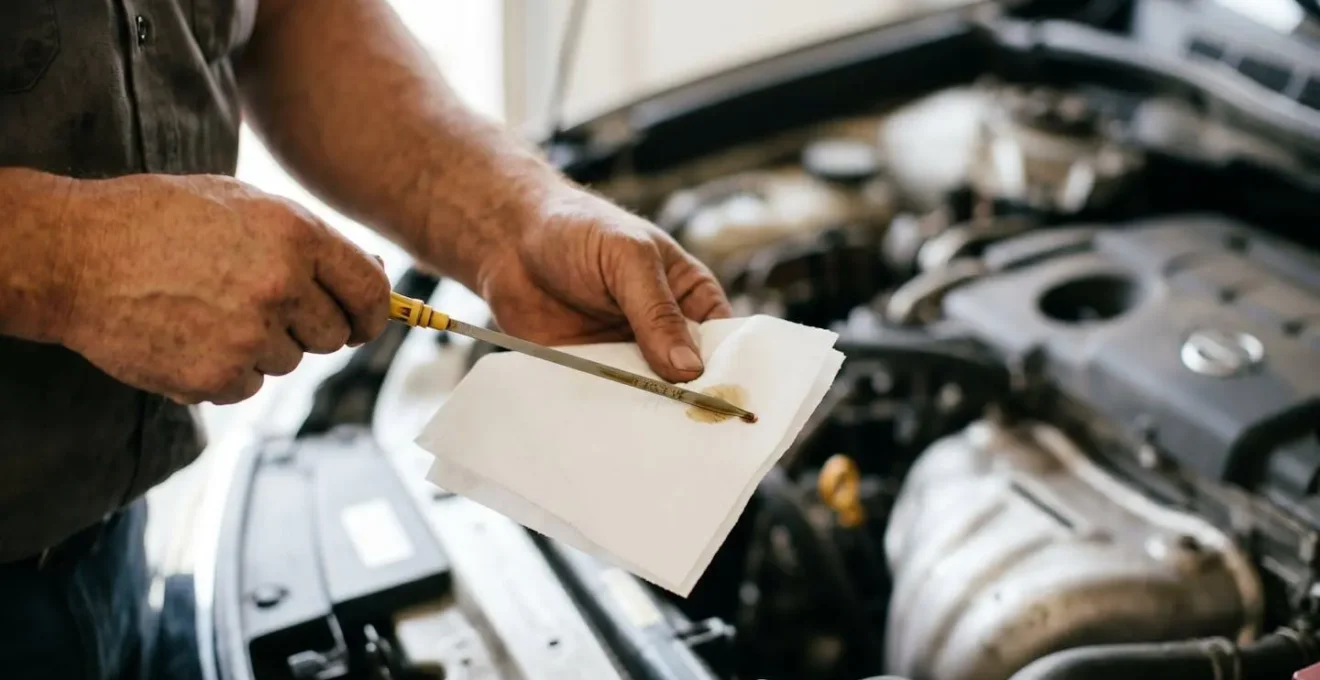
- Engine Oil: With the engine off, pull out the dipstick (usually with a yellow or orange loop). Wipe it clean with a paper towel, re-insert it fully, then pull it out again. The oil level should be between the ‘MIN’ and ‘MAX’ marks. Note the oil’s colour; it should be amber or dark brown, not black and sludgy.
- Coolant/Antifreeze: Look for the semi-transparent expansion tank (never open this when the engine is hot). The fluid level should be between the ‘MIN’ and ‘MAX’ lines marked on the side of the tank.
- Brake Fluid: Locate the small reservoir, usually high up on the driver’s side of the engine bay. The fluid should be a light, clear, honey colour and the level should be between the ‘MIN’ and ‘MAX’ marks. If it’s dark and murky, it needs changing.
- Power Steering Fluid: In cars with hydraulic power steering, this reservoir will also have ‘MIN’ and ‘MAX’ marks. Some have a small dipstick attached to the cap. Check the level and top up only with the specific fluid recommended in your handbook.
- Screen Wash: This is the only fluid you should be using regularly. Keeping the reservoir topped up with a good quality screen wash (not just water) is a legal requirement and essential for clear vision. A lack of fluid is a simple MOT failure.
Key takeaways
- A missed service is not a single event but the start of a ‘cascade failure’ that leads to predictable and expensive MOT issues.
- Brake system neglect, especially failing to change hygroscopic brake fluid every two years, is a primary cause of ‘Dangerous Defect’ MOT failures.
- A fully documented service history is a powerful financial asset, capable of increasing your car’s resale value by up to 20%.
Why Do MOT Testers Fail 12% of UK Vehicles for Brake Defects Alone?
The 12% figure isn’t just a statistic; it represents a significant number of vehicles on UK roads with compromised braking systems. MOT testers are trained to be uncompromising on brakes because a failure here has the most catastrophic potential. The failures they find are often not sudden, but the result of a long, slow process of degradation, most commonly linked to neglected brake fluid.
The core of the problem lies in a property of brake fluid that many owners are unaware of: it is hygroscopic, meaning it naturally absorbs moisture from the atmosphere. A detailed case study on brake fluid degradation explains that new fluid has a boiling point of over 230°C. Over two years of service, it can absorb enough water to lower that boiling point to below 180°C. During heavy braking (like descending a long hill or in an emergency stop), the heat generated can cause this water-contaminated fluid to boil. This creates compressible vapour pockets in the brake lines. The result is a ‘spongy’ pedal that goes to the floor and a terrifying loss of braking power.
An MOT tester can’t easily measure your fluid’s boiling point, but they can measure its effect. The rolling road brake test measures the braking force at each wheel. One of the most common failures is brake imbalance. The MOT test standards specify that the imbalance between left and right wheels on the same axle must not exceed 30 per cent. A seized caliper or a failing brake hose, often caused by corrosion from old, wet fluid, will easily create this imbalance, leading to an instant failure. This is the direct link: a missed service means old, contaminated fluid, which causes component failure, which results in a measured imbalance and a failed MOT.
The next logical step isn’t to worry, but to act. Open your glovebox, find your service book, and check the date and mileage of your last service. Compare it to your manufacturer’s schedule. If a service is overdue, booking it is the single most effective investment you can make in your car’s safety, reliability, and future value. It’s the difference between controlling your costs and letting a small problem cascade into a big one.