In summary:
- The vast majority of engine wear occurs during cold starts, before oil has fully circulated. Gentle driving from the moment you start is crucial.
- Modern engines do not need to idle to warm up; this practice wastes fuel and actively damages components by delaying optimal operating temperature.
- Using high-quality synthetic oil is not a luxury but a necessity for longevity, offering vastly superior protection under extreme temperatures and stress.
- « Sealed for life » transmission fluid is a marketing myth. Regular fluid changes every 60,000 miles are the single most effective way to prevent a £3,000+ gearbox failure.
It’s a frustrating automotive mystery: one driver nurses their vehicle well past the 200,000-mile mark with the engine and transmission running smoothly, while another, with the exact same model, faces a catastrophic, four-figure repair bill before the odometer even hits 80,000. The common advice centres on regular servicing and not ignoring warning lights, but these are merely table stakes. They don’t explain the huge disparity in mechanical lifespan. The truth is that a powertrain’s fate isn’t sealed in the service bay; it’s decided by the driver’s minute-by-minute operational habits.
The real difference lies in understanding the hidden forces at play within the metal heart of your vehicle. It’s about grasping the brutal physics of a cold start, the cumulative stress of aggressive throttle inputs on a gearbox, and the subtle but critical difference between oil that merely lubricates and oil that preserves. Many well-intentioned drivers, following decades-old wisdom, are inadvertently accelerating wear, particularly through outdated warm-up rituals. This isn’t about becoming a master mechanic; it’s about becoming an informed operator.
But what if the key wasn’t simply to ‘drive smoothly’ but to understand the precise mechanical cost of each gear change and acceleration? This guide deconstructs the common, seemingly harmless habits that secretly sabotage your engine and transmission. We will move beyond generic advice to provide a clear, evidence-based framework for powertrain preservation, explaining exactly why certain practices prevent thousands of pounds in repairs and others guarantee them.
To navigate these critical insights, this article breaks down the essential knowledge into distinct areas. From understanding cold-start damage to decoding engine noises and demystifying maintenance schedules, each section builds upon the last to give you a complete picture of vehicle longevity.
Summary: Unlocking Your Vehicle’s 200,000-Mile Potential
- Why Do the First 5 Minutes of Every Journey Cause 70% of Your Engine Wear?
- How to Add 50,000 Miles to Your Gearbox Life Through Throttle Management?
- Synthetic or Conventional Oil: Which Actually Extends Engine Life Beyond 150,000 Miles?
- The Engine Warm-Up Habit That Damages Modern Vehicles While Wasting Fuel
- The 3 Engine Noises That Give You 2 Weeks Warning Before Catastrophic Failure
- Why Does « Sealed for Life » Transmission Fluid Still Need Changing Every 60,000 Miles?
- Why Driving Just 2 Miles With a Hot Engine Warning Costs £4,000 in Damage?
- Why Does Changing Transmission Fluid at 60,000 Miles Prevent £3,000 Gearbox Replacements?
Why Do the First 5 Minutes of Every Journey Cause 70% of Your Engine Wear?
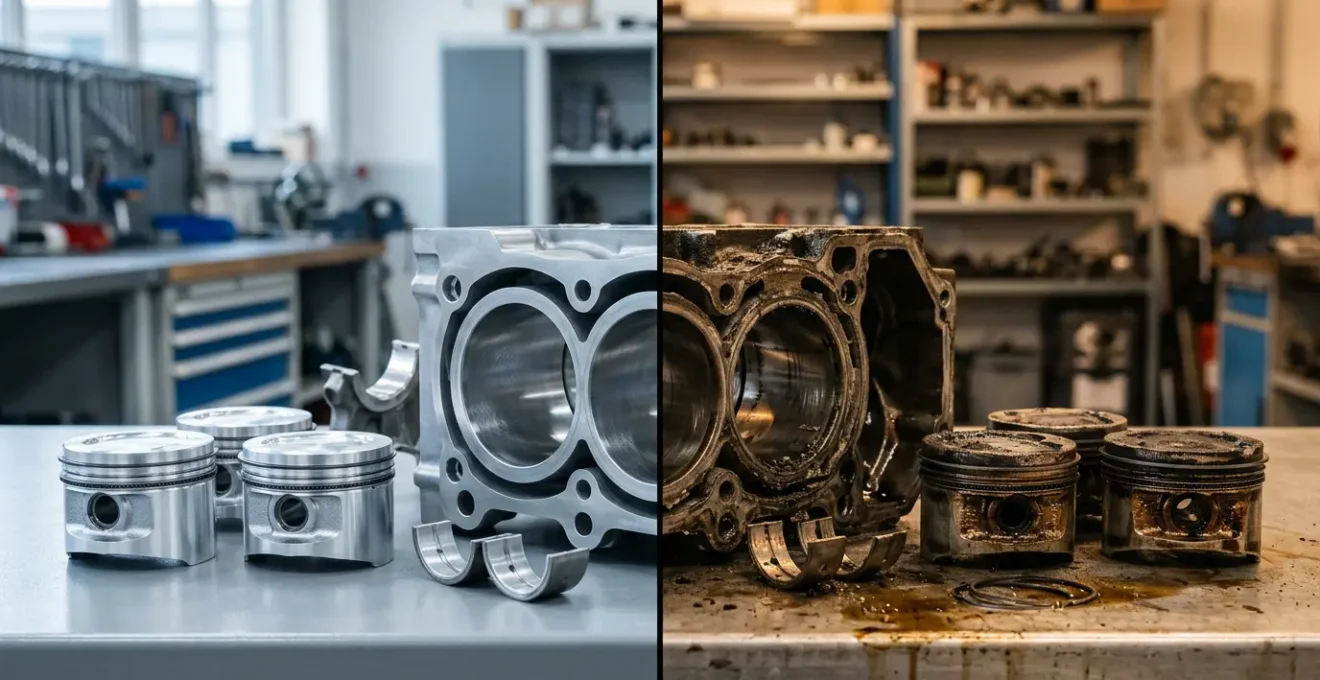
The single most destructive period for your car’s engine is not a high-speed motorway run or a heavy tow; it’s the first few minutes after you turn the key. When an engine is cold, its lubricating oil is thick and settled in the sump at the bottom. Upon starting, the oil pump begins the critical task of circulating this lifeblood to the high-friction surfaces at the top of the engine, like the camshaft and valvetrain. During these first moments, parts are moving with suboptimal lubrication, a condition known as lubrication starvation. This is where the vast majority of metal-on-metal wear occurs, long before the engine reaches its efficient operating temperature.
This isn’t theoretical; the real-world consequences are stark. Consider a documented case comparing two identical vehicles with radically different usage patterns. One, driven almost exclusively on long, fully-warmed-up motorway journeys, reached approximately 700,000 miles on its original, untouched engine. Its neighbour, used only for short city trips, suffered a complete engine failure at just 80,000 miles. The difference was not the total mileage, but the number of damaging cold starts. Each short trip represents a full cycle of maximum wear without the benefit of a long period of protective, low-wear operation.
The solution is not to let the car idle (a damaging myth we’ll debunk later), but to alter your driving style for those first five minutes. After starting, wait just 30 seconds for oil pressure to stabilise, then drive away gently. Avoid high RPMs and aggressive acceleration. This light-load operation allows the engine and its oil to warm up together, drastically reducing the period of inadequate lubrication and minimising the thermal shock of rapid temperature changes. Treating those first few miles with mechanical sympathy is the number one habit that separates a high-mileage hero from a scrapyard statistic.
How to Add 50,000 Miles to Your Gearbox Life Through Throttle Management?
While drivers often focus on the engine, the automatic transmission is an equally complex and expensive component whose lifespan is directly in your hands—or rather, under your right foot. Every aggressive acceleration from a standstill or hard kick-down to overtake sends a command to the transmission’s brain. This command spikes the hydraulic fluid pressure to force a rapid, decisive gear change. While effective, these hydraulic pressure spikes put immense stress on the clutch packs, bands, and seals inside the gearbox. Each aggressive shift is a small, violent event that contributes to the finite wear-cycle of these components.
The key to gearbox longevity is predictive driving. It’s about managing the throttle to minimise the number and severity of shifts. By anticipating the flow of traffic, you can avoid unnecessary acceleration-and-braking cycles. Instead of rushing towards a red light and braking hard, lift off the throttle early and coast. This simple act of coasting not only saves fuel but also allows the transmission to remain in a higher gear for longer, reducing the number of downshifts required as you slow down. Each shift you avoid is a cycle of wear you’ve saved for the future.
Adopting these habits can dramatically extend the life of your transmission. The goal is to operate the vehicle with smoothness and foresight, which directly translates to lower mechanical stress. To put this into practice, focus on the following techniques:
- Accelerate gradually: Use smooth, gentle throttle inputs to allow the transmission to shift at lower RPMs and with less hydraulic pressure.
- Anticipate stops: Look far ahead in traffic to identify slowing or stopped vehicles. Lift off the accelerator early to coast, minimising the need for late, hard braking and the resulting harsh downshifts.
- Maintain moderate speeds: Driving at a steady, moderate pace reduces the overall load on all powertrain components, including the transmission.
- Avoid excessive idling: While primarily an engine issue, prolonged idling can affect the transmission by preventing complete fluid circulation and contributing to thermal stress without any useful work being done.
This conscious approach to throttle management doesn’t mean driving slowly; it means driving intelligently. It’s the difference between forcing the gearbox to react to your sudden inputs and guiding it smoothly through its operation, adding tens of thousands of miles to its life in the process.
Synthetic or Conventional Oil: Which Actually Extends Engine Life Beyond 150,000 Miles?
The debate between synthetic and conventional oil is often framed as a matter of cost versus benefit, but for any driver serious about longevity, it’s not a debate at all. Synthetic oil is an engineered solution designed for a single purpose: superior engine protection under conditions where conventional oil fails. While it costs more per litre, its ability to prevent wear and extend engine life makes it a profound long-term investment. In fact, a comprehensive AAA study found that synthetic oils outperformed conventional oils by 47 percent on average in a range of industry-standard tests.
This massive performance gap comes down to molecular engineering. Conventional oil is refined from crude oil and contains molecules of varying sizes and shapes. Under high heat and pressure, the weaker molecules shear and break down, losing their lubricating properties and forming harmful sludge. Synthetic oil, by contrast, is built from the ground up in a lab to have uniformly-sized, robust molecules. This uniformity provides a stronger, more stable lubricating film that resists being squeezed out from between high-pressure components. It also maintains its integrity at extreme temperatures—both hot and cold—where conventional oil either turns to sludge or thickens into molasses.
This is especially critical for modern engines, particularly those with turbochargers or gasoline direct injection (GDI). These engines run hotter and place immense stress on the oil. Synthetic oil is essential to combat issues like Low-Speed Pre-Ignition (LSPI) and carbon buildup on intake valves, problems that can quickly cripple a modern engine running on inferior lubricant. The enhanced additive packages in synthetics also last longer, ensuring the engine remains protected for the entire duration of the extended service interval.
The following table breaks down the practical differences, making the case for synthetic oil undeniable for anyone aiming for the 200,000-mile club. As shown by a detailed cost-benefit analysis for engine protection, the higher initial cost is easily offset by longer change intervals and vastly superior component defence.
| Factor | Conventional Oil | Synthetic Oil |
|---|---|---|
| Change Interval | 3,000 to 5,000 miles | 5,000 to 25,000 miles |
| Cost Per Change | Base cost | ~£25 extra per change |
| Annual Cost (15k miles) | 3-5 changes | 1-2 changes (offset by longevity) |
| Film Strength Under Pressure | Lower, prone to shearing | Superior, resists breakdown |
| Thermal Stability | Breaks down at high temps | Maintains integrity at extreme temps |
| Cold Flow Performance | Thickens significantly | Flows 38% better at cold temps |
| Additive Package Protection | Degrades quickly | Preserved throughout interval |
| Turbo/TGDI Suitability | Inadequate for LSPI protection | Necessary to combat LSPI and carbon buildup |
| Engine Component Protection | Standard | Can extend engine life to 250,000+ miles |
The Engine Warm-Up Habit That Damages Modern Vehicles While Wasting Fuel
The long-standing ritual of starting your car and letting it idle for several minutes to « warm up » is one of the most misunderstood and counterproductive habits in modern motoring. Born from the era of carburettors, which needed to reach a certain temperature to properly atomise fuel, this practice is not only unnecessary for today’s fuel-injected engines but is actively harmful. Idling a cold engine causes an overly rich fuel mixture to enter the cylinders, which can wash the protective oil film off the cylinder walls, accelerating wear. Furthermore, testing by Argonne National Laboratory revealed that idling for more than 10 seconds uses more fuel and emits more CO2 than simply restarting the engine.
The most significant damage, however, is caused by what idling *doesn’t* do. An engine warms up most efficiently under a light load, not at idle. A modern Engine Control Unit (ECU) is specifically programmed to manage the engine through this warm-up phase while driving. It adjusts fuel mixture and idle speed to get all components to their optimal temperature as quickly and harmoniously as possible. This includes the catalytic converter, which does not function effectively until it reaches around 430°C (806°F). This temperature is achieved far more quickly by driving than by sitting stationary.
An idling engine warms up very slowly and unevenly. While the combustion chambers get hot, the transmission fluid, differential oil, and wheel bearings remain stone cold. When you finally drive away, you introduce a hot engine to a cold drivetrain, creating unnecessary stress. The correct procedure, as intended by automotive engineers, is to start the engine, wait no more than 30 seconds for the oil to circulate and pressure to build, and then drive off gently. By keeping RPMs low for the first several miles, you allow the entire powertrain—engine, transmission, and all—to warm up together as a single, cohesive system. This is the fastest, most fuel-efficient, and least damaging way to begin any journey.
The 3 Engine Noises That Give You 2 Weeks Warning Before Catastrophic Failure
A healthy engine operates with a consistent, smooth hum. When that symphony is interrupted by a new, distinct noise, it is your vehicle’s final plea for help. Ignoring these auditory warnings is the fastest way to turn a potentially manageable repair into a catastrophic, engine-destroying failure. Not all noises are equal, but three specific sounds are clear indicators of severe internal distress, and they operate on a very short timeline. Learning to identify them can give you just enough time—often less than two weeks—to act before it’s too late.
These noises are direct symptoms of critical failures in the engine’s lubrication and internal geometry. A light tapping might signal oil starvation at the top of the engine, while a deep, heavy knock indicates the imminent failure of the rotating assembly at the bottom. The key is to listen for changes from the normal operating sounds and to correlate the noise with engine speed (RPM) and temperature. A noise that is present when cold but disappears when warm tells a very different story from one that gets progressively louder as the engine works harder.
Recognising these sounds and taking immediate action is not optional; it is the line between a repair and a total replacement. The following checklist outlines the most critical engine noises and the immediate steps you must take. Delaying a visit to a qualified mechanic by even a few days can be the difference between a new set of bearings and a new engine.
Your Action Plan for Critical Engine Noises
- Identify a « Lifter Tick »: A light, rhythmic tapping, like a sewing machine, that is fastest on startup and may quieten as the engine warms. This indicates oil starvation in the top end. ACTION: Check your oil level immediately. If the level is correct, the oil is not reaching the valvetrain, risking camshaft damage. Consult a mechanic within the week.
- Listen for « Piston Slap »: A hollow, metallic rattle, most obvious when the engine is cold and under light acceleration, which lessens as it warms up. This means the piston is rocking in its cylinder due to excessive wear. The engine is in terminal decline but may last a short while with gentle use. Start planning for a major repair or replacement.
- Recognise a « Rod Knock »: A deep, heavy, speed-dependent knock from the bottom of the engine that gets louder with RPM, like a hammer hitting an anvil. This is a TERMINAL diagnosis for the connecting rod bearings. Continued driving for even a few miles can cause the rod to break and exit the engine block. ACTION: Stop the car immediately and safely. Do not restart the engine. Call for a tow.
- Establish an Early Detection Protocol: Perform routine checks and pay close attention to your oil pressure gauge. Listen to your engine every time you start it. Any deviation from the normal sound is a signal to investigate.
- Commit to Immediate Response: For any of the serious noises above, especially a rod knock, time is not on your side. Timely intervention is the only way to prevent the most expensive of all automotive repairs.
Why Does « Sealed for Life » Transmission Fluid Still Need Changing Every 60,000 Miles?
« Sealed for Life » is one of the most misleading marketing phrases in the automotive industry. It suggests that the transmission fluid in your vehicle will last for the entire operational life of the car without needing service. The reality is dangerously different. This claim is based on a definition of « lifetime » that often does not align with a driver’s expectation of long-term ownership. As industry analysis points out, the term is often used to mean the warranty period or the expected service life for the first owner.
Lifetime often means the warranty period (e.g., 100,000 miles or 5-7 years) or the expected first-owner service life, not the physical life of the vehicle.
– Industry maintenance analysis, Motor1
The proof of this fallacy lies within the manufacturer’s own service documentation. Most provide two maintenance schedules: « normal » and « severe » duty. The « severe » schedule applies to the vast majority of UK drivers, as it includes conditions like frequent short trips, driving in heavy traffic, or operating in hot or hilly environments. Under this severe schedule, even manufacturers claiming « sealed for life » will specify a transmission fluid change every 30,000 to 60,000 miles. Over time, transmission fluid breaks down due to heat and shearing forces. It becomes contaminated with microscopic metal particles from clutch packs and gears, turning from a clean, red lubricant into a dark, abrasive slurry.

This degraded fluid can no longer effectively lubricate or cool the intricate components of the transmission, leading to overheating, slipping clutches, and damage to the sensitive valve body. The following case study highlights this expensive reality.
Case Study: The « Sealed for Life » Fallacy in Practice
A fleet of work vans operating in city traffic provided a stark comparison. Vans that followed the « sealed for life » guideline began experiencing significant transmission issues, such as harsh shifting and overheating, around the 90,000-mile mark, leading to several requiring gearbox rebuilds costing over £3,000 each. A control group of vans had their « lifetime » fluid changed preventively at 60,000 miles. These vehicles sailed past 150,000 miles with their original transmissions operating flawlessly. The conclusion was clear: the £150-£250 cost of a fluid service was a negligible investment to prevent a catastrophic failure costing more than ten times that amount. This proves the « sealed for life » claim only holds true under ideal conditions that rarely exist in the real world.
Why Driving Just 2 Miles With a Hot Engine Warning Costs £4,000 in Damage?
Of all the warnings your car can give you, the engine temperature light is the one that demands an immediate and absolute stop. The temptation to « just make it home » a couple of miles down the road is a gamble with the highest possible stakes. Continuing to drive a severely overheating engine for even a few minutes initiates a rapid and catastrophic chain reaction of self-destruction, turning a potentially minor issue like a burst hose into a bill for a complete engine replacement costing upwards of £4,000.
The damage cascade is brutally fast. When the light comes on, your engine’s cooling system has already failed. Within the first minute, the coolant begins to boil. Steam pockets form, which are terrible at transferring heat, causing localised « hot spots » where temperatures skyrocket. By the third minute, the delicate aluminium cylinder head, expanding much faster than the cast iron engine block, begins to warp. This warping is the point of no return. In the fourth minute, the head gasket, the critical seal between the head and the block, is breached. Pressurised combustion gases are forced into the cooling channels, and coolant is sucked into the cylinders.
By the fifth minute, the ultimate engine-killing event occurs: oil and coolant mix. The ethylene glycol in the coolant completely destroys the lubricating properties of the engine oil, turning it into a useless, milky sludge. Without lubrication, the connecting rod and main bearings seize onto the crankshaft, and the engine grinds to a permanent, violent halt. The cost difference between acting immediately and delaying is staggering. Pulling over instantly might mean a £150 tow plus £200 for a new thermostat or radiator hose. Driving those extra two miles means a warped cylinder head that needs skimming or replacing (£1,500), a new head gasket and labour (£1,000), and likely piston and bearing damage requiring a used engine or a full rebuild (£1,500+). The choice is between a £350 inconvenience and a £4,000 disaster.
Key Takeaways
- Longevity is determined by operational habits, not just servicing. Minimising cold-start wear and driving smoothly are paramount.
- Synthetic oil and timely transmission fluid changes are non-negotiable investments that prevent multi-thousand-pound failures.
- Heeding immediate warnings, especially for engine noise and overheating, is the most critical factor in avoiding catastrophic damage and cost.
Why Does Changing Transmission Fluid at 60,000 Miles Prevent £3,000 Gearbox Replacements?
The automatic transmission is a masterpiece of hydraulic and mechanical engineering, but its longevity is entirely dependent on one thing: the health of its fluid. Ignoring a £200 transmission fluid service at 60,000 miles is a direct path to premature failure, as transmission specialists warn that skipping fluid changes accelerates wear that leads to a transmission rebuild costing £2,400 or more. This isn’t upselling; it’s a statement of mechanical fact. The fluid is not just a lubricant; it’s a hydraulic medium that actuates shifts, a coolant that dissipates heat, and a carrier for detergents that keep the intricate valve body clean.
As the fluid ages, it degrades. Its viscosity breaks down, friction modifiers are depleted, and it becomes saturated with tiny metal particles from normal clutch wear. This contaminated fluid is less effective at cooling, leading to higher operating temperatures that accelerate the degradation of seals and clutches. The abrasive particles clog narrow passages in the highly sensitive valve body, causing erratic shifting, hesitation, and eventually, complete failure. By the time you notice symptoms like harsh shifts or slipping, significant and often irreversible damage has already occurred.
A fluid change at 60,000 miles is a preventive procedure. It removes the contaminated fluid and abrasive particles, replacing them with fresh fluid containing a full package of detergents and friction modifiers. This simple service resets the wear clock on your transmission’s most vulnerable components. The cost cascade of neglect, as shown in the table below, illustrates the clear financial incentive for proactive maintenance. A few hundred pounds spent on several services over the life of the car is a fraction of the cost of a single major repair.
The data from a comparative analysis of transmission maintenance costs clearly shows that prevention is exponentially cheaper than cure. Investing in regular fluid services is the single most effective strategy to ensure your gearbox lasts the life of the vehicle.
| Maintenance Stage | Mileage | Service Required | Cost (GBP equivalent) | What Happens If Skipped |
|---|---|---|---|---|
| Preventive Fluid Change | 60,000 miles | Drain and fill, clean pan, new filter | £120-£200 | Fluid degrades, metal particles accumulate |
| Early Intervention | 90,000 miles | Valve body cleaning, solenoid replacement | £650-£1,000 | Harsh shifts begin, clutch material degradation accelerates |
| Major Component Failure | 120,000 miles | Clutch pack replacement, internal rebuild | £1,600-£2,400 | Complete transmission failure imminent |
| Total Transmission Replacement | 140,000+ miles | Remove and replace entire transmission unit | £3,200-£4,800 | Vehicle becomes undrivable, catastrophic failure |
| Lifetime Prevention Strategy | Every 60k miles | Regular fluid service (3-4 services over 200k miles) | £480-£800 total | Transmission lasts vehicle lifetime |
Ultimately, achieving a 200,000-mile lifespan from your powertrain is not a matter of luck, but of knowledge and discipline. By internalising these principles—protecting the engine during its vulnerable cold phase, operating the transmission with mechanical sympathy, and adhering to a maintenance schedule based on engineering reality rather than marketing—you shift the odds dramatically in your favour. Start applying these strategies today to ensure your vehicle serves you reliably and economically for many years to come.