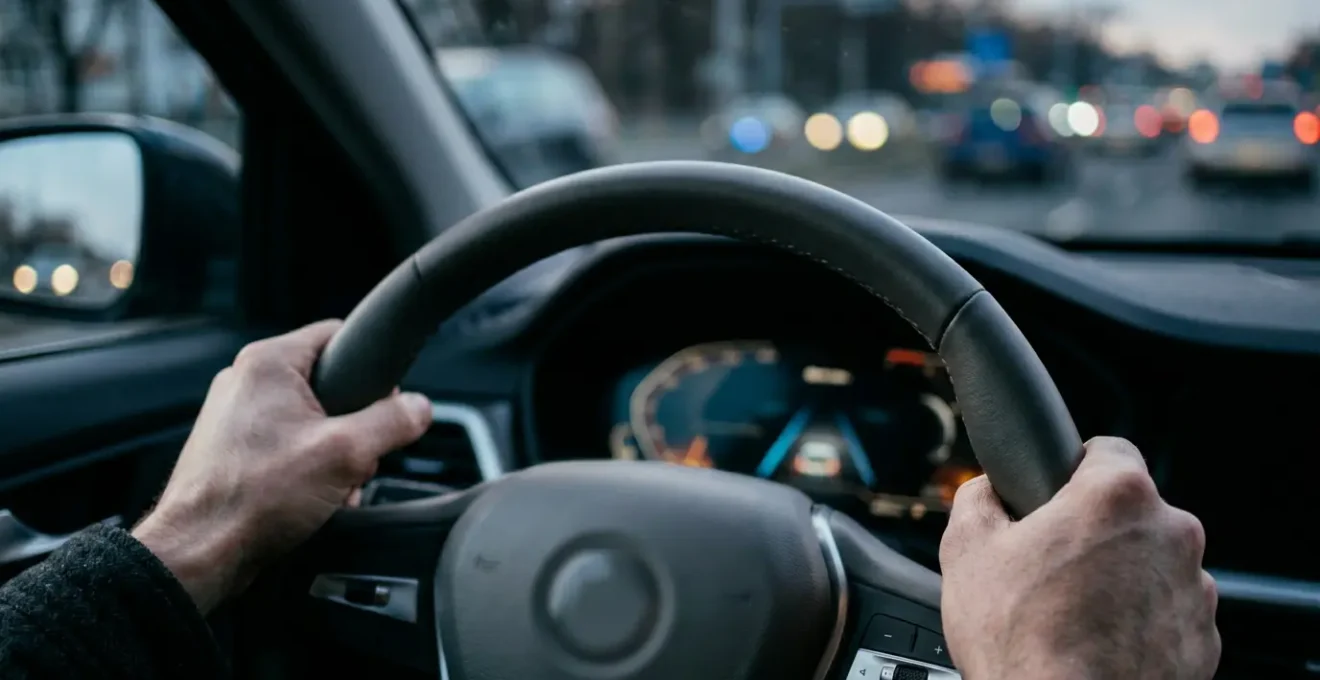
Driver-assist systems don’t make driving easier; they change your job from an active operator to a vigilant system supervisor—a role requiring different, often more intense, focus.
- Level 2 systems, like Tesla’s Autopilot, are assistance tools, not self-driving. Full responsibility always remains with the driver.
- UK-specific conditions like low sun, gritter grime, and narrow country lanes can instantly make these systems unreliable.
Recommendation: Treat your car’s « Autopilot » as a sophisticated cruise control. You must understand its limitations and be ready to take over instantly, at all times.
The flashing blue lights in the rearview mirror on the M25 are a sight no one wants to see. Yet, stories are becoming more common: a momentary lapse in concentration, a sudden jolt, and a driver explaining, « But I thought the car was driving itself. » This confusion is the single most dangerous aspect of modern Advanced Driver-Assistance Systems (ADAS). Carmakers market them with names like « Autopilot » or « Drive Pilot, » implying a level of autonomy that simply doesn’t exist in consumer vehicles today. The common advice is to « always pay attention, » but this fails to address the core issue.
The reality is far more complex. These systems don’t just assist you; they fundamentally change your role in the vehicle. You are no longer just a driver, performing the physical acts of steering, braking, and accelerating. You are promoted—or perhaps burdened—to the role of a System Supervisor. This is not a passive role. It’s an active, cognitive job of monitoring the system, understanding its operational limits, and anticipating the precise moment when you must intervene. A crash doesn’t happen because the technology « failed »; it happens because the human supervisor did not understand the boundaries of their tool and their non-negotiable responsibility within them.
This guide will deconstruct the marketing hype and provide the clarity you need as a UK driver. We will explore why your hands must remain on the wheel, how to use these systems safely in typical British traffic, what makes them fail, and when you absolutely must take back control. It’s time to understand your new job description before you get behind the wheel.
Contents: Understanding Your Role as an ADAS Supervisor
- Why Level 2 Autonomy Still Requires Your Hands on the Wheel at All Times?
- How to Set Up Adaptive Cruise for Safe Following in Heavy M1 Traffic?
- Tesla Autopilot, BMW Driving Assistant, or Mercedes Drive Pilot: Which Handles UK Roads Best?
- The 4 UK Weather Conditions That Make Your Lane Keeping Assist Dangerously Unreliable
- When to Take Back Control From Your Car: Reading the 3-Second Warning Signs?
- Why Does ACC Sometimes Follow Lorries but Ignore Motorcycles Filtering Past?
- Why Does Your Car Beep Aggressively When the Vehicle Ahead Brakes Sharply?
- Why Does Your Adaptive Cruise Control Suddenly Brake When No Obstacle Is Visible?
Why Level 2 Autonomy Still Requires Your Hands on the Wheel at All Times?
The term « Autopilot » is perhaps the most misleading marketing term of the decade. The systems in cars like Teslas, BMWs, and Mercedes are classified as SAE Level 2. This is a crucial distinction. Level 2 means the system can assist with steering and speed, but it is not « self-driving. » The defining feature of Level 2 is that the human is designated as the primary safety backup. You are not a passenger; you are the permanent, on-duty supervisor responsible for monitoring the environment and the system’s behaviour.
The technology is simply not ready to handle every eventuality, or what engineers call « edge cases. » A faded lane marking, a cyclist swerving unexpectedly, or a complex junction are all scenarios where the system’s programming can fail. Your human brain, with its lifetime of experience and predictive ability, is the final line of defence. Keeping your hands on the wheel is not just a legal requirement; it’s a physical necessity that dramatically reduces takeover time. A driver with hands on the wheel can react fractions of a second faster than one whose hands are in their lap—a difference that can mean avoiding a collision.
The industry is moving towards these systems rapidly; forecasts suggest that over 31% of new vehicle sales globally by 2035 will feature Level 2+ or higher systems. In response, regulators are focusing on the human element. As stated in an analysis of recent UNECE regulations, the emphasis is on stricter standards for driver engagement, monitoring systems and interface transparency. This confirms the industry’s direction: technology will assist, but the buck stops with the attentive, engaged, and legally responsible human supervisor.
How to Set Up Adaptive Cruise for Safe Following in Heavy M1 Traffic?
Using Adaptive Cruise Control (ACC) during a slow crawl on the M1 can feel like a godsend, but setting it up incorrectly can create risk. The system is a tool, and like any tool, it must be used correctly for the specific job at hand. Heavy, unpredictable traffic is one of its toughest challenges. The key is not to « set and forget, » but to actively manage the system as the traffic flow changes. Your role as a supervisor is to give the system the best possible chance to succeed.
Start by selecting the maximum following distance. In the stop-and-go chaos of a traffic jam, a longer gap provides a larger buffer for the system to react to sudden braking ahead. It also makes your car’s behaviour more predictable and less stressful for the driver behind you. A short gap in heavy traffic is a recipe for jerky, aggressive braking from the ACC, and it significantly increases the risk of a rear-end collision if you need to brake harder than the system anticipates.
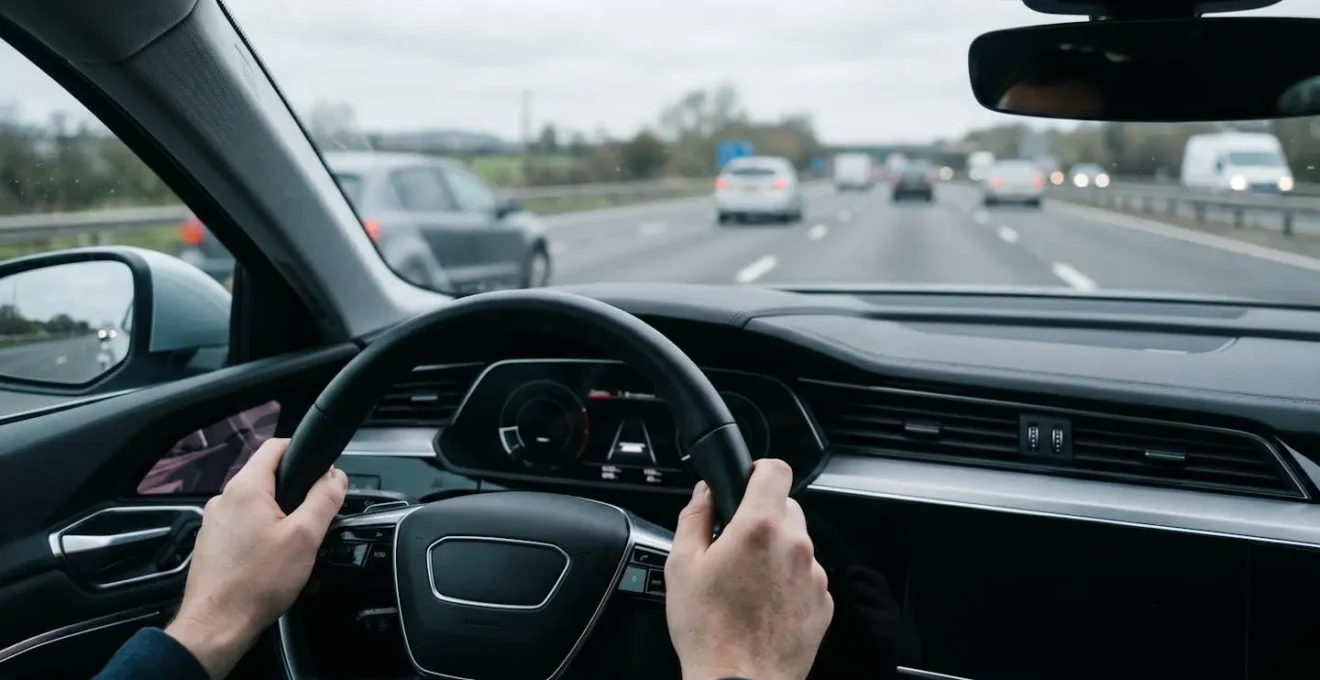
Throughout the journey, your eyes should be doing two things: scanning the road far ahead and periodically glancing at the dashboard display. You need to confirm which vehicle the ACC is tracking. When another car cuts into your lane, the system can momentarily lose its target before acquiring the new one. In that split second, the car might start to accelerate towards the vehicle it was previously following, which is now two cars ahead. This is a classic scenario where the vigilant supervisor must be ready to tap the brakes and manually reassume control. Active management is the only way to use ACC safely in dense, dynamic environments like UK motorways.
Your Action Plan: Using ACC in Heavy Traffic
- Select initial following distance based on traffic predictability—maximum gap (1.0s+) for erratic stop-and-go traffic, moderate gap (0.8-0.9s) for smooth flowing conditions.
- Monitor the dashboard display to confirm which vehicle the ACC is tracking, especially after lane merges or cuts-ins by other vehicles.
- Use gentle accelerator taps to override phantom braking during traffic waves—brief acceleration confirms to the system that you’ve assessed the situation as safe.
- Adjust follow-distance dynamically as traffic conditions change rather than using a static ‘set-it-and-forget-it’ approach, particularly when transitioning between highway and urban motorway segments.
Tesla Autopilot, BMW Driving Assistant, or Mercedes Drive Pilot: Which Handles UK Roads Best?
Not all Level 2 systems are created equal. Behind the marketing names, different manufacturers have fundamentally different philosophies about how the car should interact with the driver. Understanding these philosophies is key to choosing a system that matches your expectations and to using it safely on challenging UK roads. One system might feel confident and assertive, while another acts like a cautious co-pilot, and a third behaves like a professional chauffeur.
Tesla’s Autopilot, for example, is known for its « confident » and sometimes « arrogant » behaviour. It operates across a broad range of conditions but has historically shown lower scores for keeping the driver engaged. Conversely, Mercedes’ Driver Assist is designed to be a « cautious professional chauffeur »—its actions are predictable and smooth, and it’s designed for collaborative handover, allowing the driver to make small steering inputs without disengaging the system. BMW’s Driving Assistant Pro aims for a middle ground, acting as a « co-pilot that trusts driver judgment, » offering hands-free operation on motorways but requiring constant driver monitoring.
This following table, based on recent analysis and rankings, highlights these crucial philosophical and practical differences. It’s not about which is « best » overall, but which is best suited to a particular driver’s temperament and the specific demands of UK driving.
These different approaches are highlighted in a comparative analysis from Consumer Reports, which consistently evaluates how these systems perform in real-world driving.
| System | Consumer Reports Rank (2025) | System Philosophy | Driver Monitoring | Key Limitation |
|---|---|---|---|---|
| Tesla Autopilot | 8th | Confident, sometimes arrogant—broad operational design domain, vision-only approach | Torque-based wheel detection (shuts off if wheel jerked) | Lower driver engagement score (36/100 on road focus) |
| Mercedes Driver Assist | 3rd | Cautious professional chauffeur—predictable, radar-assisted, collaborative handover | Allows driver wheel input without disengaging (collaborative) | Lacks driver-monitoring camera in some models (EQE) |
| BMW Driving Assistant Pro | Top tier (specific rank varies) | Co-pilot that trusts driver judgment—Mobileye EyeQ4, balanced sensor fusion | Highway Assistant hands-free up to 85mph with active monitoring | Random disengagements on curves at highway speeds (65+ mph) |
Case Study: Mercedes’ Compliance-First Philosophy Pays Off
In December 2024, Mercedes-Benz became the first automaker in Germany authorized to increase the operating speed of its DRIVE PILOT Level 3 system to 95km/h and use special marker lights indicating automated driving mode. This regulatory milestone demonstrates how Mercedes’ cautious, compliance-first philosophy translates into real-world legal autonomy, contrasting with Tesla’s broader but legally Level 2 approach that maintains full driver responsibility regardless of capability.
The 4 UK Weather Conditions That Make Your Lane Keeping Assist Dangerously Unreliable
A Level 2 system is only as good as the data its sensors receive. On a clear, dry day with perfect lane markings, most systems perform admirably. But UK driving is rarely that simple. Our uniquely variable weather presents specific challenges that can render Lane Keeping Assist Systems (LKAS) dangerously unreliable in the blink of an eye. Research from AAA has shown the dramatic difference weather can make, revealing a 69% failure rate for lane keeping in poor weather, compared to just 17% in clear conditions. As a system supervisor, you must learn to recognise these high-risk scenarios and know when to switch the system off entirely.
The primary sensors for LKAS are cameras, and they are susceptible to the same limitations as the human eye, sometimes more so. Here are four critical scenarios common in the UK that can cause your system to fail without warning:
- Low Sun Dazzle: A low-angle winter or morning sun reflecting off a wet road can blind the camera sensor. The system may suddenly swerve or disengage completely, often at the worst possible moment on a busy east-west motorway like the M4.
- Post-Gritter Grime: In winter, the salty, dirty spray kicked up by traffic and road gritters can create a film on the windscreen that obscures the camera’s view. Even with wipers on full, there can be a temporary but critical blindness that causes the system to lose track of the lane.
- Leaf-Covered Lines: A quintessentially British autumn problem. A mat of wet leaves can completely cover the white lines, making them invisible to the camera. The system has no reference point and will likely disengage or behave erratically.
- Patchy Fog: While the car’s radar can see through fog, its cameras cannot. This creates a « sensor-fusion conflict. » The car gets conflicting data about its environment and, in the absence of clear lane markings from the camera, will default to safety and disable the steering assist.
In all these cases, the car may give you a chime or a visual warning, but the responsibility to immediately take firm control is yours. Recognising the weather conditions *before* the system fails is a key skill of a competent system supervisor.
Your Pre-Drive ADAS Reliability Checklist
- Weather & Light: Is it raining, foggy, or is there a low, dazzling sun? These conditions degrade camera performance.
- Windscreen Clarity: Is the area in front of the camera sensors (usually top-centre of the windscreen) perfectly clean, inside and out? Any grime or film will blind the system.
- Road Markings: Are you on a road with clear, well-maintained lane markings? Worn-out city streets or country roads with no lines will disable the system.
- Traffic Type: Are you in predictable motorway traffic or chaotic urban traffic with cyclists and pedestrians? The system is designed for the former.
- Your Own State: Are you feeling alert, rested, and ready to supervise? If you’re tired, you’re not fit to be a system supervisor, let alone a driver.
When to Take Back Control From Your Car: Reading the 3-Second Warning Signs?
The most critical moments in semi-automated driving are the transitions of control. This can be a planned handover, like when you approach your motorway exit, or an unplanned, emergency handover when the system encounters a situation it cannot handle. Your ability to read the subtle clues that the system is struggling—the « warning signs »—and react instantly is paramount. These signs often appear a few seconds before the audible alarm, giving the vigilant supervisor a crucial head start.
One of the first signs is what engineers call « lane hunting. » Instead of tracking smoothly in the centre of the lane, the car may begin to make tiny, almost imperceptible sways from one side of the lane to the other. It’s « hunting » for a clear signal from the lane markings that is becoming degraded. This is your first clue that the camera’s confidence is dropping. Another sign is a subtle change in the following distance to the car ahead. If the ACC starts to lag more than usual or allows the gap to close inconsistently, it could be a sign that its radar or camera is struggling to maintain a solid lock.
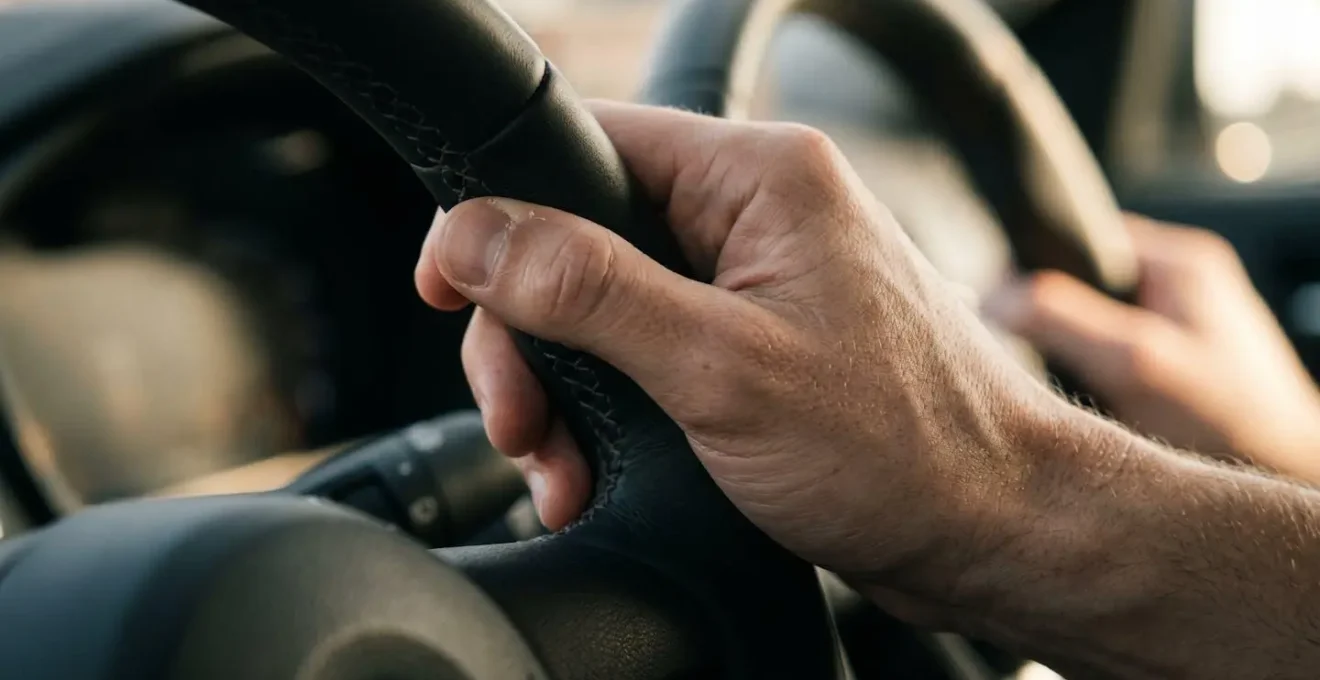
The ultimate signal is an unexpected and unprompted change in speed, whether it’s a slight deceleration for no reason (a « phantom brake ») or a failure to slow down when the traffic ahead is clearly braking. These are not « glitches »; they are clear signs that the system has reached the edge of its operational domain. The moment you detect any of these behaviours, it is not the time to wait and see what the car does next. It is the time for an immediate, decisive takeover. Your hands should already be on the wheel, allowing you to grip firmly, override the system, and resume full manual control. This is not the system failing; this is the system doing its job of assisting up to its limit, and you doing your job as supervisor to take over when that limit is reached.
Why Does ACC Sometimes Follow Lorries but Ignore Motorcycles Filtering Past?
This is a classic and terrifying scenario for many drivers using Adaptive Cruise Control (ACC). You’re following a large lorry at a safe distance, and suddenly a motorcycle filters between the lanes. The car doesn’t react, and you have to slam on the brakes. The reason for this heart-stopping moment lies in the physics of how your car’s primary sensor, the radar, actually « sees » the world. It doesn’t see vehicles; it sees reflective objects and makes judgments based on their size, speed, and consistency.
A large, articulated lorry presents an ideal target for radar. It has a massive, flat metal back, providing a huge radar cross-section. It’s a giant, slow-moving, and predictable radar signal that the system can lock onto with very high confidence. The system’s algorithm says, « This is a large, stable object. I will follow it. » In contrast, a motorcycle is a radar nightmare. It is small, narrow, and made of many different materials that scatter rather than reflect the radar signal. Its radar cross-section is tiny and can flicker in and out of detection.
Furthermore, the system’s « object permanence » programming is a factor. The ACC is designed to ignore fleeting signals, like a bird flying past or a piece of road debris. Because the motorcycle is moving at a different speed to the traffic flow (filtering) and has a weak radar signal, the system can misclassify it as a transient, unimportant object. It sees the strong, consistent signal of the lorry ahead and the weak, intermittent signal of the bike, and its programming prioritises the high-confidence target. It is not ignoring the motorcycle out of a « flaw » but because, according to its rigid logic, the lorry is a much more certain object to track. This is a perfect example of where a human supervisor’s ability to identify and prioritise a vulnerable road user is irreplaceable.
Why Does Your Car Beep Aggressively When the Vehicle Ahead Brakes Sharply?
That sudden, loud, and often aggressive BEEP-BEEP-BEEP from your Forward Collision Warning (FCW) system can be jarring. It feels like the car is panicking. But it’s not panicking; it is communicating a very specific and urgent message. It’s performing a « responsibility transfer. » The system has calculated that a collision is likely and that its own automated braking capabilities might not be sufficient to avoid it, or that its intervention would be uncomfortably harsh.
Think of the system’s layers of response. The first is the automated braking from the ACC or Autonomous Emergency Braking (AEB). This is designed for smooth, controlled deceleration. However, if the car ahead brakes with extreme force, the system’s computer calculates the closing speed and realises that its pre-programmed « comfortable » or « efficient » braking profile is not enough. It needs maximum braking force, and it needs it *now*. The system knows that the most powerful and effective braking system in the car is the one controlled by a panicked human foot standing on the brake pedal.
The beep is a command, not a suggestion. It is the digital equivalent of a co-pilot shouting, « Your controls! » It is a deliberately startling sound designed to break your fixation, trigger your adrenaline, and force an immediate physical response. As one design paper puts it, the sound has a very precise meaning:
The beep is not just saying ‘danger’; it’s saying ‘My automated braking may not be sufficient or smooth. I am transferring responsibility to you NOW.’
– Forward Collision Warning System Design Philosophy, MDPI – Optimization of Adaptive Cruise Control Strategies
When you hear that beep, your immediate action should be to brake as hard as you can while checking your mirrors for an escape route. You are no longer supervising; you are the pilot-in-command, and the car has just handed you a full-blown emergency.
Key Takeaways
- You are a System Supervisor, not a passenger. Your primary job is to monitor the system and be ready to intervene.
- Every Level 2 system has a limited « Operational Domain. » UK weather, poor road markings, and complex junctions are all outside its reliable working conditions.
- The system’s alerts (beeps, vibrations) are not suggestions; they are commands signifying an immediate transfer of responsibility back to you.
Why Does Your Adaptive Cruise Control Suddenly Brake When No Obstacle Is Visible?
The infamous « phantom braking » event is one of the most unnerving experiences when using an ADAS. You’re driving on a clear road, and the car suddenly and sharply brakes for no apparent reason. It’s not a random glitch. This is often a direct consequence of a fundamental engineering trade-off: is it better to brake for something that isn’t there (a false positive) or fail to brake for something that is (a false negative)? For safety engineers, the answer is clear. The phantom brake is a deliberate choice that prioritises safety over comfort.
These events are often triggered by « sensor-fusion conflicts. » Your car’s camera might see a shadow on the road from an overpass and misinterpret it as a stationary object. Simultaneously, its radar sees the road is clear. Faced with conflicting data—camera says « stop, » radar says « go »—the system is programmed to err on the side of caution. It momentarily trusts the sensor that is indicating danger and applies the brakes. Other common triggers include metal plates on the road, parked cars on a curved exit ramp, or even a vehicle in an adjacent lane on a sharp bend.
While frustrating, this behaviour demonstrates a core principle of the system’s design. It shows that the system is actively looking for potential threats and is programmed to assume the worst-case scenario. Researchers are constantly working to reduce these false positives, but the underlying philosophy remains.
Engineering Insight: Choosing Safety Over Comfort
Recent research into next-generation ACC systems highlights this trade-off. One experimental system, SFRL-ACC, was specifically designed to reduce phantom braking by using a more advanced learning model. The researchers noted that traditional systems are deliberately biased towards safety. In their analysis, they confirmed that « the annoying phantom brake is a deliberate engineering choice favoring safety over comfort. » The system brakes because the risk of not braking for a potential hazard, however small, is deemed unacceptable by its designers.
As the system supervisor, understanding this helps reframe the event. It’s not a malfunction; it’s a window into the car’s conservative, safety-first thought process. Your job is to anticipate it, check your mirrors, and be ready to override it with a gentle tap on the accelerator to tell the system, « I’ve seen it, I’ve assessed it, and it’s safe to proceed. »