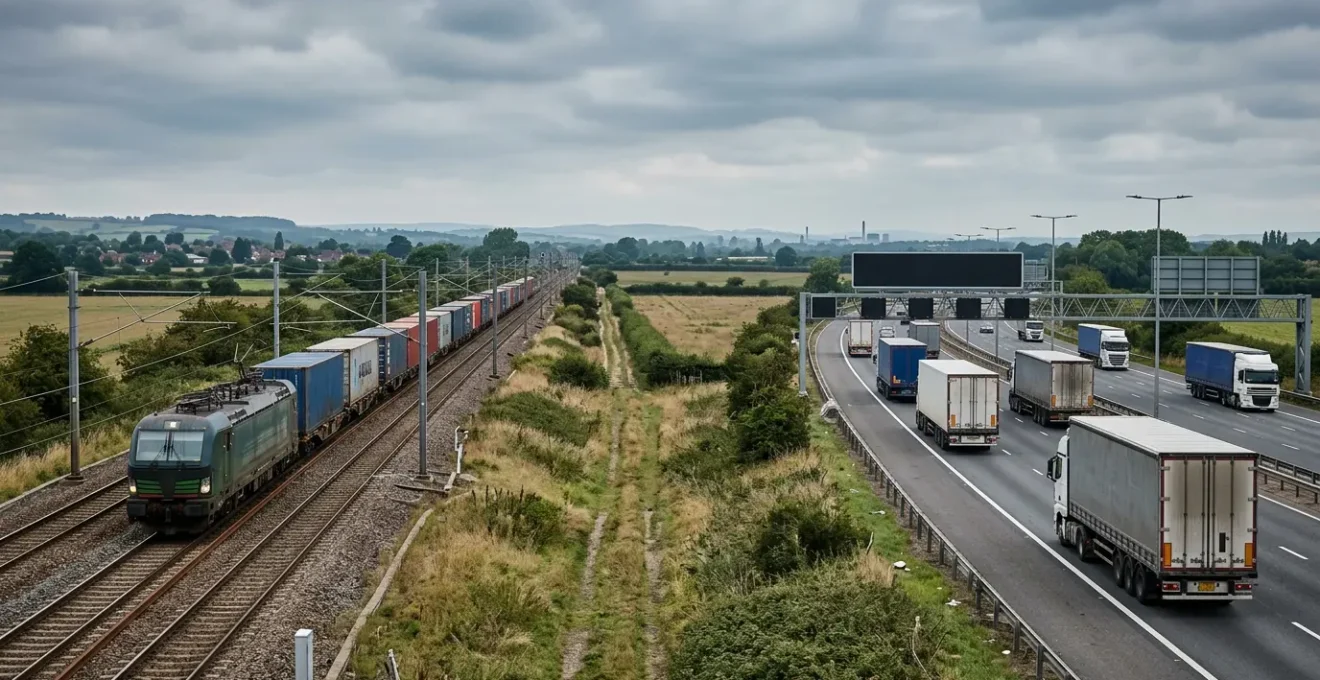
The high per-shipment cost of rail freight isn’t a flaw; it’s the price of entry to a system designed for massive economies of scale.
- Rail’s cost-effectiveness is unlocked by absorbing high fixed costs (terminals, locomotives, paths) across large, consistent volumes of goods.
- Success depends on minimizing « intermodal friction »—the cost and complexity of road-to-rail transfers—by using routes with dense logistics hubs at the destination.
Recommendation: Stop comparing a single lorry to a single rail shipment. Instead, analyse your total annual volume on a specific corridor to find the critical mass where rail’s per-pallet cost drops below road transport.
For any UK shipper, the paradox is familiar. You receive a quote for a single pallet or container by road and it seems reasonable. Then you ask for a rail freight quote and the price per shipment appears prohibitively high. Yet, every industry report and logistics expert extols rail as the cheaper option for long-distance haulage, with a lower cost per tonne-mile. This apparent contradiction leaves many businesses confused, sticking to the perceived safety of road transport while missing out on significant strategic advantages. The common refrains—that rail is « greener » or « good for bulk »—are true, but they fail to explain the underlying economic mechanics.
The confusion stems from comparing two fundamentally different logistics models. A lorry is a self-contained unit of capacity you hire on demand. A rail service is a slice of a vast, scheduled infrastructure with enormous fixed costs. The key to unlocking rail’s value isn’t just about distance; it’s about understanding the principles of fixed-cost absorption and intermodal efficiency. The high « per shipment » cost is simply the price of under-utilising the immense capacity of the railway. When volume reaches a critical mass, that initial cost is spread so thinly that the per-pallet price plummets.
This guide demystifies the economics for the UK shipper. We will break down the components that contribute to the cost structure, moving beyond simplistic platitudes to provide a practical framework. We’ll explore when rail becomes cheaper, which operators can provide end-to-end services, and why the model is a perfect fit for supermarkets but a challenge for just-in-time component delivery. By understanding the « why » behind the costs, you can accurately identify the thresholds where rail transitions from an expensive alternative to a powerful tool for sustainable and cost-effective logistics.
To navigate this complex topic, this article breaks down the core questions that shippers face. From calculating break-even points to understanding network capabilities, the following sections provide a clear and structured overview of UK rail freight economics.
Summary: Decoding UK Rail Freight Economics
- How Many Pallets Make Rail Freight Cheaper Than Trucking From Glasgow to London?
- Which UK Rail Freight Operators Offer Door-to-Door Service With Final Mile Delivery?
- How Much CO2 Does Moving 20 Tonnes by Rail Save Compared to Road Haulage?
- Why Does Rail Work for Supermarket Distribution but Not for Engineering Parts?
- When to Start Rail Freight Planning: The 3-Month Slot Booking Requirement?
- Which UK Rail Freight Terminals Can Handle 45ft Containers for European Trade?
- Why Some Routes Benefit From Rail-Road Combination While Others Lose Money?
- Why Does Germany Move 20% of Freight by Rail While UK Manages Only 9%?
How Many Pallets Make Rail Freight Cheaper Than Trucking From Glasgow to London?
There is no single magic number of pallets that triggers the switch to rail freight. Instead, the break-even point is a dynamic calculation based on the principle of fixed-cost absorption. A freight train has immense fixed costs: the locomotive, the crew, the wagons, track access charges from Network Rail, and terminal handling fees at both ends. A single pallet bears an impossibly high share of these costs, making it far more expensive than a dedicated van. However, as you add more pallets to the same train, these fixed costs are divided across a larger volume, causing the per-pallet cost to decrease dramatically.
The goal is to reach a « critical mass » where the per-pallet cost on rail drops below the equivalent cost for road haulage on that specific corridor. For a high-density route like Glasgow to London, this threshold is achieved by consignments that can fill, or significantly contribute to filling, an entire train. This typically involves hundreds of pallets, often aggregated from multiple customers or from a single high-volume shipper. It’s a game of volume and consistency. A one-off large shipment may still be more expensive than multiple lorries due to the complexities of spot-booking a train path.
The pioneering Tesco-Stobart Rail partnership provides a clear benchmark. This dedicated service for high-volume retail freight established the economic model for the Glasgow-London corridor. By committing to consistent, large-scale movements, they were able to make the economics work. Over its initial three-year term, the service replaced 130,000 lorry journeys, proving that once the volume threshold is met, rail offers significant cost advantages. For a shipper, the question isn’t « is this one shipment cheaper by rail? » but rather « is my total annual volume on this corridor sufficient to anchor a regular, cost-effective rail service? »
Which UK Rail Freight Operators Offer Door-to-Door Service With Final Mile Delivery?
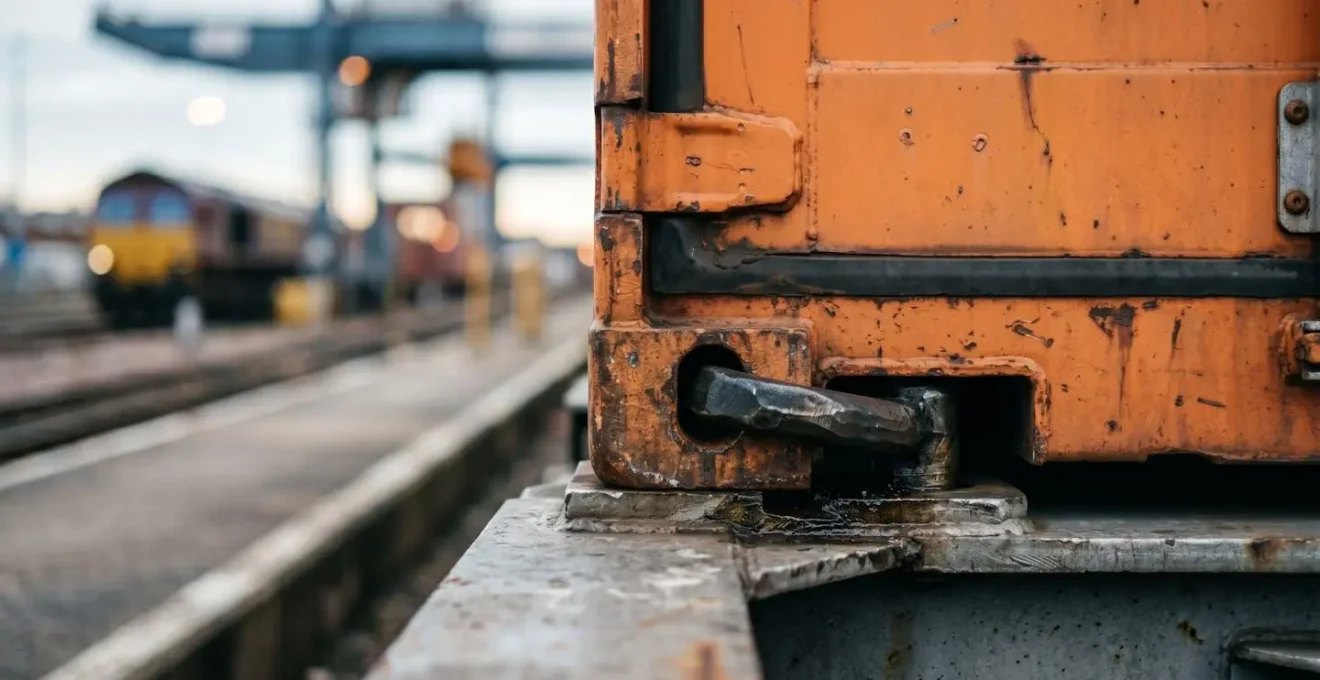
One of the biggest hurdles for shippers new to rail is the challenge of « intermodal friction »—the cost, time, and logistical complexity of moving goods from a factory to a rail terminal (first mile) and from the destination terminal to the final delivery point (last mile). While rail is efficient for the long-haul trunk journey, a seamless door-to-door solution is essential for it to compete with the inherent flexibility of road transport. Several major UK rail freight operators have built their business models around minimizing this friction by offering integrated, end-to-end logistics solutions.
These operators bridge the gap by either owning their own road haulage fleets and terminal infrastructure or by establishing deep partnerships with third-party logistics (3PL) providers. This integration allows them to offer a single point of contact and a unified service level agreement (SLA) covering the entire journey. For the shipper, this transforms a complex multi-stage process into a single, managed transport solution. The operator takes responsibility for the container transfer at the terminal, coordinating road collection and final delivery to align with the train’s arrival and departure.
The image below illustrates the critical moment of transfer at an intermodal terminal, where the container is moved between the rail wagon and the road vehicle. This is the physical manifestation of « intermodal friction, » and the efficiency of this operation is paramount to a successful door-to-door service.
The level of integration varies by operator, with some specialising in specific market sectors. A shipper’s choice will depend on the type of freight, the route, and the required level of service integration. Understanding these specialisms is key to finding the right partner.
The following table provides a comparison of the major UK operators and their capabilities in offering these crucial end-to-end services. This highlights how market leaders like Freightliner have invested in a fully integrated model, while others leverage partnerships to achieve the same result for their customers.
| Operator | Market Share (2024) | Primary Specialism | Door-to-Door Capability |
|---|---|---|---|
| Freightliner Group | 32% | Maritime containers via ports, intermodal logistics | Full end-to-end with owned terminals and road fleet |
| GB Railfreight | 29% | Construction, aggregates, intermodal domestic | Terminal management and partnerships |
| DB Cargo UK | 27% | Automotive, steel, petrochemicals, finished vehicles | Integrated logistics with road partners |
| Direct Rail Services | ~8% | Nuclear, retail (Tesco/Asda), spot market | Bespoke tailor-made transport solutions |
| Colas Rail | ~3% | Timber, construction materials | Limited, sector-specific |
How Much CO2 Does Moving 20 Tonnes by Rail Save Compared to Road Haulage?
Beyond pure cost economics, the environmental benefit is one of the most compelling drivers for modal shift to rail. For UK businesses with ESG (Environmental, Social, and Governance) targets and pressure to decarbonise their supply chains, rail freight offers a proven and impactful solution. The carbon savings are not marginal; they are substantial and directly quantifiable, making them a powerful tool for corporate sustainability reporting.
The core advantage stems from efficiency of scale. A single freight train can move the equivalent of over 76 heavy goods vehicles (HGVs), but with vastly lower energy consumption per tonne-mile. This efficiency translates directly into reduced carbon emissions. According to official data, rail freight’s carbon footprint is significantly smaller than its road counterpart. Figures confirm that there are 76% lower carbon emissions compared to road transport, with freight rail producing just 26g of CO2 equivalent (CO2e) per net tonne-kilometre.
To put this into perspective for a shipper, let’s consider moving a 20-tonne consignment from Glasgow to London (approximately 650 km or 400 miles). * By Road (HGV): The emissions would be roughly 540 kg of CO2e for the journey. * By Rail: The same 20-tonne consignment would generate approximately 130 kg of CO2e. This represents a saving of over 410 kg of CO2e for a single 20-tonne movement. When scaled up across hundreds or thousands of shipments annually, the cumulative carbon savings can run into many tonnes, making a significant contribution to a company’s net-zero ambitions. This calculation provides a clear, data-backed justification for modal shift that resonates far beyond the logistics department, appealing to stakeholders, investors, and customers alike.
Why Does Rail Work for Supermarket Distribution but Not for Engineering Parts?
The suitability of rail freight is determined less by the product itself and more by the nature of the demand. The stark contrast between supermarket logistics and the supply chain for specialist engineering parts perfectly illustrates this. Rail thrives on predictability, high volume, and time-tolerance—three characteristics that define grocery distribution but are often absent in specialist manufacturing.
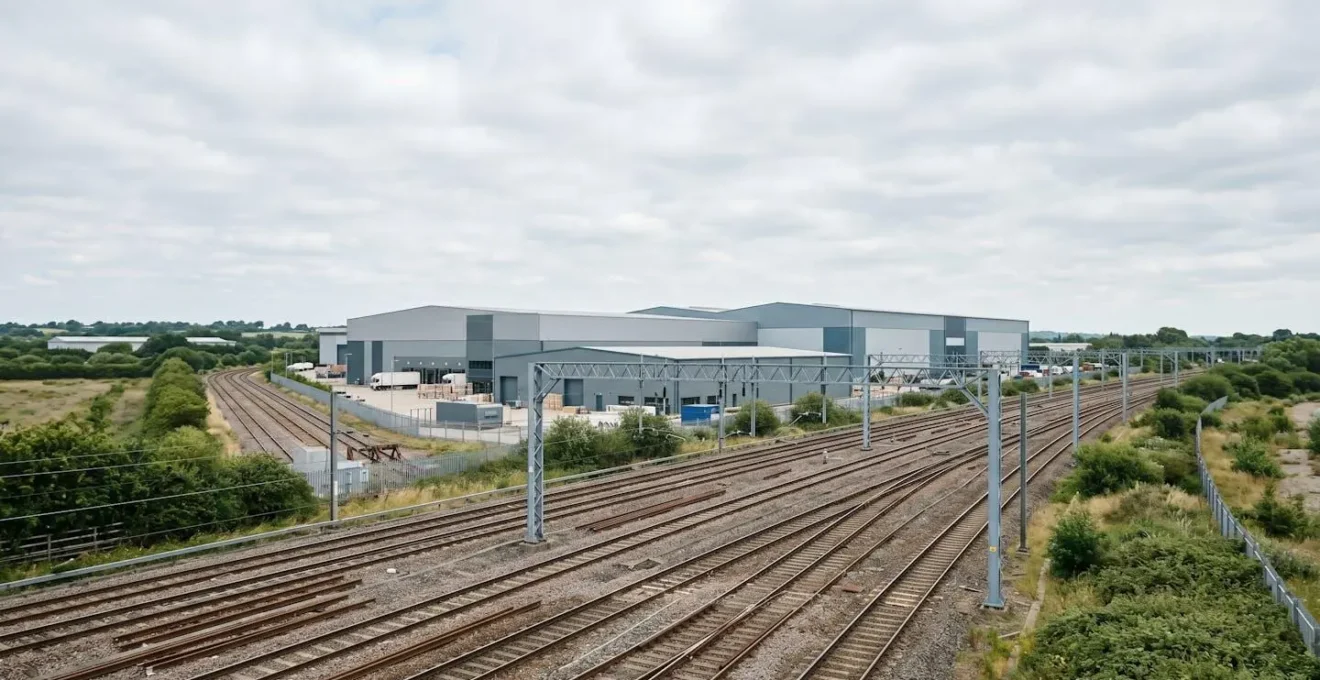
Supermarkets like Asda and Tesco have built their supply chains around a hub-and-spoke model with massive, centralised distribution centres (DCs). They need to move vast quantities of fast-moving consumer goods (FMCG) on fixed, reliable schedules between these DCs. As the case study of Asda’s services between Daventry, Grangemouth, and Aberdeen shows, these are dedicated, high-volume flows. The consistency allows them to book entire trains, maximising asset utilisation and achieving the economies of scale needed to drive down per-unit costs. The inventory is relatively time-tolerant; a delay of a few hours for a train load of baked beans is manageable within the DC’s safety stock.
This large-scale infrastructure, connecting rail sidings directly to modern distribution warehouses, is the backbone of the retail rail freight model, as depicted in the landscape below.
In contrast, the market for specialist engineering parts is often characterised by low-volume, high-variety, and time-critical demand. A manufacturing plant might need a specific, single component to prevent a line stoppage. The shipment is small, urgent, and the delivery window is inflexible. This « just-in-time » model is perfectly suited to the on-demand, point-to-point flexibility of road haulage. Attempting to move such a small, urgent consignment by rail would be economically unviable and operationally risky, as the fixed schedules and terminal processes of rail cannot offer the required agility. Rail’s strength lies in planned, bulk movements, not reactive, single-item logistics.
When to Start Rail Freight Planning: The 3-Month Slot Booking Requirement?
Shifting to rail freight is not a tactical, last-minute decision; it is a strategic change in your supply chain that requires significant forward planning. Unlike booking a lorry, which can often be done with 24 hours’ notice, securing capacity on the rail network is a complex process governed by what is known as « pathing and timetabling economics. » The UK rail network is a finite resource, with passenger services typically given priority. Freight services must bid for the remaining available slots, or « paths, » in a process managed by Network Rail.
For regular, scheduled services, these paths are often booked months in advance as part of the national timetabling process. This means a shipper looking to establish a new rail flow must engage with a freight operating company (FOC) long before the first container is ready to move. A lead time of three to six months is standard for establishing a new, reliable service. This period is not just for bureaucracy; it’s essential for conducting feasibility studies, vetting terminal infrastructure at both ends, and securing the necessary last-mile road haulage partnerships.
This long planning horizon is often a deterrent for businesses accustomed to the flexibility of road transport. However, it reflects the fundamental difference in models: you are not just booking a vehicle, you are integrating your supply chain into a piece of national infrastructure. The process requires commitment and a clear forecast of volumes. For shippers ready to make that strategic shift, a structured approach is essential to ensure a smooth implementation.
Your Action Plan: New-to-Rail Project Implementation Timeline
- T-6 months: Initial Feasibility Assessment – Conduct volume analysis, route viability study, and initial operator consultations to determine if rail freight offers commercial advantages including reliability, speed and cost-effectiveness for your specific corridor.
- T-4 months: Terminal & Last-Mile Infrastructure Vetting – Assess loading/unloading capabilities at origin and destination terminals, verify container handling equipment compatibility, and establish road haulage partnerships for final mile delivery.
- T-3 months: Path Bidding/Booking with Operator – Submit formal path request through your chosen freight operating company, who will coordinate with Network Rail’s complex timetabling process, understanding that passenger services receive priority.
- T-2 months: Contract Finalization & SLA Agreement – Negotiate service level agreements (SLAs), establish Freight Delivery Metric targets (the industry achieves 97% reliability on premium services), and define contractual penalties for volume shortfalls.
- T-1 month: Trial Run & Operational Readiness – Execute a test shipment to validate the entire supply chain, train warehouse staff on rail-specific procedures (e.g., container loading protocols), and confirm access to real-time visibility platforms.
Which UK Rail Freight Terminals Can Handle 45ft Containers for European Trade?
For UK shippers engaged in trade with Europe and beyond, the ability to handle specific container types is a critical factor in terminal selection. The 45ft pallet-wide high-cube container is a particularly important standard in European logistics, as it is designed to maximise pallet capacity, accommodating 26 standard Euro-pallets, the same as a standard lorry. However, not all UK rail lines and terminals can accommodate their larger size due to historical infrastructure constraints, specifically the « loading gauge » which dictates the maximum height and width of rolling stock.
Fortunately, significant investment in the UK’s Strategic Rail Freight Network has upgraded key routes to W10 and W12 loading gauges, enabling the widespread movement of these larger containers. The major deep-sea and short-sea ports have developed vast intermodal rail terminals specifically designed to handle these units, positioning themselves as critical gateways for European and global trade. These terminals offer not just the physical handling capability but also high-frequency daily services connecting the ports to inland distribution hubs across the country.
Forth Ports, operator of the Grangemouth terminal in Scotland, highlights the advanced equipment required, stating:
The container facility is well equipped, offering 3 modern gantry cranes as well as 16 straddle carriers, each of which are capable of handling boxes between 20ft and 45ft.
– Forth Ports, Grangemouth Container Terminal Technical Specifications
This capability is crucial for creating efficient, post-Brexit supply chains that can bypass congested road routes in the South East by using alternative North Sea ports. The following table outlines some of the key UK terminals with proven 45ft container handling capability, highlighting their strategic importance in the national logistics network.
| Terminal | Loading Gauge | 45ft Capability | Post-Brexit Strategic Advantage |
|---|---|---|---|
| Felixstowe (3 terminals) | W10/W12 | Full capability, 36 daily departures | Deep-Sea Gateway – UK’s largest intermodal rail facility |
| London Gateway (Tilbury) | W9/W10 | 775m train capacity, 24/7 operations | Deep-Sea Gateway with Channel Tunnel link |
| Southampton | W10 | High-cube/45ft compatible | Deep-Sea Gateway, DP World Modal Shift Programme |
| Grangemouth (Scotland) | W10 (gauge-free to East/West Coast) | Straddle carriers handle 20ft-45ft | Scotland’s largest, short-sea feeder to European deep-sea ports |
| Teesport | W10 | Full 45ft capability | North Sea Ro-Ro Hub, Brexit-alternative to Dover |
| Immingham | W10 | High-cube compatible | North Sea Ro-Ro Hub, port-rail integration |
| East Midlands Gateway (iPort Doncaster) | W12 | New investment, extended sidings | Strategic inland hub with automated handling |
Why Some Routes Benefit From Rail-Road Combination While Others Lose Money?
The profitability of an intermodal rail-road service is not determined by distance alone. A very long rail journey can still lose money if the « last mile » is inefficient, while a shorter route can be highly profitable if it connects to a dense logistics ecosystem. The key to success lies in the hub-and-spoke model, where rail is used for the high-volume, long-distance « trunk » haul, and road transport is used for efficient, short-distance distribution from a strategically located inland terminal.
Routes that lose money are often those with a fragmented destination profile. If a train arrives at a terminal and its containers must then be trucked to dozens of individual locations scattered over a 150-mile radius, the cost and complexity of the last-mile road haulage erodes or eliminates any savings made on the rail portion. This is a classic example of high « intermodal friction. » The rail journey simply becomes a more complicated and expensive way to get goods to a point from which costly road transport is still required.
In contrast, the most profitable routes are those that plug into a Strategic Rail Freight Interchange (SRFI) like Daventry in the Midlands. These locations are not just rail terminals; they are epicentres of logistics activity, surrounded by a dense cluster of major retailers’ and manufacturers’ national distribution centres. As the Felixstowe to Daventry route demonstrates, its profitability is secured by this destination density. The Port of Felixstowe, Britain’s largest intermodal generator, can run multiple, fully loaded trains daily to Daventry. Upon arrival, the final road journey to the surrounding DCs is short, often less than 50 miles, making the last-mile distribution extremely cost-effective. This configuration allows each mode to do what it does best: rail for efficient, high-volume trunking and road for flexible, short-range delivery.
Key takeaways
- Rail’s high initial cost is a fixed-cost barrier; the key is to surpass the volume threshold where the per-unit cost drops dramatically below road transport.
- The most profitable UK rail routes are not just long, but connect major ports to dense inland distribution hubs (a « hub-and-spoke » model), minimising expensive last-mile road haulage.
- Planning a new rail service is a strategic move requiring a 3- to 6-month lead time to secure network paths and coordinate logistics, not a tactical, last-minute booking.
Why Does Germany Move 20% of Freight by Rail While UK Manages Only 9%?
The disparity in rail freight’s modal share between the UK and Germany—roughly 9% versus over 20%—is not due to a single factor but a combination of geography, historical investment, and government policy. While UK rail freight is a success story in specific sectors like intermodal and construction, its overall share is constrained by several systemic challenges that Germany has addressed more proactively.
Firstly, geography plays a role. Germany’s position at the heart of Europe gives it a much larger volume of long-distance, cross-border freight, a market naturally suited to rail. The average length of haul is significantly greater. In contrast, Great Britain’s island nature and relatively shorter domestic distances mean many journeys fall below the threshold where rail’s economic advantage over road becomes compelling. In the UK, a vast amount of freight is moved by road; in 2024, official statistics showed that while rail moved 17 billion tonne-kilometres, roads handled 168 billion, giving rail an 8.2% modal share of the total.
Secondly, there is a marked difference in government policy and investment priorities. Germany has historically pursued a more integrated transport policy that actively favours rail, resulting in lower track access charges for freight operators compared to the UK. In the UK, the highly congested network, particularly in the south, often prioritises passenger services, making it more difficult and expensive to secure reliable paths for freight. Furthermore, the German network is more extensively electrified and has a more generous loading gauge, facilitating more efficient and cost-effective operations. While the UK government supports modal shift through grants like the Mode Shift Revenue Support (MSRS), the structural economics remain a higher barrier for potential users compared to their German counterparts. This combination of factors means that while UK rail freight is highly efficient within its niche, achieving a German-style modal share would require a transformative, long-term national strategy.
Ultimately, the decision to use rail freight requires a shift in perspective. By moving away from a shipment-by-shipment comparison and instead analysing corridor volumes, lead times, and sustainability goals, UK shippers can unlock the immense economic and environmental benefits that lie hidden behind the initial cost paradox. The next logical step is to apply this framework to your own supply chain and identify a high-volume corridor ripe for a strategic modal shift.