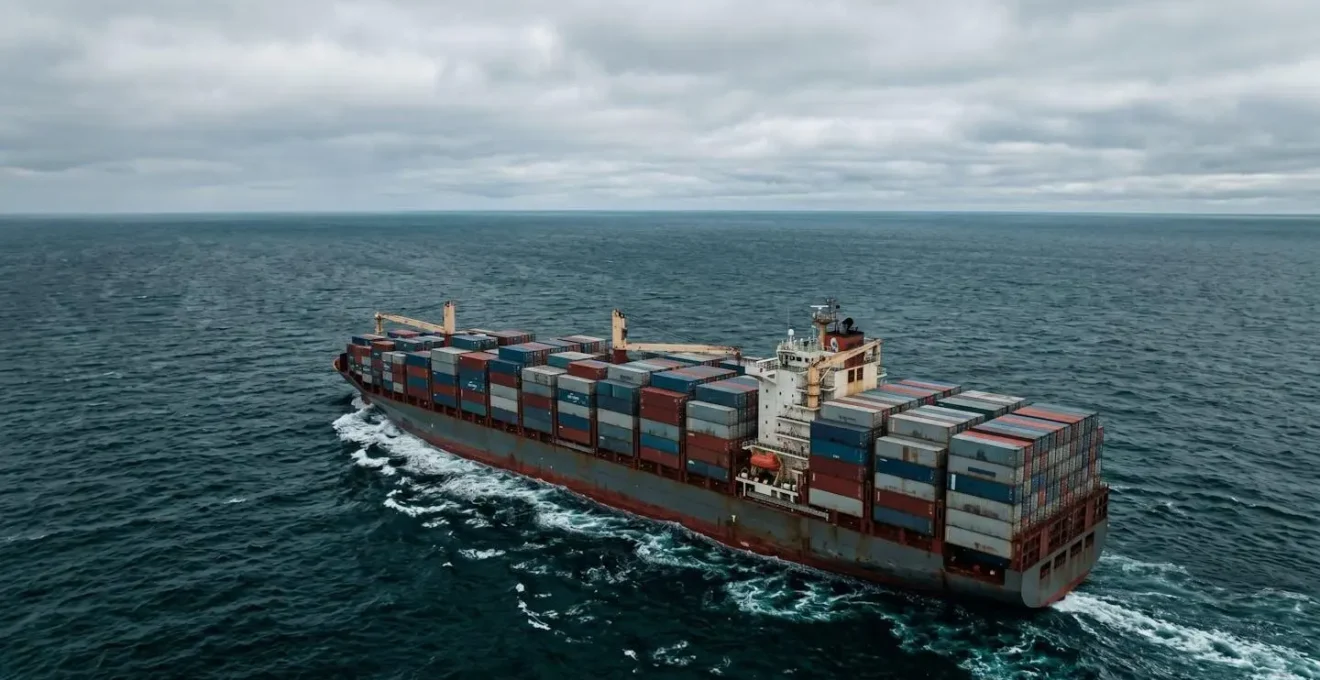
The seven-day gap in your shipping timeline isn’t random; it’s the direct result of the carrier’s commercial strategy, operational routing, and your choice between cost and speed.
- A cheaper quote often buys you a place on a slower, indirect « transshipment » service, adding days or weeks to the journey.
- Apparent tracking « blackouts » are normal; they represent time between scannable port events, not a stalled container.
Recommendation: Shift from focusing solely on the upfront freight cost to evaluating the total time-cost of the service, including potential port delays and deconsolidation fees, to make a truly informed logistics decision.
As a UK importer, you’ve faced the frustrating paradox of modern logistics. You book a container from Shanghai, quoted for a 35-day transit. Meanwhile, a competitor’s identical shipment from the same port arrives in just 28 days. The common culprits cited are always the same: port congestion, bad weather, or vague customs issues. While these factors play a role, they are merely symptoms of a much deeper reality that carriers and forwarders rarely explain in detail.
The truth is, the duration of your container’s journey is less about the ocean itself and more about a series of deliberate commercial and operational choices. The price you pay directly influences the route your cargo takes, the priority it receives, and its vulnerability to predictable bottlenecks. A lower price might secure you a slot on a vessel, but it could be a vessel that makes multiple stops, transfers your container at a secondary hub, or sits at anchorage for days awaiting a berth. This isn’t a failure of the system; it’s how the system is designed to balance capacity, demand, and price points.
But what if the key to shortening that 35-day transit wasn’t just about finding a « faster ship, » but about understanding the hidden mechanics behind the quote? The real power lies in deciphering the trade-offs between direct and indirect services, anticipating seasonal chokepoints, and mastering the nuances of customs documentation. It’s about moving from being a passive recipient of delays to becoming a strategic architect of your supply chain.
This guide will dissect the critical factors that dictate your transit time. We will explore why carrier pricing varies so dramatically, how to properly track your shipment, the true cost of choosing a shared container, and how to navigate the bottlenecks at UK ports and the complexities of customs clearance. By understanding these levers, you can finally take control of your timeline.
Summary: Decoding and Optimising Your China-UK Shipping Timeline
- Why MSC Charges £2,000 for the Same Container Maersk Quotes at £2,500?
- How to Track Your Ocean Container in Real-Time From Shanghai to Southampton?
- Full Container or Shared Load: Which Costs Less for 10 Cubic Metres?
- Why Felixstowe Delays Add 5 Days to Your Shipment Every August?
- When to Book Ocean Freight to Avoid the Chinese New Year Rate Surge?
- Why Your Tracking Shows « In Transit » for 5 Days Without Any Location Updates?
- The 5 Customs Form Mistakes That Flag Your Shipment for Physical Examination
- Why Did Your EU Shipment Get Held at Dover for 72 Hours Over a Missing Code?
Why MSC Charges £2,000 for the Same Container Maersk Quotes at £2,500?
The £500 price difference between two carriers for the exact same 40ft container on the same route isn’t arbitrary; it’s a direct reflection of their differing commercial strategies and service levels. A lower price from one carrier doesn’t mean they have a more efficient ship. It often means you are purchasing a different, and frequently slower, service product. Some carriers, like MSC and CMA CGM, have historically pursued aggressive market share strategies, while others, like Maersk, often bundle their freight rates with a promise of higher schedule reliability or premium services.
This price discrepancy is driven by two key factors: the service loop and transshipment. A premium-priced service typically follows a direct service loop, where the vessel travels directly from the origin port (e.g., Shanghai) to the destination port (e.g., Southampton) with minimal stops. The cheaper service is often a transshipment service. Your container is loaded onto a « feeder » vessel, taken to a massive hub port (like Singapore or Rotterdam), offloaded, and then reloaded onto a larger « mother » vessel for the main leg of the journey. Each of these steps adds days, risk, and complexity to the timeline, which is the hidden cost of the lower upfront rate.
The industry is rife with examples of this dynamic. These pricing wars demonstrate that carriers differentiate not on their physical infrastructure—which is often shared—but on their commercial approach. One carrier aims to fill every last slot, even at a discount, by offering less desirable routes. Another maintains price integrity by guaranteeing faster, more reliable transit for clients willing to pay a premium. When you receive two different quotes, you are not comparing apples to apples; you are choosing between two distinct service tiers.
Case Study: Asia-Europe Price War
In early 2025, a fierce rate war erupted on the Asia-Europe trade lane. Maersk initiated an aggressive pricing strategy, quoting under $4,000 per 40ft container. MSC quickly responded, matching the move with rates as low as $3,840. This competition wasn’t about one carrier suddenly having lower costs; it was a strategic battle for volume. Carriers used these low rates to secure cargo for their vessels, often deploying a mix of direct and transshipment services to manage the influx. Importers who secured the lowest rates often found their cargo on the slower, multi-stop routes, while those paying slightly more benefited from the more direct sailings.
How to Track Your Ocean Container in Real-Time From Shanghai to Southampton?
The standard tracking number provided by a shipping line offers what is known as event-based tracking, not a live GPS feed. This system updates only when your container passes a specific, scannable checkpoint: loaded onto a vessel, departing a port, arriving at a port, or discharged. This is why your container can appear to be in a « data black hole » for days or weeks at sea. It *is* moving, but it’s not triggering a new event in the carrier’s system. For a UK importer, this lack of visibility across the long ocean passage can be a major source of anxiety and operational disruption.
To achieve a semblance of real-time tracking, you must combine several tools. The carrier’s portal is your baseline. However, you can supplement this by using the vessel’s name or IMO number on public Automatic Identification System (AIS) tracking platforms like MarineTraffic or VesselFinder. These services use satellite and terrestrial receivers to show the ship’s actual location, speed, and heading on a map. This allows you to visually confirm that your container is, in fact, making progress across the Indian Ocean or through the Suez Canal, even when the carrier’s system just says « In Transit. »
The next frontier in logistics is true real-time visibility through IoT devices. Some forward-thinking shippers and forwarders are now placing small, battery-powered GPS and sensor devices inside containers. These units provide live location data and can also monitor conditions like temperature, humidity, and shock, which is critical for sensitive cargo. While not yet standard for all shipments, inquiring about this option with your freight forwarder can provide an unparalleled level of control and peace of mind, transforming tracking from a reactive process to a proactive management tool.

As this image illustrates, modern IoT trackers are compact, rugged, and can be easily affixed to the container’s interior wall. They represent the shift from relying on intermittent scans to having a constant, live feed of your cargo’s exact whereabouts. This technology is the ultimate answer to the question, « Where is my container right now? »
Full Container or Shared Load: Which Costs Less for 10 Cubic Metres?
For a shipment of 10 cubic metres (CBM), the choice between a Full Container Load (FCL) and a Less than Container Load (LCL) presents a classic logistics trade-off: upfront cost versus total transit time. On paper, LCL is the clear winner for cost. You only pay for the 10 CBM of space you use within a shared 40ft container, rather than paying the full price for an FCL container that would be two-thirds empty. However, this initial saving comes with significant, often-underestimated, time penalties that can erode its value.
The LCL process inherently adds multiple steps at both origin and destination. Before your shipment even leaves China, it must be transported to a consolidation warehouse. There, it waits for other LCL shipments destined for the same region to be grouped together to fill a container. This consolidation process alone can add several days to a week. Upon arrival in the UK, the reverse happens. The container is taken to a deconsolidation warehouse, where it is stripped, and the various shipments are sorted for individual customs clearance and final delivery. This entire process can add significant delays, as logistics experts note that LCL shipments add 5-10 days to the total transit time.
An FCL shipment, by contrast, is far simpler. The container is sealed at your supplier’s factory and is not opened until it reaches you in the UK. It bypasses the entire consolidation and deconsolidation process, moving directly from the port to your door. Furthermore, your shipment is isolated from a customs perspective. In an LCL container, if just one of the other shipments has a documentation error or is flagged for inspection, the entire container is held, delaying everyone’s cargo. With FCL, you are master of your own destiny. The decision for 10 CBM therefore hinges on your priority: if your timeline is flexible and minimizing upfront cost is paramount, LCL is viable. If speed and predictability are critical, the higher cost of FCL often provides better overall value.
| Factor | FCL (Full Container Load) | LCL (Less than Container Load) |
|---|---|---|
| Upfront Cost (10 CBM) | Higher – paying for full container | Lower – pay only for space used |
| Consolidation Time | 0 days – direct loading | 3-5 days at origin |
| Deconsolidation Time | 0 days – direct delivery | 5-7 days at UK groupage warehouse |
| Total Transit Time | 28-32 days (China to UK) | 38-45 days (China to UK) |
| Customs Risk | Isolated – only your cargo | Shared – delayed if other shipments have issues |
| Cost-per-Day Efficiency | Moderate initial cost, faster delivery | Lower cost, significantly longer timeline |
| Best For | Time-sensitive shipments, volume >15 CBM | Small volumes, flexible timelines |
Why Felixstowe Delays Add 5 Days to Your Shipment Every August?
The recurring delays at the Port of Felixstowe, particularly during peak periods like late summer, are a prime example of a bottleneck cascade. This isn’t just about the port being « busy. » It’s a complex interplay of high import volumes, limited berth space, labour shortages, and strained inland infrastructure (road and rail) that creates a domino effect, adding days or even weeks to your shipment’s arrival time. August is a critical month as retailers begin stocking up for the pre-Christmas peak season, leading to a surge in container arrivals that the system struggles to absorb.
When a port like Felixstowe reaches its capacity, a series of predictable consequences unfolds. Vessels arriving from Asia are forced to wait at anchor offshore for a free berth, a period known as « port waiting time, » which can last for several days. This immediately invalidates the carrier’s estimated time of arrival. To mitigate these delays and preserve their tight sailing schedules, carriers often make a strategic decision to « cut and run. » They may discharge only a portion of their UK-bound containers, or worse, enact a port omission, skipping Felixstowe entirely.
In such a scenario, your container might be offloaded at an alternative European port like Rotterdam, Antwerp, or Zeebrugge. From there, it must wait for a smaller feeder vessel to transport it back across the Channel to Felixstowe or another UK port like London Gateway or Southampton. This rerouting adds significant time, complexity, and cost to the journey. The initial delay at Felixstowe thus triggers a cascade of further delays, turning a straightforward delivery into a logistical puzzle. For an importer, understanding this dynamic is key to setting realistic expectations and building buffer time into your supply chain, especially during the known peak season from August to November.
Case Study: Felixstowe Congestion and Schedule Chaos
In late 2024, Felixstowe faced severe congestion due to a perfect storm of high demand and operational capacity limits. As turnaround times for vessels and trucks slowed, carriers responded by drastically adjusting their sailing schedules. Some lines altered their rotations to call at mainland European ports *before* heading to the UK, hoping the congestion would ease. Others diverted vessels entirely to less-congested ports like London Gateway. This created widespread schedule unreliability, with importers finding their cargo arriving at a different port than planned, days or weeks behind schedule, illustrating how a single port’s bottleneck can disrupt an entire international trade lane.
When to Book Ocean Freight to Avoid the Chinese New Year Rate Surge?
Chinese New Year (CNY) is the single most significant disruptive event in the global shipping calendar. It’s not just a one-day holiday; factories across China shut down for two to four weeks, creating a massive pre-holiday shipping rush followed by a prolonged production vacuum. Navigating this period successfully requires more than just « booking early. » It demands a precise, strategic timeline to avoid both the dramatic rate surges and the infamous « blank sailings » (cancelled voyages) that follow.
The critical window for action begins long before the holiday itself. The pre-CNY rush typically starts eight weeks prior, as manufacturers race to get goods out before they close. Consequently, shipping rates skyrocket, and space on vessels becomes scarce. To secure a spot and avoid the worst of the price hikes, you must book your freight 9 to 10 weeks before the date of Chinese New Year. This means coordinating with your suppliers in Q4 of the previous year to confirm their exact closure dates and final production deadlines. During this period, logistics planning guides recommend to budget for 20-30% higher freight costs, even with early booking.
Beyond booking, a crucial part of your strategy must be inventory management. You need to build a sufficient buffer stock in your UK warehouse to see you through the entire disruption period, which includes the factory closures and the subsequent weeks it takes for production and shipping to return to normal. Analysing your sales data to forecast demand and ensuring you have enough inventory to cover a 3-4 week production gap is non-negotiable. This proactive stock management is the only way to insulate your business from the inevitable supply chain volatility of CNY.
Your Action Plan: Strategic Booking Timeline for CNY
- Supplier Coordination (Q4): Contact all your Chinese suppliers by October/November to confirm their exact CNY closure dates and the final day they can have cargo ready for collection.
- Space Booking (9-10 Weeks Prior): Engage your freight forwarder to book container space on a vessel no later than 9-10 weeks before CNY to secure a slot before the peak rush begins 8 weeks out.
- Inventory Forecasting (Q4): Analyse your sales data and forecast your inventory needs to cover a minimum 4-week production and shipping gap. Place purchase orders accordingly to build your buffer stock.
- Explore Alternatives: Investigate rail freight from China to the UK as a potential backup. With a transit time of 18-22 days, it is less susceptible to ocean port congestion and can be a valuable alternative during this period.
- Secure Your Slot: For absolutely critical shipments, discuss negotiating a ‘no-roll’ premium or guarantee with your forwarder. This pays extra to ensure your container is not bumped (« rolled ») to a later sailing if the vessel is overbooked.
Why Your Tracking Shows « In Transit » for 5 Days Without Any Location Updates?
The dreaded « in transit » status with no updates for days on end is one of the most common sources of anxiety for importers. It creates an impression that the container is lost or stalled in the middle of the ocean. However, the reality is far more mundane and is rooted in how standard shipping line tracking systems are designed. Your shipment is almost certainly moving exactly as planned; the lack of updates is a feature of the system, not a bug in the journey. This phenomenon is best described as a data black hole.
Standard carrier tracking is not a live GPS feed. It is an event-based system. An update is only triggered when the container undergoes a physical scan at a key logistical node, such as being loaded onto the vessel, unloaded at a transshipment port, or discharged at the final destination. The long stretch of open ocean between, for example, Singapore and the Suez Canal, contains no such scannable events. The vessel is sailing for thousands of miles, but because it isn’t interacting with a port, the system status remains unchanged. The container is moving at 20 knots, but the tracking data is static.
As leading industry analysts explain, this distinction is crucial for managing expectations. The lack of a digital update does not signify a lack of physical movement. It simply means the container is between two points where its barcode can be scanned and its status updated in the carrier’s system.
The tracking system is event-based, not a live GPS feed. The lack of an update doesn’t mean a lack of movement, but a lack of a scannable event like passing a port.
– Industry logistics experts, China Shipping Delay Analysis
Therefore, when you see a static « in transit » status, your first step should be to use AIS vessel tracking tools. By tracking the ship itself, you can gain confidence that the journey is progressing as expected, even when the carrier’s own system offers no new information. This bridges the data black hole and provides a much more accurate picture of your shipment’s true progress.
Key Takeaways
- The price of freight directly reflects the service speed; a cheaper quote often means a slower, indirect transshipment route.
- Proactively build buffer stock and book 9-10 weeks in advance to mitigate the guaranteed disruption of Chinese New Year.
- Customs delays are rarely random. They are typically caused by specific, preventable errors in documentation like mismatched TARIC codes or incorrect valuations.
The 5 Customs Form Mistakes That Flag Your Shipment for Physical Examination
While some customs delays are due to random checks, many are triggered by specific and entirely preventable errors on the import declaration. For a UK importer, a shipment being flagged by HMRC’s systems for a physical examination can add days or even weeks to the delivery time. Mastering the details of the commercial invoice and customs entry is your best defence against these costly hold-ups. These are not minor administrative slips; they are red flags for the risk-profiling algorithms used by Border Force.
The most common error is a mismatch between the goods’ description and the declared TARIC code. The TARIC code (Integrated Tariff of the European Communities, which the UK still uses) is a ten-digit number that tells HMRC exactly what the goods are, what duty rate applies, and if any specific import licenses are required. If you declare a shipment of « leather footwear » but use a TARIC code for « textile shoes, » the system will immediately flag the entry for a compliance review. Similarly, using the wrong Customs Procedure Code (CPC) will cause an automatic rejection or review, as this code dictates the reason for the import (e.g., goods for free circulation, temporary admission).
Another major trigger is a suspiciously low valuation, especially for branded items. If you import goods from a well-known brand and declare a value that seems far below market rate, it raises alarms for potential counterfeit products or customs duty evasion. This can trigger an intellectual property check by Border Force, a process that can be lengthy. Ultimately, a smooth passage through customs depends on absolute accuracy and consistency across all your documents—the commercial invoice, packing list, and bill of lading must all tell the same, correct story.
To ensure your shipments clear customs without issue, avoid these five critical errors:
- Mistake 1: Code Mismatch: A discrepancy between the plain-language description of your goods on the commercial invoice and the specific TARIC code declared on the customs entry.
- Mistake 2: Incorrect CPC: Using the wrong Customs Procedure Code (CPC), which tells HMRC the purpose of the import and the customs regime that applies.
- Mistake 3: Undervaluation: Declaring a value for goods, particularly branded items, that is so low it triggers a suspicion of being counterfeit or an attempt to evade duty.
- Mistake 4: Incomplete Paperwork: Submitting a declaration with missing or inaccurate information, such as an incorrect EORI number, missing certificates, or an incomplete commercial invoice.
- Mistake 5: Missing Security Declarations: Failure to submit the required Entry Summary Declaration (ENS) at the right time, which can lead to your shipment being selected for a random or targeted security inspection.
Why Did Your EU Shipment Get Held at Dover for 72 Hours Over a Missing Code?
For any goods moving from the EU into the UK via ro-ro ports like Dover, the post-Brexit landscape is governed by a single, critical system: the Goods Vehicle Movement Service (GVMS). A 72-hour delay at the border is almost always a direct result of a failure within this system, typically because the driver arrived without a valid Goods Movement Reference (GMR) code. Without this barcode, the vehicle is simply not permitted to board the ferry or train in Calais or Coquelles, leading to significant and costly disruptions.
The GMR is a unique reference number that bundles together all the customs declarations for the goods on a single truck. Before the vehicle even leaves its depot in Europe, the haulier must generate a GMR in the GVMS portal. This GMR links your UK import declaration reference number (the MRN) to the specific vehicle. When the driver presents the GMR barcode at the check-in, the system automatically validates that a pre-lodged customs declaration exists for all goods on board. If the GMR is missing, incorrect, or doesn’t link to a valid declaration, the system returns a « do not proceed » message.
This system has proven to be a point of systemic fragility. The process is unforgiving of errors. If the haulier has used the wrong vehicle registration, or if your customs broker has failed to include the necessary RRS01 code on the declaration to mark it as a GVMS-location import, the link will be broken. The driver is then left stranded, and your « just-in-time » shipment becomes a « just-in-case-it-ever-arrives » problem. As a case study from April 2022 showed, even a temporary outage of the GVMS system itself can cause massive tailbacks, highlighting the critical importance of having every piece of digital paperwork perfectly in order *before* the truck starts its engine.
To prevent your goods from being held, you must ensure your haulier and customs broker follow this strict sequence:
- Step 1: Pre-Lodge Declaration: Verify that your customs import declaration has been successfully submitted into the Customs Declaration Service (CDS) before the vehicle departs its collection point.
- Step 2: Create GMR: Confirm with your haulier that they have successfully created a Goods Movement Reference (GMR) in the GVMS system for the specific vehicle and trailer.
- Step 3: Link References: Ensure the haulier has correctly linked your customs declaration MRN(s) to the GMR. One GMR can contain multiple declaration references for a groupage load.
- Step 4: Provide Barcode to Driver: Check that the driver has the correct GMR barcode to present at the border, not a job number or trailer reference.
- Step 5: Check for RRS01 Code: Verify with your customs agent that the RRS01 code is included on your import declaration, which is mandatory for all GVMS locations.
By shifting your focus from simply chasing the lowest freight quote to strategically managing these commercial, operational, and documentary variables, you can transform your supply chain from a source of uncertainty into a competitive advantage. The next logical step is to audit your current shipping processes against these critical points to identify and eliminate your biggest sources of delay.