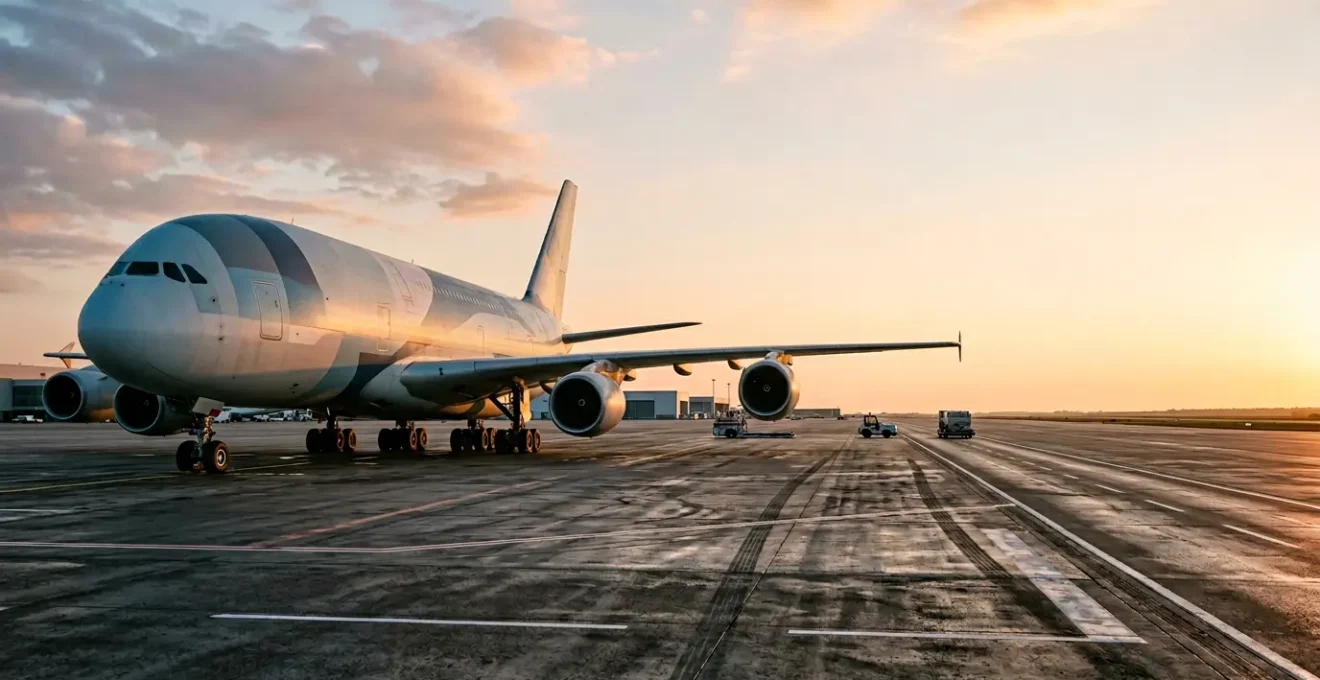
The huge price gap between USA and China air freight isn’t about distance; it’s driven by the lopsided value of ‘belly cargo’ space on passenger flights.
- Trade imbalances mean more goods fly from China to the UK than vice-versa, making the return westbound flights (and thus the primary eastbound leg) cheaper to fill.
- The high volume of passenger travel on the USA-UK route makes cargo a secondary, more expensive payload competing for limited space.
Recommendation: Stop comparing routes on a per-mile basis. Start analysing them based on trade flow and passenger flight density to forecast costs accurately and make smarter logistics decisions.
As a UK shipper, you’ve likely stared at two air freight quotes and felt a deep sense of confusion. How can shipping a kilogram from the USA cost £8, while the same kilogram from China, a much greater distance, costs a mere £3? It defies simple logic. The common explanations—fluctuating fuel surcharges, chargeable weight calculations, and seasonal demand—are all true, but they are only part of the story. They don’t explain the fundamental, route-specific price discrepancy that can make or break your import margins.
The truth is, air freight pricing isn’t a straightforward cost-per-mile calculation. It’s a complex auction for space, and the rules of that auction are dictated by factors most shippers never see. The key lies in understanding the hidden world of route economics, specifically the interplay between passenger flights and dedicated cargo freighters, and the powerful impact of global trade imbalances.
But what if the key wasn’t just about supply and demand, but about the *type* of supply available on a specific route? This guide moves beyond the generic advice. We will dismantle the core economic principles that govern these price differences. We’ll explore why passenger flight cancellations can make your quote skyrocket, how to choose the right service for your shipment size, and why a missing code on a form can leave your goods stranded for 72 hours. By understanding these underlying mechanics, you can shift from being a price-taker to a strategic logistics planner.
This article will delve into the critical factors that influence your air freight costs and timelines. We will break down everything from the fundamental economics of cargo capacity to the practical realities of customs, insurance, and airport choice, providing you with the insights needed to navigate the complexities of UK importing.
Summary: Why Air Freight Rates Vary So Drastically Between Routes
- Why Does Your Air Cargo Quote Double When Passenger Flights Get Cancelled?
- DHL Express or Air Cargo Forwarding: Which Service Fits a 200kg Monthly Shipment?
- Heathrow, East Midlands, or Stansted: Which Airport Handles Pharma Freight Best?
- The Screening Certification Your Supplier Needs to Avoid 24-Hour Cargo Delays
- When to Book Air Freight Before Christmas: The November Capacity Crunch?
- The 5 Customs Form Mistakes That Flag Your Shipment for Physical Examination
- Why Your £3,000 Laptop Claim Gets Paid at £100 Under Standard Carrier Terms?
- Why Did Your EU Shipment Get Held at Dover for 72 Hours Over a Missing Code?
Why Does Your Air Cargo Quote Double When Passenger Flights Get Cancelled?
The core reason for volatile air freight pricing lies in a concept that is often invisible to shippers: belly cargo economics. A significant portion of the world’s air freight doesn’t travel on dedicated cargo planes (freighters). Instead, it flies in the cargo hold—the « belly »—of the very same passenger aircraft that people use for holidays and business trips. This symbiotic relationship creates both opportunity and risk. For airlines, selling belly space to freight forwarders is a fantastic way to generate ancillary revenue on a flight that’s already scheduled.
However, this means that a large part of the global air freight capacity is directly tied to passenger travel schedules. When a major event grounds passenger flights, that capacity vanishes overnight. The cargo that was supposed to fly in the bellies of those planes must now compete for the much more limited and expensive space on dedicated freighters. This sudden spike in demand for a drastically reduced supply is what causes rates to double or even triple almost instantly.
The most dramatic example of this was the initial shock of the COVID-19 pandemic. When passenger travel collapsed, it wasn’t just the holiday routes that were affected. Approximately 75% of airfreight capacity was removed from the market, triggering record-high air cargo rates. This demonstrates a fundamental principle: your « stable » cargo rate is often subsidised by passenger ticket sales. When those ticket sales disappear, the true cost of moving goods by air is exposed.
Case Study: The COVID-19 Pandemic Belly Cargo Shock
During the pandemic, when passenger traffic plummeted, a massive amount of cargo capacity was instantly removed from the market. Even though belly cargo typically represents only about 45% of total airfreight, its sudden disappearance created a supply shock that forced lower-priority cargo onto expensive spot-rate freighter space. This event provided a clear, real-world lesson on how dependent the logistics industry is on passenger flight stability, with rates soaring to unprecedented levels in the spring of 2020.
This explains the China vs. USA price difference. The China-UK lane is a massive trade route with many dedicated freighters, driven by a manufacturing imbalance. The USA-UK lane, however, is a huge passenger route. Much of its cargo capacity is belly space, making it more susceptible to pricing volatility tied to passenger travel trends.
DHL Express or Air Cargo Forwarding: Which Service Fits a 200kg Monthly Shipment?
Choosing the right air service is not just about price; it’s about aligning the service model with your shipment’s characteristics. For a recurring 200kg shipment, you’re at a crossroads between two fundamentally different services: integrated express carriers and traditional air cargo forwarding. Understanding the distinction is crucial for cost optimisation.
Integrated Express Carriers (like DHL, FedEx, UPS) operate their own aircraft, hubs, and delivery networks. They offer a seamless, door-to-door service with a single point of contact and tracking number. This model is optimised for speed, convenience, and reliability for smaller parcels and documents. Their pricing is structured to reflect this all-in-one service. For a 200kg shipment, using an express service is possible, but you are paying a premium for a level of integration you may not need. It’s the equivalent of hiring a chauffeured car for a cross-country move—fast and simple, but not cost-effective for the size.
Traditional Air Cargo Forwarding is a different model. A freight forwarder does not operate its own aircraft. Instead, their expertise lies in consolidating freight from multiple shippers to buy space in bulk from airlines (both passenger bellies and freighters) at wholesale rates. They manage the entire process: collection, terminal handling, booking airline space, customs clearance, and final delivery. For a 200kg shipment, this is typically the sweet spot. The forwarder can consolidate your cargo with others, achieving a much lower cost-per-kilo than you could get directly or through an express carrier. You trade the one-stop-shop simplicity of an integrator for significant cost savings.
The decision comes down to your priorities:
- Choose DHL Express if: Your primary need is absolute speed and simplicity, you have an urgent one-off shipment, and the higher cost is justified by the value of the goods or the deadline.
- Choose Air Cargo Forwarding if: You have a recurring, planned shipment of this size. Your goal is to find the most cost-effective and sustainable logistics solution, and you are comfortable with a process that involves multiple parties managed by your forwarder.
For a 200kg monthly shipment, a good freight forwarder will not only provide a better price but also offer strategic advice on timing, routing, and consolidation to further optimise your supply chain.
Heathrow, East Midlands, or Stansted: Which Airport Handles Pharma Freight Best?
When shipping high-value, temperature-sensitive goods like pharmaceuticals, the choice of UK arrival airport is not trivial. It’s a strategic decision that impacts compliance, speed, and product integrity. The UK has several major air freight hubs, but three stand out for different reasons: Heathrow (LHR), East Midlands (EMA), and Stansted (STN). While one is the clear leader, the others play vital roles in the logistics ecosystem.
London Heathrow (LHR) is the undisputed giant of UK air cargo, especially for pharmaceuticals. With its vast network of long-haul passenger flights providing immense belly capacity and state-of-the-art climate facilities, it’s the default choice for many. Research indicates that over 50% of the UK’s pharmaceutical air cargo passes through Heathrow. Its IATA CEIV Pharma certification and dedicated temperature-controlled handling zones (« pharma corridors ») are designed to ensure an unbroken cold chain from aircraft to vehicle.
This specialisation requires significant investment in ground handling infrastructure. The equipment and processes involved are far more complex than for general cargo, focusing on maintaining precise temperature ranges at every stage of the offloading and transfer process.

However, Heathrow’s dominance also means it can become congested. During periods of high demand or operational disruption, capacity at LHR can be constrained. This is where other airports become critical. East Midlands (EMA) is the UK’s largest dedicated cargo airport, a major hub for integrators like DHL, and operates 24/7. Its focus on freighter traffic makes it less dependent on passenger schedules and a robust alternative. Stansted (STN), also a major freighter hub, often handles overflow from Heathrow, but it too can reach its limits, forcing cargo to be rerouted to airports like Birmingham or EMA.
So, which is best?
- Heathrow is the premier choice for its specialised pharma infrastructure and unparalleled route network, assuming capacity is available.
- East Midlands is the go-to for reliability and freighter-centric operations, especially for integrator-led shipments.
- Stansted serves as a crucial relief valve and a strong freighter option, particularly for cargo originating from other specialist hubs.
The « best » airport depends on your specific needs: the origin of the flight, the urgency, and the specific cold chain requirements. A good forwarder will analyse these factors to recommend the optimal port of entry, not just the most obvious one.
The Screening Certification Your Supplier Needs to Avoid 24-Hour Cargo Delays
In a post-9/11 world, air cargo security is non-negotiable. Every piece of cargo loaded onto an aircraft must be screened or originate from a secure, audited supply chain. For a shipper, this presents a major potential bottleneck. If your supplier in the origin country is not part of a recognised security programme, your cargo will be stopped at the airport and subjected to screening by a third party. This can add 24 hours or more to your transit time and introduce additional costs and risks of damage.
To avoid this, you need to ensure your supplier is a « Known Consignor » or part of an equivalent government-recognised security initiative. These programmes involve rigorous audits of a company’s facilities, staff, and procedures to ensure they can pack and transport goods in a way that prevents tampering. Once certified, their cargo is deemed « secure » and can bypass the often-congested airport screening facilities, moving directly to the aircraft.
Globally, several of these programmes exist, and many have Mutual Recognition Agreements (MRAs), meaning they trust each other’s security standards. Understanding these is key for smooth international trade.
| Program | Region | Certification Type | Primary Benefit | Mutual Recognition |
|---|---|---|---|---|
| CTPAT | United States | Customs Trade Partnership Against Terrorism | Reduced inspections at US borders, priority processing | MRAs with EU, Canada, Mexico, Taiwan, others |
| AEO | European Union | Authorized Economic Operator | Simplified customs procedures, reduced examinations EU-wide | MRAs with CTPAT, other global programs |
| UK Regulated Agent | United Kingdom | Air cargo security screening approval | Authority to screen own cargo, avoid airport bottlenecks | Post-Brexit separate from EU AEO |
| PIP | Canada | Partners in Protection | Faster border access, reduced inspections Canada-US | Harmonized with CTPAT |
For a UK importer, the most important question to ask your supplier is: « Are you a Known Consignor or do you hold an AEO/CTPAT (or equivalent) certification? » If the answer is no, you must factor in the certainty of airport screening delays into your timeline. If the answer is yes, you need to verify it.
Your Action Plan: Vetting Your Supplier’s Security Status
- Verify certification status: Request official AEO/CTPAT/equivalent certification documents and validation dates. These programmes often operate on revalidation cycles (e.g., 4 years), so ensure the certificate is current.
- Assess chain of custody protocols: Confirm the supplier can document a secure supply chain from the point of packing through to lodging the cargo at the airport without any breaks in security.
- Confirm screening capability: Determine if the supplier holds ‘secure packer’ or ‘known consignor’ status, which allows in-house screening, versus relying on third-party airport screening which causes delays.
- Evaluate mutual recognition alignment: Check if your supplier’s certification programme has a Mutual Recognition Agreement (MRA) with the destination country (UK) to ensure the security benefits transfer across borders.
- Review compliance track record: Request evidence of successful security audits and a clean record of any security violations that could trigger enhanced screening from customs authorities.
Proactively managing this aspect of your supply chain is a simple but powerful way to build resilience and predictability into your air freight operations.
When to Book Air Freight Before Christmas: The November Capacity Crunch?
Navigating air freight during Q4 is a high-stakes game. The period from October to December, known as « peak season, » sees a massive surge in demand driven by holiday retail, new tech product launches (like smartphones and gaming consoles), and businesses rushing to stock up before year-end. This surge in demand slams into a finite amount of aircraft capacity, creating the dreaded « November capacity crunch » where prices can soar and space becomes almost impossible to find.
For shippers, this isn’t a time for reactive booking. Proactive planning is the only way to avoid exorbitant costs or, worse, failing to get your goods to market on time. During this period, the normal rules of pricing no longer apply. Airlines and forwarders implement a Peak Season Surcharge (PSS) on top of regular rates to manage the overwhelming demand. Indeed, industry data shows that during the November peak season, rates can double or even more on critical trade lanes as desperate shippers bid for the last available slots.
The key to survival is to understand the booking calendar from a forwarder’s perspective and book well ahead of the crunch. Waiting until November to book your Christmas freight is a recipe for disaster. Space is allocated weeks, if not months, in advance. To make this tangible, think of the booking season as a traffic light system.
Here is a strategic calendar to guide your Q4 booking decisions:
- Green Zone (Mid-September to Mid-October): This is your golden window. Book now to secure capacity at standard rates before Peak Season Surcharges (PSS) are fully activated. Consolidation slots are widely available, making it the optimal time to lock in your Q4 shipments at baseline pricing.
- Amber Zone (Late-October to Mid-November): Expect tight capacity and guaranteed PSS. Consolidation opportunities are filling up fast. You must coordinate closely with your forwarder to hit their main consolidation days (e.g., booking by Tuesday for a Friday flight) to have a chance at securing space.
- Red Zone (Late-November onwards): Welcome to the wild west of spot rates. In this period, you are in a « pay-anything » market. There is a high risk of your cargo being offloaded in favour of higher-paying freight. E-commerce giants and major tech launches have absorbed most of the available freighter capacity. At this stage, you must either accept premium pricing or consider alternative transport modes.
An additional factor to monitor is the « shadow peak, » caused by major product launches. A new smartphone can trigger a mini-capacity crunch outside the traditional retail cycle, so staying informed on market news is vital.
The 5 Customs Form Mistakes That Flag Your Shipment for Physical Examination
Nothing is more frustrating for a shipper than seeing their time-critical air freight shipment marked as « Held for Customs Examination. » While some inspections are random, many are triggered by simple, avoidable mistakes on the customs declaration. Customs authorities use sophisticated algorithms to flag shipments that look suspicious, and your paperwork is the first thing they analyse. Getting it right is your first line of defence against costly delays.
The process of customs documentation is about creating a clear, consistent, and verifiable story about your shipment. Any ambiguity or inconsistency is a red flag that forces an officer to intervene manually, leading to delays and potential physical inspections. To avoid this, you must be meticulous in your declarations.

Based on analysis of common shipper errors, here are the five most critical mistakes on customs forms that virtually guarantee your shipment will be flagged for a closer look.
- Value Mismatch Red Flag: Declaring a ridiculously low value for the type of goods. For example, a shipment of « electronics » valued at £10. Customs’ algorithms instantly compare your declared value against databases of commodity values. Any significant deviation triggers a mandatory inspection to verify the goods and investigate potential duty evasion.
- Vague Goods Description: Using generic terms like « parts, » « samples, » or « promotional materials » is a major error. This forces an inspection because customs has no idea what you are actually shipping. Be specific. Use the format: ‘[Quantity] [Material] [Item Type], [Size/Specs], for [Purpose]’. For instance, change « T-shirts » to « 250 printed cotton T-shirts, size L, for marketing event ».
- Inconsistent Incoterms Error: This occurs when the Incoterm on the commercial invoice contradicts the freight charges listed. A common example is shipping under EXW (Ex Works), where the buyer is responsible for all costs, but the invoice shows freight charges as prepaid. This signals an amateur shipper to customs, triggering a full document review and value verification.
- Country of Origin vs. Country of Supply Trap: This is a critical distinction. Purchasing goods from a supplier in the USA does not automatically mean the goods are « Made in USA. » They could have been manufactured in another country. Intentionally declaring the incorrect Country of Origin to avoid higher tariffs is a serious violation that leads to significant penalties far beyond inspection delays.
- Incomplete Harmonized System (HS) Code: The HS code is the universal language of customs classification. Providing a missing or incomplete code (e.g., just the first 4 digits instead of the required 6-10) forces customs to classify the goods themselves. This process is manual and can delay clearance by 24-72 hours.
Avoiding these five mistakes will dramatically reduce the chances of your shipments being delayed and will contribute to a smoother, more predictable supply chain.
Key Takeaways
- Air freight pricing is dictated by route-specific trade imbalances and passenger flight patterns, not just distance.
- Insurance is critical: standard carrier liability is weight-based and will not cover the value of your high-tech or lightweight goods.
- Proactive documentation is not optional. Simple errors in customs forms are the primary cause of preventable shipment delays.
Why Your £3,000 Laptop Claim Gets Paid at £100 Under Standard Carrier Terms?
One of the most painful lessons in logistics comes when a high-value shipment is lost or damaged, and the shipper discovers they are entitled to only a fraction of its value. Imagine your brand-new, 5kg laptop worth £3,000 is damaged in transit. You file a claim, expecting full compensation, only to be offered around £100. This isn’t a scam; it’s the standard operating procedure under international air law.
This shocking discrepancy is due to the Montreal Convention, an international treaty that governs airline liability. To create a uniform and predictable system, the convention limits an airline’s liability for lost or damaged cargo to a set amount based on weight, not value. Currently, the Montreal Convention limits airline liability to approximately £20 per kilogram. So, for your 5kg laptop, the maximum payout is 5kg * £20/kg = £100. This is the default « carrier liability, » and it’s designed to protect airlines, not shippers of high-value goods.
Relying on this default coverage for anything valuable is a major financial risk. Fortunately, you are not powerless. You have options to increase your protection, and understanding them is essential for any shipper dealing with goods where the value exceeds the weight-based limit. A robust insurance strategy involves understanding three distinct tiers of protection.
Here is a simple, three-tier strategy to ensure your cargo is adequately protected:
- Tier 1 – Default Carrier Liability (Inadequate): First, understand that the default coverage provided by the Montreal Convention (~£20/kg) is automatic but virtually useless for any high-value goods. For a 5kg laptop worth £3,000, you will receive only about £100 in compensation. Never assume this is sufficient.
- Tier 2 – Declared Value for Carriage (Middle Ground): This is an often-missed option on the air waybill. You can declare a higher value for your goods directly to the carrier. This isn’t insurance, but it increases the carrier’s liability limit for your specific shipment. It costs an additional « valuation charge » (typically 0.5-1% of the declared value), but it’s a cost-effective way to get more protection without a separate policy.
- Tier 3 – All-Risk Cargo Insurance (Full Protection): This is the most comprehensive option and is essential for valuable shipments. Purchasing a dedicated « All-Risk » cargo insurance policy from your forwarder or a third-party provider covers the full replacement value of your goods, not a limit based on weight. Think of it like car insurance: carrier liability is basic third-party coverage, while All-Risk cargo insurance is the fully comprehensive policy that protects your own asset.
For any electronics, pharmaceuticals, luxury goods, or items where the value-to-weight ratio is high, Tier 3 is not an optional extra; it is a fundamental part of responsible shipping.
Why Did Your EU Shipment Get Held at Dover for 72 Hours Over a Missing Code?
For UK businesses importing from the EU post-Brexit, few things have caused more confusion and delay than the Goods Vehicle Movement Service (GVMS). A shipper might see their truck is held at Dover and assume it’s a UK customs issue upon arrival. In reality, the 72-hour delay likely began in Calais, hours earlier, because of a missing digital code linking all the necessary paperwork together before the lorry was even allowed to board the ferry.
This reflects a fundamental shift in process that many EU exporters initially struggled with. Before Brexit, goods moved freely. Now, the UK requires a « pre-lodged » customs model. This means that a valid customs declaration must be submitted and accepted into the UK systems *before* the goods even begin their journey. The GVMS is the digital system that enforces this. It generates a unique Goods Movement Reference (GMR) number that acts as a digital envelope, linking together all the customs declarations and safety and security declarations for all the goods on a single lorry.
Case Study: Post-Brexit GVMS Implementation Delays
Following Brexit, the UK’s GVMS required valid GMR numbers before lorries could board ferries in the EU. The critical hold-up began at ports like Calais when trucks were denied boarding without this valid digital handshake, not at Dover upon arrival. Many EU exporters, accustomed to « arrived » declaration models where paperwork is submitted after goods arrive, struggled with the UK’s new « pre-lodged » model. This disconnect between operating models caused systematic 72-hour delays at channel crossings during the transition period as supply chains adapted.
Without a valid GMR, the haulier is denied boarding at Calais, Zeebrugge, or the Eurotunnel terminal. The clock starts ticking as the driver, haulier, and shipper scramble to figure out what’s missing. Is it the UK import declaration? The EU export declaration? Who was responsible for creating the GMR entry? This is where Incoterms become critically important, as they define where responsibility lies.
| Incoterm | Customs Declaration Responsibility | GVMS Entry Creation | Broker Coordination | Delay Risk Owner |
|---|---|---|---|---|
| EXW (Ex Works) | Buyer/Importer | Buyer’s haulier or agent | Importer must ensure broker ready | Importer bears all delay costs |
| FCA (Free Carrier) | Shared at handover point | Depends on named place; typically buyer post-pickup | Requires explicit agreement | Split responsibility creates risk |
| DAP (Delivered At Place) | Seller for export, Buyer for import | Seller’s haulier for export leg | Seller coordinates to border, buyer post-border | Transition point vulnerability |
| DDP (Delivered Duty Paid) | Seller handles all customs | Seller’s agent creates GVMS | Seller fully responsible for broker | Seller absorbs all delays and costs |
As the table shows, shipping under terms like EXW places the entire burden and risk of GVMS compliance on the UK importer. If your supplier is not familiar with the UK’s pre-lodged model, you are setting yourself up for failure. Agreeing on clear responsibilities and using an Incoterm like DDP (or ensuring your DAP supplier is highly competent) is essential for smooth EU-UK trade.
Ultimately, navigating the world of air freight is not about finding the cheapest quote; it’s about understanding the systems that generate those quotes. By grasping the impact of belly cargo, planning for peak season, ensuring compliance in security and customs, and protecting the value of your goods, you transform from a reactive shipper into a strategic logistics partner for your own business. To put these concepts into practice, the next logical step is to have a detailed discussion with a freight forwarding professional about your specific shipping patterns and challenges.