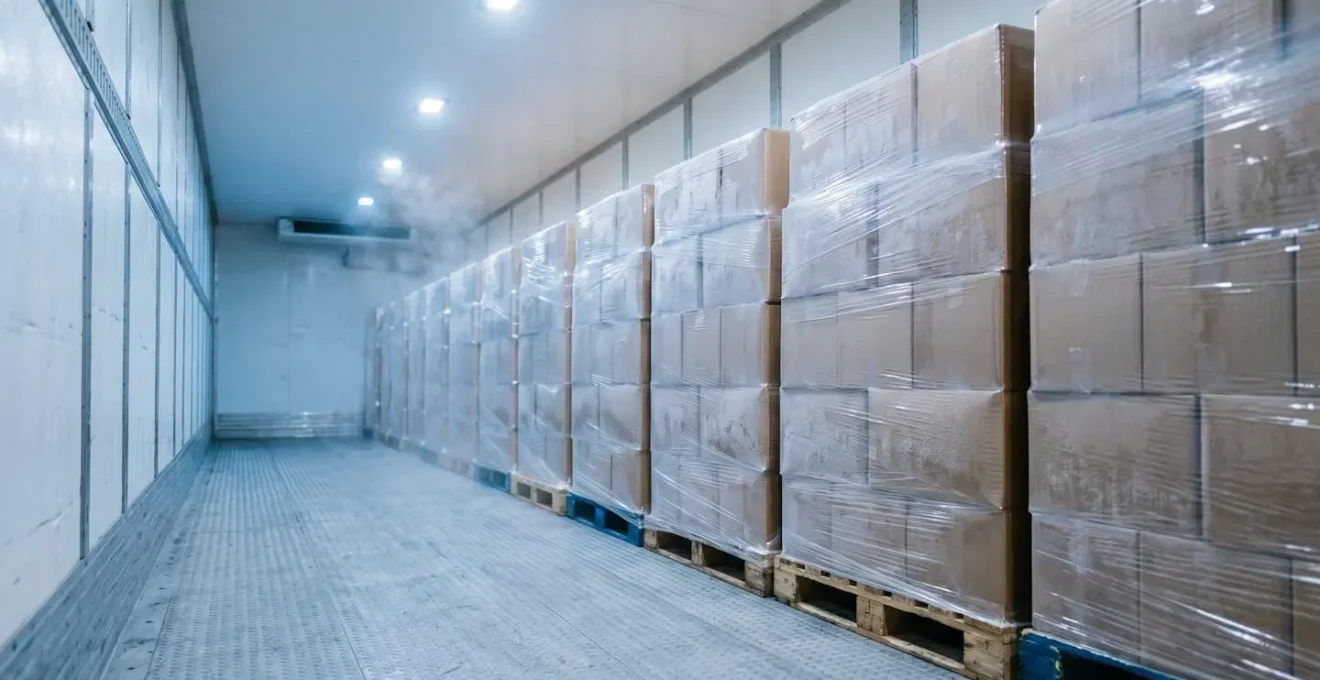
The partial thawing of your frozen goods isn’t a refrigeration failure; it’s a system failure caused by an accumulation of unmonitored thermal debt across the entire supply chain.
- A shipment’s thermal mass is its primary defence; smaller parcels and individual boxes warm up dramatically faster than full, dense pallets, even in the same refrigerated environment.
- The highest-risk moments for temperature gain are not during the long haul, but during brief, intense exposures at transitional points like the loading bay and customs inspections.
Recommendation: Shift from reactive temperature threshold alerts to a predictive system that analyses the rate of temperature change, giving you a crucial intervention window before the product is compromised.
It’s one of the most frustrating paradoxes in food distribution. You’ve followed the protocol: the refrigerated truck was set to a steady -18°C, the documentation is perfect, and the journey was on schedule. Yet, the delivery is rejected. The product at the core of the pallet is solid, but the outer layers are soft, showing clear signs of partial thawing and refreezing. This isn’t just a quality issue; it’s a costly failure that erodes margins and trust. The common advice—use a reliable haulier, check the temperature logs—feels inadequate because you’re already doing that.
The problem lies in a fundamental misunderstanding of the cold chain. We treat it as a static state, a « cold box » on wheels. But the reality is a dynamic battle against thermodynamics, where integrity is lost not in one catastrophic event, but through a « thermal cascade »—a series of small, often unmonitored, temperature gains that accumulate over time. The key isn’t simply maintaining an ambient -18°C; it’s about protecting the product’s own core temperature from a dozen hidden vulnerabilities along its journey.
This isn’t about a single faulty reefer unit. It’s about the physics of small shipments, the critical minutes on the loading dock, the blind spots in your alert systems, and the procedural friction at international borders. Understanding these overlooked gaps is the only way to move from reactively documenting failure to proactively preventing it. This article will dissect these critical vulnerabilities and provide a framework for building a resilient cold chain that protects your product from dispatch to delivery.
To navigate these critical points of failure, we will explore the specific mechanisms that undermine temperature integrity. The following sections break down the most common yet misunderstood challenges and provide actionable strategies to fortify your cold chain operations.
Summary: Mastering the science of cold chain integrity
- Why small shipments warm up 5x faster than full pallet loads in transit?
- How to set temperature alerts that give you 2 hours to intervene before spoilage?
- Refrigerated truck or insulated box: Which protects vaccines on a 4-hour delivery?
- The 15-minute loading bay delay that raises product temperature by 8°C
- How to save a £50,000 frozen load when your truck’s refrigeration fails mid-journey?
- How to prove your temperature-sensitive medicine stayed cold throughout transit?
- How to build an alert system that warns you 24 hours before delivery failures?
- Why did your medicine shipment get destroyed at customs despite proper documentation?
Why small shipments warm up 5x faster than full pallet loads in transit?
The core reason your frozen products arrive partially thawed often comes down to a fundamental principle of physics: thermal mass. A large, dense, fully packed pallet of frozen goods behaves like a giant ice block. It has high thermal inertia, meaning it can absorb significant amounts of ambient heat before its own core temperature begins to rise. This mass acts as its own buffer, protecting the products in the centre from short-term temperature fluctuations, such as those experienced during brief door openings.
In contrast, a small shipment—a single box or a sparsely packed pallet—has a much higher surface-area-to-volume ratio. This means more of its total mass is exposed to the surrounding air. It has very low thermal inertia and acts less like an ice block and more like a single ice cube. It will react to changes in ambient temperature almost immediately. Even within a truck holding a steady -18°C, the air that rushes in during a delivery stop can be enough to start the thawing process on these smaller, vulnerable shipments.
Case Study: The Physics of Thermal Retention
This principle is directly analogous to findings in the natural world. Laboratory experiments confirmed that animals with a smaller surface area to volume ratio maintain their body temperature at a better rate than animals with a larger ratio. This translates directly to frozen shipment physics, where smaller packages have far less ability to retain their cold temperature when exposed to thermal challenges, explaining why they experience faster temperature changes than dense, full pallets.
The visual below demonstrates this disparity in thermal mass. The single box is highly susceptible to external temperature changes, while the dense pallet uses its collective mass to create a stable thermal core, shielding the interior boxes from rapid warming.

This illustrates why consolidating shipments into dense, tightly packed pallets is a primary strategy for temperature protection. For a food distributor, this means that even if the carrier is maintaining the correct air temperature, sending out small, unconsolidated loads is an inherently high-risk activity that dramatically increases the likelihood of product temperature excursions.
How to set temperature alerts that give you 2 hours to intervene before spoilage?
A standard temperature alert is a tombstone: it tells you when your product is already dead. An alert that triggers only when the temperature breaches the -15°C or -12°C threshold is a notification of failure, not a tool for prevention. By the time you receive that message, the thermal cascade has already begun and the product’s integrity is likely compromised. This is especially true for the final leg of the journey, as over 25% of temperature excursions happen during last-mile delivery, where intervention options are limited.
The key to creating a genuine intervention window is to shift from monitoring static thresholds to analysing the rate of change. A sophisticated system doesn’t just ask, « Is it too warm? » It asks, « How fast is it warming up? » An alert triggered by a rise of 0.5°C every 10 minutes, for example, can warn you of a potential issue—like a failing reefer unit or a door left ajar—hours before the product’s temperature enters the critical spoilage zone. This is the difference between a post-mortem and a life-saving diagnosis.
Building this predictive capability requires a more holistic approach to data. It involves correlating temperature data with other sensors to understand the « why » behind a temperature change in real-time. Is the temperature rising because the driver has opened the doors for a legitimate delivery, or is it an unscheduled stop in a high-risk area? This level of intelligence transforms your monitoring from a passive logging system into an active risk management tool, giving you the time needed to alert the driver, reroute the vehicle to a cold storage facility, or notify the customer of a potential delay.
To implement such a system, consider the following strategic steps:
- Deploy multi-sensor monitoring, including temperature probes, door sensors, and GPS tracking, to collect comprehensive real-time data.
- Configure rate-of-change alerts based on temperature rise velocity (e.g., 0.5°C every 10 minutes) rather than just static threshold breaches.
- Correlate data streams to diagnose root causes, distinguishing between normal operational events (like a door opening at a geofenced delivery point) and anomalies.
- Establish automated escalation protocols that contact the driver first, then dispatch, and can identify the nearest partner cold storage facility.
- Create product-specific spoilage profiles, setting different alert sensitivities based on the vulnerability of the goods (e.g., ice cream vs. frozen peas).
Refrigerated truck or insulated box: Which protects vaccines on a 4-hour delivery?
When transporting high-value, temperature-sensitive products like vaccines, the choice between active cooling (a refrigerated truck) and passive cooling (a qualified insulated box) is critical. For a short, 4-hour delivery, the answer isn’t always obvious and depends entirely on qualification and validation. A refrigerated truck provides a constant source of cold air, but it’s a blunt instrument. The temperature inside a large trailer can fluctuate, with hotspots near doors and walls, and it’s susceptible to complete failure.
A professionally qualified insulated shipping container, on the other hand, is a precision instrument. These systems are not just « cool boxes »; they are engineered thermal packaging solutions designed and tested against rigorous real-world conditions. Standards bodies like the International Safe Transit Association (ISTA) provide protocols for this. For example, the development of ISTA 7E profiles from 82 different shipping lanes provides a standardized, data-driven way to test how a passive shipper will perform in a real-world transit environment. This is a level of assurance that a standard refrigerated van often cannot provide for a small, critical payload.
A qualified insulated box, validated against a profile like ISTA 7E, is designed to maintain its internal temperature within a precise range (e.g., 2-8°C) for a specific duration (e.g., 48 or 72 hours), regardless of external ambient temperatures. For a 4-hour journey, this provides an enormous safety margin. The integrity of the shipment is self-contained and not dependent on the vehicle’s mechanical systems, protecting it from both temperature fluctuations within the truck and a complete reefer failure. The table below highlights the differences in testing rigor between older and modern ISTA standards.
| Standard | Temperature Range | Profile Type | Test Duration | Development Method |
|---|---|---|---|---|
| ISTA 7D | -10°C to 35°C (-14°F to 95°F) | Extreme simulation with immediate temperature changes and hold steps | Unlimited 24-hour cycles | General simulation not based on current data research |
| ISTA 7E | Global heat and cold profiles | Gradual diurnal temperature changes reflecting real-world conditions | 72 or 144 hours (cyclable for longer durations) | Developed from intensive data collection across 82 shipping lanes during summer and winter campaigns |
For a high-stakes 4-hour vaccine delivery, a validated insulated box often provides superior protection and provable compliance. It isolates the product from the operational uncertainties of the vehicle, ensuring the chain of custody for temperature is unbroken and verifiable, which is something a simple refrigerated truck cannot guarantee on its own.
The 15-minute loading bay delay that raises product temperature by 8°C
The loading bay is the most kinetically and thermally chaotic environment in the entire cold chain. It’s the handover point where your product is most exposed, and even brief delays can inflict irreversible damage. A phenomenon known as « dock shock » occurs when a frozen pallet is moved from a -18°C warehouse onto an ambient-temperature loading dock, even for just a few minutes, before being loaded onto a pre-chilled truck. During this short window, the pallet is bombarded with thermal energy from all sides.
The air on the dock might be 20°C, the concrete floor can radiate heat, and direct sunlight could be hitting the product. This multi-faceted thermal attack begins to warm the outer layers of the boxes instantly. While the core of the pallet remains frozen due to thermal mass, the surface temperature can rise dramatically. A 15-minute delay is more than enough time for the surface of the product to climb by several degrees, initiating the formation of ice crystals and cellular damage that ruins texture and quality upon final thawing. Indeed, dedicated research on frozen fish pallets demonstrated this heterogeneous temperature rise, with corners and outer edges heating up significantly faster than the stable center.
This risk isn’t just theoretical; it’s a measurable zone of vulnerability. Warehouse monitoring consistently shows that products staged for shipping are at the highest risk. In fact, studies reveal that products stored within 20 feet of active dock doors face significantly higher temperature fluctuations than items kept in the facility’s core. This underscores the need for strict procedural discipline.
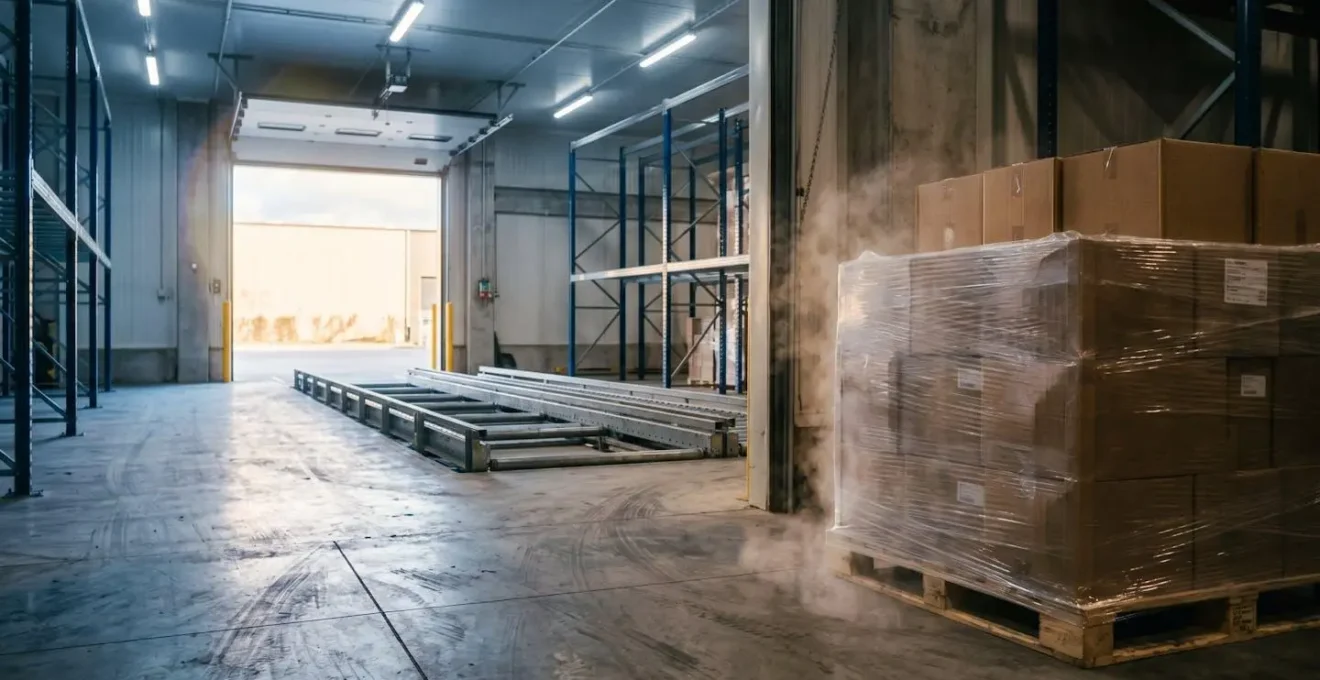
Minimizing time on the dock is paramount. This requires synchronizing the arrival of trucks with the staging of products, using dock seals and shelters to create a better thermal barrier, and ensuring that pallets are moved directly from the freezer to the truck with no staging time in between. The loading dock isn’t just a transitional space; it’s the cold chain’s most critical control point.
How to save a £50,000 frozen load when your truck’s refrigeration fails mid-journey?
A reefer unit failure mid-transit is the ultimate cold chain crisis. With a high-value load, the clock starts ticking immediately. The trailer, once a protective cocoon, becomes an insulated oven, slowly absorbing heat from the road and the sun. Without a contingency plan, a £50,000 load can become a £50,000 write-off in a matter of hours. This is not a rare occurrence; logistics research indicates that a staggering 20% of all temperature-sensitive pharmaceuticals are damaged by excursions, and 30% of all scrapped life science products are lost due to cold chain issues.
Saving the load is not about hoping the insulation holds. It’s about having a pre-defined, data-driven Disaster Recovery Protocol. The moment a predictive alert flags a reefer failure (e.g., fuel level critical, compressor failure, or a rapid rate of temperature change), an automated process should be triggered. The first step is immediate communication with the driver to diagnose the issue—is it something that can be fixed on the spot?
Simultaneously, the system’s GPS data becomes critical. The logistics team must instantly identify the truck’s location and cross-reference it with a pre-vetted network of emergency cold storage facilities or partner distributors. The goal is to calculate the ‘time to spoilage’ based on the product’s known stability profile and the current rate of temperature increase, and compare that with the ‘time to rescue’—the ETA to the nearest safe haven. Can another truck be dispatched to perform a trans-shipment? Can the load be diverted to a nearby cold warehouse before temperatures breach the critical threshold? Having these answers and contact numbers pre-programmed into your transport management system is what separates a successful rescue from a total loss.
The financial justification is simple. The cost of developing and maintaining a robust contingency plan—including building relationships with partner facilities—is a tiny fraction of the value of a single lost load. It turns a catastrophic event into a manageable operational challenge, protecting both the product and the bottom line.
How to prove your temperature-sensitive medicine stayed cold throughout transit?
In the world of pharmaceuticals, if you can’t prove it stayed cold, it didn’t. A complete and unbroken temperature log is not just a customer requirement; it’s a regulatory mandate. A missing data point or an uncalibrated sensor can lead to the quarantine and destruction of a perfectly good shipment, as regulators and quality assurance departments must assume the worst. Proving temperature integrity requires creating an unimpeachable dossier of evidence—a regulatory-ready compliance package that tells the complete thermal story of the shipment’s journey.
This package goes far beyond a simple printout from a temperature logger. It is a multi-layered defence built on data and documentation. It starts with the sensors themselves. Are they calibrated? Can you produce certificates tracing their accuracy back to national standards? Without this, all your temperature data is inadmissible. The data must then be contextualized. A log showing a brief spike is meaningless without the corresponding GPS and door sensor data to explain it. Was it a delivery, an inspection, or an anomaly? Overlaying these data streams creates a powerful narrative that can justify minor fluctuations and demonstrate control.
Furthermore, relying solely on air temperature is insufficient. Regulators are increasingly interested in the actual product core temperature. This is where technologies like Time-Temperature Indicator (TTI) labels come into play. These chemical labels, applied directly to the product packaging, provide a simple, visual, and irreversible record of cumulative heat exposure, offering a crucial secondary layer of evidence. The growth of this market is a testament to its importance, with the global cold-chain monitoring market forecast to double to USD 13.4 billion by 2032.
Ultimately, a robust chain of custody for temperature requires a structured approach:
- Compile calibrated sensor certificates: Include full calibration documentation for all monitoring devices, proving traceability to national standards.
- Overlay GPS and temperature data: Create synchronized maps showing location and temperature at every point, proving the correlation between route and thermal conditions.
- Implement product-core temperature verification: Use Time-Temperature Indicator (TTI) labels on product packaging to differentiate between ambient air temperature and actual product temperature.
- Maintain signed hand-off logs: Secure signatures and temperature readings at every point of custody transfer, from shipper to carrier to final recipient.
- Prepare a regulatory-ready compliance package: Pre-organize all documentation with an executive summary, sensor placement diagrams, and excursion logs with documented corrective actions to anticipate any inspection.
How to build an alert system that warns you 24 hours before delivery failures?
A truly advanced logistics system doesn’t just predict temperature excursions; it predicts delivery failures. A late delivery of a frozen or chilled product is often as bad as a warm one, as it disrupts production schedules and incurs penalties. Warning of a potential failure 24 hours in advance seems like fortune-telling, but it’s achievable by expanding the definition of an « alert. » Instead of just monitoring the product’s environment, you must monitor the health and progress of the entire delivery operation.
This involves integrating multiple data streams into a single predictive model. Your system should monitor not only the reefer’s temperature and fuel level but also the vehicle’s telematics (engine health, fault codes), the driver’s hours of service, and the truck’s real-time progress against the planned route and ETA. A predictive alert would be triggered not by a single failure, but by a confluence of risk factors. For example: a truck is reporting an intermittent engine fault, its current speed is below average for that stretch of motorway, and the driver is nearing their legal driving limit. Individually, these are minor issues. Combined, they create a high probability of a significant delay or breakdown within the next 24 hours.
This approach allows for proactive intervention. You can contact the driver to check on the engine issue, reroute them to a service centre, or even dispatch a backup truck to a rendezvous point to take over the load before the failure occurs. This is precisely the strategy used by forward-thinking companies. One frozen meal manufacturer implemented a system where geofencing and vehicle health monitoring worked in tandem. The system flagged a truck that had broken down after deviating from its route and automatically dispatched a backup vehicle, saving the shipment. Proactive management is critical when poor temperature control causes roughly 14% of the world’s food to be lost before it even reaches retail.
Action Plan: Auditing Your Cold Chain Alert System
- Identify Contact Points: List every source that provides data on your shipment’s status. This includes primary sources like temperature and GPS loggers, but also secondary sources like driver mobile apps, vehicle telematics, and door sensors.
- Inventory Collection: For each contact point, inventory the exact data it collects (e.g., temperature, humidity, GPS coordinates, door open/close events, reefer fuel levels). Assess the frequency and reliability of this data.
- Check for Coherence: Cross-reference the collected data against your Standard Operating Procedures (SOPs). Does the real-world data from a typical journey align with the route, timing, and temperature profile defined in your quality agreement?
- Assess Impact & Significance: Analyse historical alert data. Differentiate between one-off, random events (e.g., a single long stop) and systemic, recurring patterns (e.g., a specific route consistently causing temperature drift). Prioritize fixing the systemic issues.
- Develop an Integration Plan: Based on the gaps identified, create a prioritized roadmap. This could include upgrading sensors, integrating new data streams (like traffic feeds), or revising alert protocols and escalation paths to be more predictive.
Key Takeaways
- Thermal Mass is King: The most significant factor in a product’s ability to withstand temperature fluctuations is its own density. Small, individual shipments are inherently high-risk and require enhanced protection.
- Shift to Predictive Alerts: Stop waiting for failure notifications. Monitor the rate of temperature change to create an intervention window, allowing you to act before the product is compromised.
- Transitional Points are the Weakest Links: The moments of highest risk are not during the long haul but during the brief, chaotic handovers at the loading dock and during customs clearance. These points require maximum procedural discipline.
Why did your medicine shipment get destroyed at customs despite proper documentation?
This is perhaps the most infuriating cold chain failure. The product was manufactured correctly, packaged in a validated shipper, transported flawlessly across continents with a perfect temperature log, and all the customs paperwork was filed. Yet, the shipment is flagged for a physical inspection, gets stuck in a customs warehouse for 48 hours, and is ultimately destroyed because its thermal shipper was only qualified for a 72-hour journey. The documentation was perfect, but it was irrelevant.
Customs clearance represents a critical vulnerability where a customs delay could lead to a temperature excursion, potentially resulting in shipment destruction even when all documentation is technically correct.
– International cold chain logistics industry analysis, Mercury Logistics Cold Chain Guide
The core issue is that customs officials are not part of your cold chain protocol. Their priority is security and regulatory compliance, not your product’s temperature stability. A minor error in a Harmonized System (HS) code or a random compliance check can trigger a delay that exceeds your packaging’s validated duration. The solution, therefore, cannot be just having the right documents; it must be a proactive customs clearance strategy designed to minimize friction and anticipate delays.
This strategy involves treating the customs broker as a critical partner. Pre-submitting the entire data package—including temperature logs and sensor calibration certificates—before the shipment even arrives can build trust and transparency. It also means building in a buffer. If the journey is 48 hours, use a 96-hour or 120-hour qualified shipper to account for potential delays. This thermal buffer is your insurance policy against bureaucratic friction.
An effective proactive strategy includes several key actions:
- Pre-submit a comprehensive data package: Send the full chain-of-custody and temperature documentation to the destination broker before arrival to demonstrate transparency.
- Verify Harmonized System (HS) code accuracy: Ensure product classification codes are perfect, as even minor errors trigger suspicion and delays.
- Include ISTA certification documentation: Provide the thermal shipper’s qualification certificates (e.g., ISTA 7E) to prove the packaging meets regulatory standards.
- Establish a broker communication protocol: Have emergency contact channels ready for real-time issue resolution before a shipment is physically detained.
- Prepare redundant temperature evidence: Include both electronic logger data and photographs of chemical TTI labels to show an unbroken cold chain throughout the journey.
Ultimately, safeguarding a frozen product is not about controlling a single variable but about mastering an entire system of interconnected risks. From the physics of thermal mass to the human element at the loading dock and the procedural maze of customs, every link in the chain must be fortified. By shifting focus from passive monitoring to proactive, data-driven intervention, you can transform your cold chain from a source of costly failures into a competitive advantage built on reliability and trust. The first step is a comprehensive audit of your current processes to identify these hidden vulnerabilities. Evaluate your operations today to prevent the next costly temperature excursion tomorrow.