
Modern car safety is not about brute strength, but about the masterfully engineered choreography of controlled failure.
- The front and rear of a car are sacrificial structures, designed to crumple in a specific way to absorb and manage crash energy.
- The central passenger cabin is a rigid « survival cell » made of ultra-high-strength steel to resist intrusion.
- Pedestrian safety regulations now dictate softer, higher bonnets, and even pop-up systems, to cushion impacts and reduce severe injury.
Recommendation: Understand that extensive visible damage after a crash is often a clear sign of the safety system working exactly as designed to protect human life.
It’s a sight that has become increasingly common on British roads: a vehicle involved in a seemingly moderate collision looks utterly destroyed, yet the occupants emerge shaken but largely unharmed. The immediate conclusion is often that modern cars are « flimsy » or « built to be written off. » This perception, while understandable, misses the profound engineering philosophy at play. For decades, the focus of safety was simply on making cars stronger, a brute-force approach to crashworthiness. But this logic is flawed; a completely rigid car would transfer the full, lethal force of an impact directly to its occupants.
The real breakthrough in passive safety—the systems that protect you during a crash—is not about preventing damage, but about managing it. Today’s vehicles are designed as sophisticated energy management systems. The core principle is a stark contrast between a sacrificial exterior and a protected interior. This involves an intricate dance of materials with different strengths and components designed to break away or deform in a highly specific sequence. From the engine dropping to the ground to the bonnet buckling in a pedestrian impact, nothing is left to chance.
This article moves beyond the simple concept of « crumple zones » to reveal the hidden engineering that governs what happens in the critical milliseconds of a collision. We will explore the deliberate design choices that allow a car to sacrifice its own structure to preserve human life. It’s a story not of weakness, but of meticulously planned, controlled collapse.
To fully grasp this complex system, this guide breaks down the key passive safety designs, explaining the engineering principles behind each one. The following sections detail why your car behaves the way it does in a crash, revealing the hidden strength within its design.
Summary: Why Modern Cars Are Designed to Deform
- Why Your Car’s Engine Drops Downward During Head-On Collisions?
- Why Do Modern Cars Have Reinforced Door Beams You Cannot See?
- Why Are Modern Car Bonnets Higher and Softer Than They Used to Be?
- The Body Shop Repair That Restores Appearance but Removes Crash Protection
- When to Have Your Car Inspected: The 15 MPH Impact Threshold for Hidden Damage?
- Why Modern Cars Look Totally Destroyed After 40 MPH Crashes Yet Occupants Walk Away?
- Why Do Airbags Deploy Gently in Low-Speed Crashes but Explosively in High-Speed Impacts?
- Why Did Your Car’s Cabin Stay Intact While the Front Crumpled Beyond Recognition?
Why Your Car’s Engine Drops Downward During Head-On Collisions?
In a severe frontal impact, the engine is one of the densest, most rigid objects in the vehicle. If it were to be pushed rearward, it could easily breach the firewall and intrude into the passenger footwell, causing catastrophic leg and lower body injuries. To prevent this, engineers have developed a system of breakaway engine mounts. These are not a weakness; they are a critical and intentional part of the crash energy management pathway.
During a high-g deceleration event, these mounts are designed to fail in a controlled manner. This allows the entire powertrain—the engine and transmission assembly—to detach and « submarine » downwards, sliding under the passenger floor rather than through it. This clears a vital path for the frontal crumple zones to do their work and absorb the maximum amount of kinetic energy. The design is particularly effective in vehicles with specific engine layouts, like Subaru’s horizontally-opposed ‘BOXER’ engine, whose low centre of gravity naturally facilitates this downward movement.
Case Study: Subaru WRX Breakaway Engine Mounts in Action
A real-world example documented a Subaru WRX involved in a severe frontal collision at approximately 80 MPH. Post-crash analysis showed the entire engine and transmission had ejected from the vehicle in one piece and were found on the road. This dramatic-looking result was the breakaway system functioning perfectly. The engine submarined under the cabin as designed, preventing intrusion into the passenger survival cell. While the driver sustained serious injuries, this engineered failure of the mounts was a key factor in their survival by preserving the integrity of the cabin space.
This principle of controlled detachment is a perfect example of sacrificing a component’s mounting to protect the occupant survival cell. It transforms the engine from a potential battering ram into a component that is moved out of the energy absorption path. This ensures the structural components of the chassis can deform and dissipate forces as intended.
Why Do Modern Cars Have Reinforced Door Beams You Cannot See?
Side impacts are uniquely dangerous because there is very little space between the impacting object and the occupant. Unlike a frontal crash with a large engine bay to act as a crumple zone, a side impact has only the width of the door. Statistics underscore this danger, showing that a significant portion of occupant fatalities occur in side-on collisions. To counter this, engineers have turned the humble car door into a sophisticated piece of safety equipment, centred around a hidden but immensely strong side-impact beam.
This is not a simple piece of metal; it is often a tubular or stamped beam made from advanced ultra-high-strength steel, such as boron-alloyed steel. This material is a marvel of modern metallurgy. For instance, some types of boron steel are four times stronger than average high-strength steel, allowing them to resist immense force without deforming. These beams are strategically positioned, often diagonally, within the door structure to absorb impact energy and, crucially, transfer those forces away from the occupant and into the more robust parts of the car’s frame, like the A and B pillars and the floor structure.
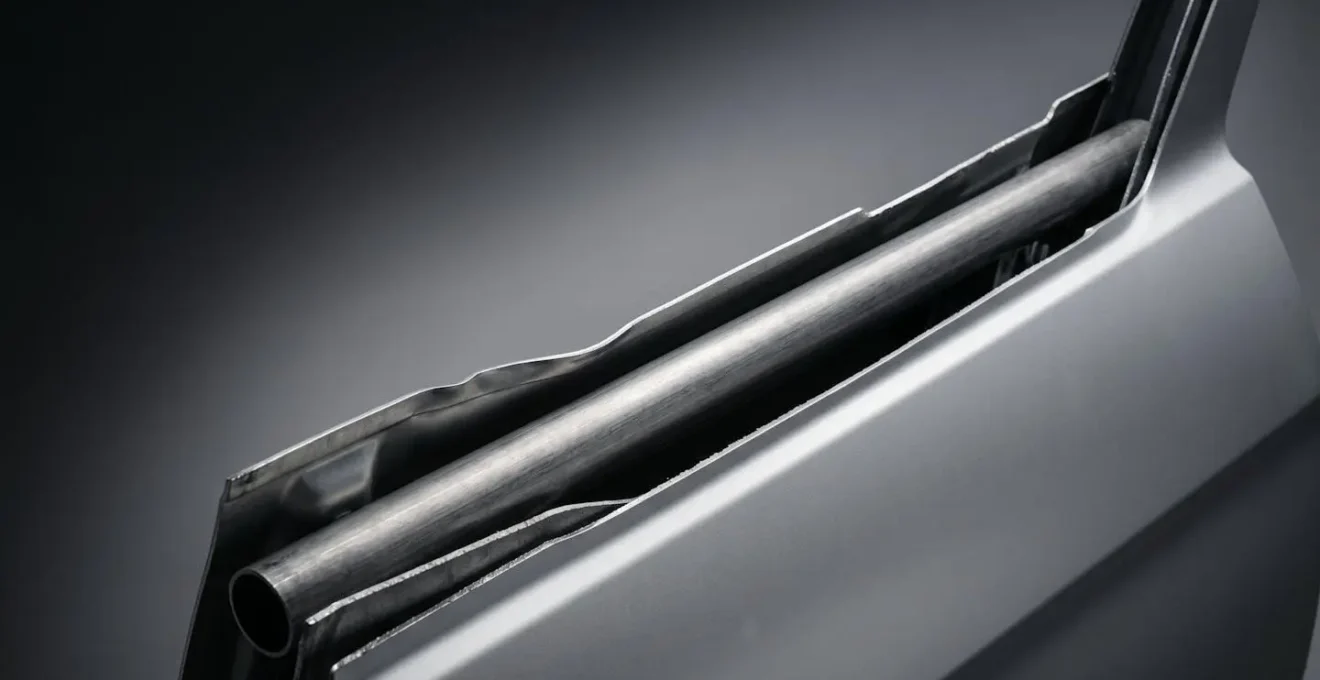
The effectiveness of this hidden reinforcement is significant. The goal is to prevent intrusion into the occupant survival cell. Data from safety authorities has shown that vehicles with these advanced systems offer substantially better protection. In fact, research shows that 24% of passenger vehicle occupant fatalities are from side-impact collisions, but advanced beam systems can dramatically reduce the risk of severe injuries by maintaining the structural integrity of the cabin.
Why Are Modern Car Bonnets Higher and Softer Than They Used to Be?
The design of a car’s front end is no longer just about aerodynamics and aesthetics; it’s now heavily dictated by pedestrian protection regulations. In a collision between a vehicle and a pedestrian, the most severe injuries are often caused by the person’s head striking the hard, unyielding surface of the bonnet, which sits directly on top of the solid engine block. To mitigate this, engineers have fundamentally changed bonnet design in two ways: by increasing the clearance to the engine and by incorporating active safety systems.
The « softness » of a modern bonnet refers to its ability to deform upon impact, absorbing energy and cushioning the blow. This is measured using a metric called the Head Injury Criterion (HIC). A lower HIC value means a lower risk of severe head trauma. By creating space between the bonnet panel and the engine’s hardpoints, and by designing the bonnet with deformable structures and breakaway hinges, manufacturers can significantly lower the HIC score. For example, a HIC value of 700 represents a 5% risk of severe injury and is a common target for modern designs.
Some manufacturers take this a step further with active « pop-up hood » systems. These use sensors in the front bumper to detect a pedestrian impact and, in milliseconds, fire a pyrotechnic actuator to raise the rear edge of the bonnet. As Honda’s engineers describe it:
When a collision with a pedestrian is perceived… the system triggers an actuator that raises the rear end of the hood around 100 mm before the pedestrian’s head hits the hood.
– Honda Global Technology Division, Pop-up Hood System Technology Documentation
This action instantly creates a large cushion of space, dramatically reducing the severity of the head impact. The higher, more bluff front ends of modern SUVs and crossovers are also a direct result of these regulations, as they provide more initial clearance by design.
The Body Shop Repair That Restores Appearance but Removes Crash Protection
After a collision, a vehicle’s safety systems are compromised. While a body shop can make a car look as good as new, an improper repair can permanently disable the very features designed to save your life. This is particularly true for sacrificial structures like the bonnet, bumper, and the underlying chassis rails. These components are designed to deform in a very specific way just once. Repairing them with excessive filler or replacing them with cheap, non-certified aftermarket parts can be catastrophic.
An aftermarket bonnet, for instance, may not have the same pre-stressed deformation zones or breakaway hinge design as the Original Equipment Manufacturer (OEM) part. In a subsequent pedestrian impact, it will behave like a rigid sheet of metal, failing to absorb energy and leading to much more severe injuries. Similarly, repairing a bent chassis rail instead of replacing it according to the manufacturer’s procedure means it will not collapse predictably in the next crash. The energy management pathway is broken.
It is therefore critical for owners to be vigilant about post-collision repairs. A shiny new coat of paint can easily hide a structural compromise that has rendered the car’s passive safety systems useless. Ensuring the repair facility is properly certified and uses OEM parts is not about aesthetics; it is about restoring the vehicle’s carefully engineered ability to protect you and others on the road.
Action Plan: How to Ensure a Safe Post-Collision Repair
- Request itemized invoices: Always ask for a detailed invoice that explicitly specifies OEM (Original Equipment Manufacturer) parts rather than generic aftermarket alternatives for critical safety components.
- Verify certifications: Check that the repair shop holds relevant credentials, such as I-CAR (Inter-Industry Conference on Auto Collision Repair) certification or specific manufacturer approvals.
- Inspect panel gaps: After the repair, carefully look at the spacing between panels like the bonnet, wings, and doors. Uneven or wide gaps can indicate improper fitment or hidden structural misalignment.
- Check for paint inconsistencies: Look for differences in paint texture or orange-peel effect between panels, which can reveal the use of heavy body filler to mask damage instead of replacing the part.
- Demand sensor recalibration proof: For any vehicle with advanced driver-assistance systems (ADAS) or active safety features like a pop-up bonnet, ensure the final report documents the recalibration of all relevant sensors.
When to Have Your Car Inspected: The 15 MPH Impact Threshold for Hidden Damage?
There is a common misconception that if a low-speed impact—say, under 15 MPH—results in no visible damage, then the car is fine. This can be a dangerous assumption. Modern cars are designed with bumper covers made of flexible plastic that can pop back into shape after a minor knock, hiding significant damage to the crucial safety structures underneath. The real issue is not the cosmetic bumper, but the energy-absorbing crash bar, sensors, and chassis mounting points behind it.
An impact at just 10-15 MPH can be enough to crack the foam absorbers, damage the mounting brackets of the steel reinforcement bar, or misalign critical ADAS sensors for automatic emergency braking and adaptive cruise control. Even more concerning, the force can be transmitted into the longitudinal chassis rails, potentially creating a weak point that will not collapse as designed in a more severe future collision. The car’s energy management pathway could be compromised without any external sign.
The same logic applies to side impacts. A seemingly minor scrape from a car park incident could potentially compromise the integrity of the door’s internal reinforcement beam or its connection to the B-pillar. While the outer door skin may only be scuffed, the internal structure designed to prevent intrusion could be weakened. For example, research into side-impact systems shows that when they work correctly, they are incredibly effective, with some optimized door beam systems decreasing intrusion by 52% in 50 km/h (31 mph) crash tests. Any pre-existing damage could negate this benefit.
Therefore, any impact, no matter how minor it appears, warrants a professional inspection. The « 15 MPH threshold » is less a rule and more a reminder that hidden damage is a real and significant risk. Only a trained technician can assess whether the car’s passive safety systems remain fully operational.
Why Modern Cars Look Totally Destroyed After 40 MPH Crashes Yet Occupants Walk Away?
The dramatic sight of a car’s front end compressed like an accordion after a 40 MPH crash is not a sign of poor build quality; it is the pinnacle of passive safety engineering in action. This is the controlled collapse philosophy made visible. The primary goal in a frontal impact is to dissipate the immense kinetic energy and, crucially, to increase the time over which the occupants decelerate. By extending the duration of the crash event by even a few milliseconds, the peak forces (or g-forces) exerted on the human body are drastically reduced.
To achieve this, the front structure of a vehicle is a carefully engineered sacrificial lamb. The longitudinal chassis rails are not simple steel beams; they are stamped with specific trigger points and accordion-like patterns. These pre-weakened areas are designed to initiate a predictable, progressive collapse, absorbing energy with every fold and buckle of the metal. This is why the front of the car looks so completely mangled—it has used up its own structure to manage the crash forces.

This is made possible by huge advancements in material science. Engineers use a gradient of steel strengths throughout the car. The very front might use softer, more ductile steels that deform easily, while the structures further back use progressively stronger materials. Innovations in press-hardened steels have been a game-changer. For example, some next-generation materials have shown a significant performance increase, with KIRCHHOFF Automotive’s new steel grade achieving 15% higher energy absorption compared to previous materials. This allows engineers to design crumple zones that are more efficient than ever, absorbing more energy in less space.
Why Do Airbags Deploy Gently in Low-Speed Crashes but Explosively in High-Speed Impacts?
Early airbag systems were a relatively blunt instrument: a crash was detected, and a single, powerful explosive charge inflated the bag. While life-saving, this « one-size-fits-all » approach could cause injuries in lower-speed collisions where a less forceful deployment would have been sufficient. Today’s systems are far more intelligent, relying on multi-stage inflators to tailor the deployment force to the severity of the impact.
The vehicle’s central Electronic Control Unit (ECU) acts as the brain of the safety system. It constantly receives data from a network of accelerometers placed strategically around the car. These sensors measure the deceleration pulse—the rate at which the car is slowing down. In a minor frontal collision, the ECU detects a relatively slow deceleration pulse and makes a critical decision: it fires only the first, smaller pyrotechnic charge in the airbag’s inflator canister. This results in a gentler, lower-pressure inflation, providing sufficient cushioning for the low-speed event while minimising the risk of airbag-induced injury.
In a high-speed, severe crash, however, the ECU reads a much more rapid and violent deceleration pulse. It instantly determines that maximum protection is required. In this scenario, it fires both charges in the inflator. The second, more powerful charge is often triggered just milliseconds after the first, resulting in a near-instantaneous and forceful inflation to full pressure. This explosive deployment is necessary to create a protective cushion before the occupant, who is moving forward at high velocity, makes contact with the steering wheel or dashboard.
The car’s computer (ECU) analyzes data from accelerometers and decides in real-time whether to fire one charge for a softer deployment or both charges (sequentially) for a faster, more forceful one.
– Automotive safety systems engineering literature
This ability to adapt the deployment force is a key aspect of modern passive safety, ensuring the airbag’s response is always proportional to the threat.
Key Takeaways
- Passive safety is a system of controlled failure, not brute strength, designed to manage crash energy.
- A car is divided into sacrificial crumple zones and a rigid occupant survival cell made of ultra-high-strength steel.
- Features like breakaway engine mounts and pop-up bonnets are designed to move or deform to protect both occupants and pedestrians.
Why Did Your Car’s Cabin Stay Intact While the Front Crumpled Beyond Recognition?
The stark contrast between a demolished engine bay and a largely intact passenger cabin is the ultimate expression of modern crash safety philosophy. This is not an accident; it is the result of a design principle known as the occupant survival cell. Engineers treat the cabin as a non-negotiable, rigid fortress, while everything around it is considered sacrificial and designed to protect that core structure at all costs.
This is achieved through a sophisticated application of material science, creating a gradient of strength throughout the vehicle’s chassis. The front and rear crumple zones are made from more ductile steels that are designed to fold and absorb energy. The survival cell, however, is constructed from the most advanced materials available: ultra-high-strength steels (UHSS) and press-hardened boron steels. These materials are incredibly strong and resistant to deformation. Key areas like the A and B pillars, roof rails, floor pan, and door sills are all part of this reinforced cage.
The numbers are astonishing. The steel used in the crumple zone might have a tensile strength of a few hundred megapascals (MPa), but the materials in the safety cell are vastly stronger. As demonstrated in advanced engineering applications, it’s now common for modern vehicles to use martensitic 1500 MPa steel in these critical areas. This allows the cabin to maintain its shape even under extreme loads, preventing intrusion that could cause direct injury and giving the restraint systems—seatbelts and airbags—the secure space they need to function effectively.
So, when you see a car with its front end completely destroyed but its doors still able to open, you are witnessing the system working to perfection. The sacrificial structures have done their job of absorbing the impact, leaving the rigid survival cell to do its job of protecting the people inside. It is the visual proof that the car has given its life to save its occupants.
Now that you understand the hidden engineering that protects you in a crash, the next logical step is to ensure this complex system is always maintained to the highest standard. Appreciate that the visible damage is part of the design, and always entrust repairs to certified professionals who understand the critical importance of restoring every component to its original specification.