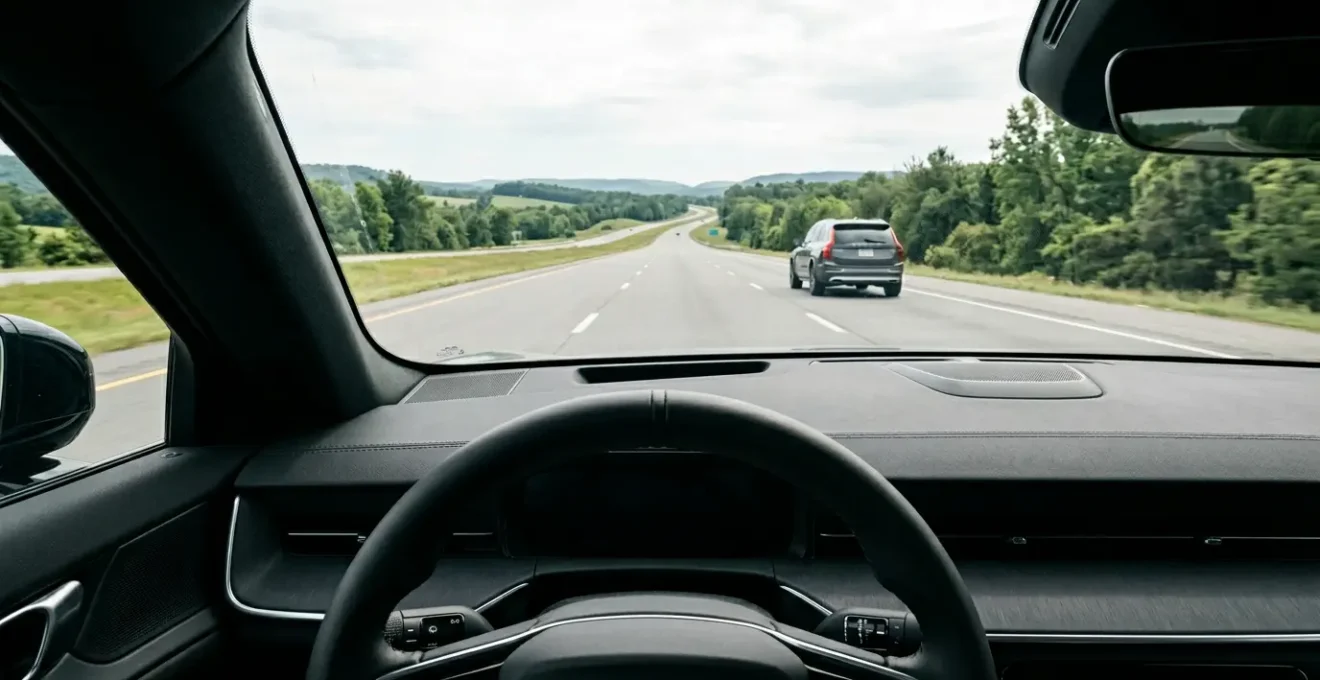
That sudden, uncommanded braking wasn’t a fault; it was your car’s digital co-pilot making a calculated, life-saving decision based on a high-speed data conversation.
- Proactive systems constantly measure ‘Time-to-Collision’ and will intervene if a human driver doesn’t react within a critical window.
- This technology, once a premium feature, is now standard and highly effective on most new vehicles, but requires precise calibration to function correctly.
Recommendation: Embrace this technology by understanding its logic and your non-negotiable role as the ultimate commander of the vehicle.
It’s a heart-in-mouth moment every modern driver is starting to experience. You’re navigating a busy road, maintaining a safe distance, when suddenly your car emits an aggressive beep and the brakes apply themselves with a force that feels entirely alien. Your first thought is likely, « What’s wrong with my car? » It feels like a glitch, a malfunction, a terrifying loss of control. For a UK driver, who has just had this unsettling experience, the immediate question is whether the vehicle is safe to drive.
The common explanations often miss the point, focusing on ‘phantom’ activations or simply labelling it as ‘Autonomous Emergency Braking’ (AEB) without further detail. While these systems aren’t infallible, the reality is far more sophisticated. That sudden stop was not a random error. It was the final, decisive action in a high-speed digital conversation between sensors, processors, and actuators—a conversation about physics, risk, and the preservation of your safety envelope.
This article will not just tell you what happened; it will explain *why* it happened from a vehicle safety systems engineer’s perspective. We will decode that split-second decision-making process. We will move from the initial warning beep to the physical braking action, explore how this technology has become commonplace, and clarify the absolute, non-negotiable responsibility that still rests with you, the driver. By understanding the logic of your digital co-pilot, you can transform that moment of fear into one of confident appreciation.
To fully grasp the intricate systems at play, this article breaks down each critical aspect of your vehicle’s proactive safety features. The following sections will guide you through the technology’s logic, its practical requirements, and your essential role in the human-machine partnership.
Contents: Why Your Car’s Sudden Braking Is a Feature, Not a Bug
- Why Does Your Car Beep Aggressively When the Vehicle Ahead Brakes Sharply?
- Do Cheap Cars Have Emergency Braking Now or Is It Still a Premium Feature?
- Why Your Emergency Braking System Needs Recalibrating After a Windscreen Change?
- The Sensitivity Setting That Prevents False Emergency Braking in Stop-Start Traffic?
- When to Test Your New Car’s Emergency Features: The Empty Car Park Drill?
- Why Level 2 Autonomy Still Requires Your Hands on the Wheel at All Times?
- Why Does Your Car Feel Like It Hesitates When Pulling Out on a Wet Roundabout?
- Why Did That Driver Crash Despite Having Autopilot: Understanding the Human Responsibility?
Why Does Your Car Beep Aggressively When the Vehicle Ahead Brakes Sharply?
That loud, insistent beep is the start of the conversation, not the conclusion. It’s your vehicle’s Forward Collision Warning (FCW) system alerting you that a critical threshold has been crossed. The system isn’t just measuring distance; it’s constantly calculating a metric known as Time-to-Collision (TTC). This is the time you have left before impacting the object ahead if your speed and the other vehicle’s speed remain constant. The auditory alarm is designed to be impossible to ignore for a reason.
Engineers have programmed the system to act at a specific point. For many systems, a sustained auditory tone is triggered at a TTC of around 2 seconds. This is the moment the car has identified a high-risk scenario and is demanding your immediate attention. It’s a digital tap on the shoulder, asking, « Are you seeing what I’m seeing? » If you, the driver, react by braking or swerving, the system has done its job and stands down. But if you don’t, it escalates to the next phase.
As the Ford Motor Company explains regarding its own system, this is when the car prepares for the worst, hoping for the best. The system doesn’t just wait for you to brake; it actively prepares the braking system for maximum performance. This is a crucial, unseen step that makes a significant difference in an emergency.
If you don’t react and continue to get closer to the other vehicle, your car will pre-charge and increase brake assist sensitivity to provide full responsiveness when you brake.
– Ford Motor Company, Ford Forward Collision Warning System Description
This pre-charging action means the brake pads are moved infinitesimally closer to the discs, eliminating the tiny travel time delay. When you finally hit the pedal, you get 100% braking power instantly, rather than the slightly delayed, progressive feel of normal braking. If you still fail to act, the car then takes the final step: Autonomous Emergency Braking (AEB).
Do Cheap Cars Have Emergency Braking Now or Is It Still a Premium Feature?
Not long ago, advanced safety systems like Autonomous Emergency Braking (AEB) were the exclusive domain of high-end, premium vehicles. Today, that landscape has fundamentally changed. Due to a combination of regulatory pressure, consumer demand, and the falling cost of sensor technology, AEB is now a standard or low-cost optional feature on the vast majority of new cars sold in the UK, including entry-level models.
What’s more important is that the technology itself has matured dramatically. Early-generation AEB systems were effective but had limitations. They might have struggled in poor weather, at higher speeds, or with detecting pedestrians and cyclists. The systems fitted to new vehicles are orders of magnitude more capable, using a sophisticated sensor fusion of cameras, radar, and sometimes LiDAR to build a highly detailed picture of the world ahead.
The improvements are not just theoretical; they are backed by real-world data showing a dramatic increase in effectiveness. Research consistently demonstrates that the latest systems are far superior at preventing common types of accidents. For a driver of a new car, this means the safety net is both wider and stronger than ever before. As a tangible example, AAA’s latest research demonstrates that 2024 model year vehicles avoided 100% of forward collisions at speeds up to 35 mph in their tests, a significant leap in performance.
This rapid democratisation and improvement of AEB technology is one of the most significant safety advancements since the seatbelt. While it was once a « nice-to-have » luxury, it’s now a fundamental, highly effective safety system that buyers of almost any new car can expect. The technology has evolved from a simple collision-mitigation tool to a genuinely effective collision-avoidance system in many common scenarios, as confirmed by a comprehensive MITRE study which found the technology now cuts rear-end crashes in half.
Why Your Emergency Braking System Needs Recalibrating After a Windscreen Change?
The ‘eye’ of your car’s AEB system is a forward-facing camera, typically mounted at the top-centre of your windscreen, often housed within the same black-fritted area as the rearview mirror. This camera isn’t just taking a picture; it’s constantly scanning the road, identifying vehicles, pedestrians, and lane markings with incredible precision. Its angle and position are absolutely critical to its function. From the factory, it is calibrated to within fractions of a degree.
When your windscreen is replaced, that camera is either removed and re-fitted to the new glass, or the new windscreen has a new mounting bracket. In either case, it is impossible to guarantee that the camera’s final position is identical to its original, factory-calibrated state. A tiny deviation of just one degree in the camera’s angle can translate to a targeting error of metres down the road, rendering the entire safety system unreliable or, worse, completely inoperative.
This is why an ADAS (Advanced Driver-Assistance Systems) recalibration is not an optional extra after a windscreen replacement; it is a mandatory safety procedure. The process involves placing the vehicle in a controlled environment and using specialised targets and diagnostic equipment to tell the camera’s software its new, precise position relative to the vehicle’s centerline and thrust angle. It is, in essence, giving your car’s ‘eye’ a new prescription. Without it, the car is driving partially blind.
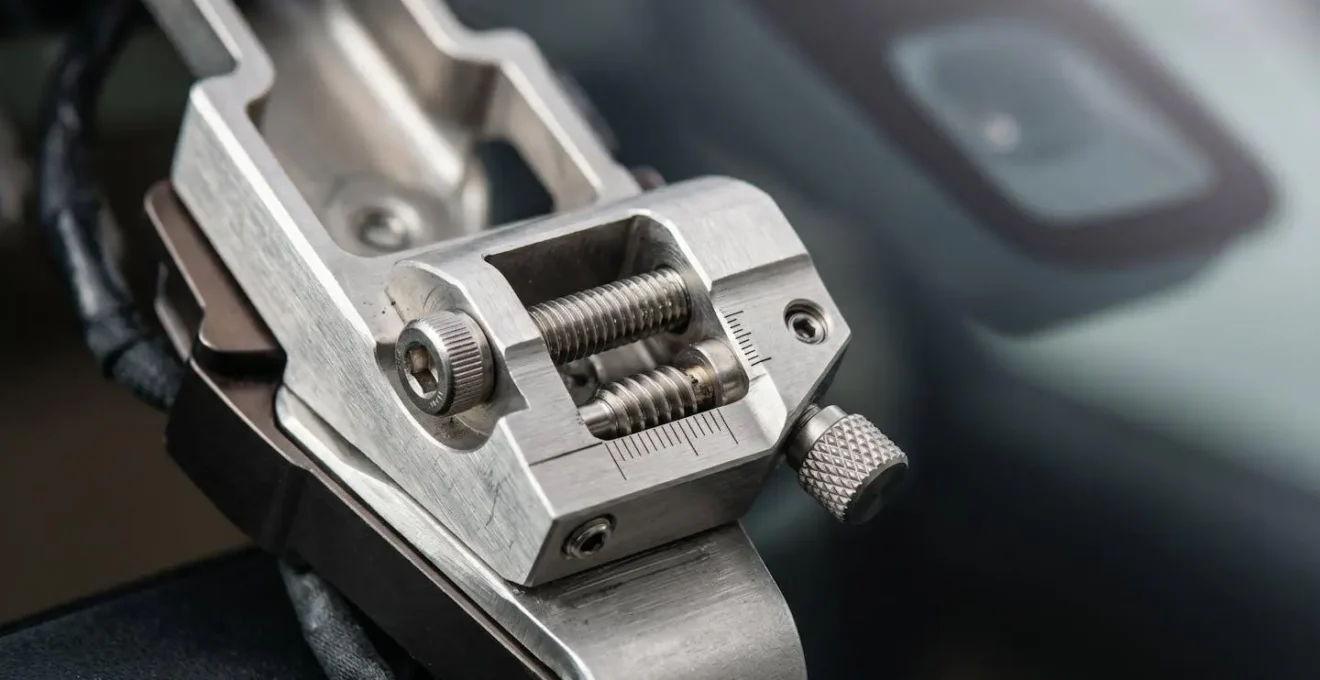
As this illustration of a mounting bracket suggests, the engineering tolerances are minute. The financial and legal ramifications of skipping this step are significant. In the UK, failure to ensure your vehicle is roadworthy can have serious consequences, and a misaligned safety system could be viewed as just that. An insurance company could argue that by not performing the required calibration, the vehicle was not maintained in a safe condition.
If an accident occurs and it’s found that the ADAS camera was not recalibrated after a windscreen replacement, your insurance company could refuse the claim, and you could be held liable for the accident.
– Safelite AutoGlass, ADAS Calibration Safety and Liability Guidelines
The Sensitivity Setting That Prevents False Emergency Braking in Stop-Start Traffic?
While sudden, uncommanded braking is often a life-saving intervention, there are situations, particularly in dense, stop-start city traffic, where an overly sensitive system can feel jarring or even counter-productive. A gap that a human driver would deem perfectly safe to merge into might be interpreted by the system as a high-risk, low-TTC scenario, triggering an alert or a sharp brake application. This is where user-adjustable sensitivity settings become your primary tool for customising the system’s behaviour.
Most modern vehicles with AEB offer a menu setting, usually within the vehicle or infotainment settings, to adjust the Forward Collision Warning sensitivity. While the specific terminology varies between manufacturers, you will typically find three options:
- Late / Low: In this mode, the system will only provide warnings and intervene at the very last moment. This setting provides the latest possible warning, reducing the frequency of alerts in dense traffic but also providing the shortest reaction time window for the driver.
- Normal / Medium: This is the default factory setting, balanced to provide timely warnings in most driving conditions without being overly intrusive. For most drivers, this is the optimal setting.
- Early / High: This setting provides the earliest possible warning. The system will alert you to potential collisions much further out, giving you maximum time to react. However, in heavy traffic, this can lead to frequent alerts that some drivers find distracting.
Adjusting this setting is how you communicate your driving style and the current conditions to your digital co-pilot. If you are driving on an open motorway, the ‘Early’ setting might provide a welcome extra layer of comfort. Conversely, if you are navigating the intricate stop-start ballet of central London traffic, switching to ‘Normal’ or even ‘Late’ can prevent the system from crying wolf at every yellow box junction. It’s about finding the right balance that keeps you safe without creating unnecessary stress. It does not, however, disable the system—it simply adjusts the timing of its alerts and potential intervention.
When to Test Your New Car’s Emergency Features: The Empty Car Park Drill?
Having a powerful safety system is one thing; understanding its behaviour is another. There is a natural curiosity to want to « see it work. » However, attempting to test your Autonomous Emergency Braking system by driving towards a solid object is an exceptionally bad idea with obvious and expensive consequences if it fails to activate as expected. So, how can you safely build confidence in your car’s digital senses?
The key is to test the inputs, not the final, drastic output. The same sensors that trigger AEB also power other, less aggressive driver-assistance features. As Greg Brannon, a key research director at AAA, points out, the safest way to verify the system’s « vision » is by using a feature you can control.
AEB isn’t something you can easily experiment with, because if it doesn’t work, you can easily get into a lot of trouble. The best way to see if your car’s detection systems are functioning as they should is to experiment with adaptive cruise control.
– Greg Brannon, AAA Director of Automotive Engineering Research, AAA AEB Testing and Safety Recommendations
By using your Adaptive Cruise Control (ACC), you can safely observe how your car detects and reacts to other vehicles in a controlled manner. A simple drill in a safe, open space can teach you volumes about your car’s personality. This isn’t about testing the emergency brakes; it’s about familiarising yourself with the warning beeps and the system’s perception of the world.
Your Action Plan: The Empty Car Park ACC Familiarisation Drill
- Choose Your Location: Find a large, completely empty car park (a supermarket on a Sunday morning is ideal). You need clear, open space with no pedestrians, shopping trolleys, or other cars. Ensure conditions are dry and clear.
- Review Your Manual: Before you start, take five minutes to read the ACC and FCW sections of your owner’s manual. Understand how to activate ACC, set the speed, and adjust the follow-distance setting.
- Test Forward Collision Warning (FCW) Alerts: Use a large, soft object that will not damage your car, like an empty oversized cardboard box. Place it in the middle of a lane. Drive slowly towards it (under 10 mph). Do *not* expect the car to brake. Listen for the audible alert. This safely confirms the camera is identifying an object.
- Test Adaptive Cruise Control (ACC) Detection: This requires a second person and a second vehicle. With immense caution and in the empty car park, have the lead car drive slowly and predictably. From a safe distance behind, activate your ACC at a low speed (e.g., 15 mph).
- Observe and Learn: Watch how your car manages the gap. Does it brake smoothly when the car ahead slows? Does it accelerate gently when the way is clear? Change the follow-distance setting from far to near and feel the difference. This is the system’s brain in action, and it’s the same brain that commands the AEB.
Why Level 2 Autonomy Still Requires Your Hands on the Wheel at All Times?
Many modern cars sold in the UK offer « Level 2 » autonomous driving features, often marketed with impressive names that might suggest the car can drive itself. Systems like Tesla’s Autopilot, Ford’s BlueCruise, or Mercedes-Benz’s Drive Pilot fall into this category. It is absolutely essential to understand what Level 2 means: the car can assist with steering, acceleration, and braking under certain conditions, but you, the driver, must remain in complete control and supervise the system at all times.
Think of it as a very advanced cruise control, not a chauffeur. The system can keep you centered in your lane on a motorway and maintain a set distance from the car in front. It significantly reduces the cognitive load of a long journey, but it is not self-driving. Your hands must remain on the wheel (or ready to take over instantly), and your eyes must remain on the road. The car is merely your co-pilot, and you are the captain.
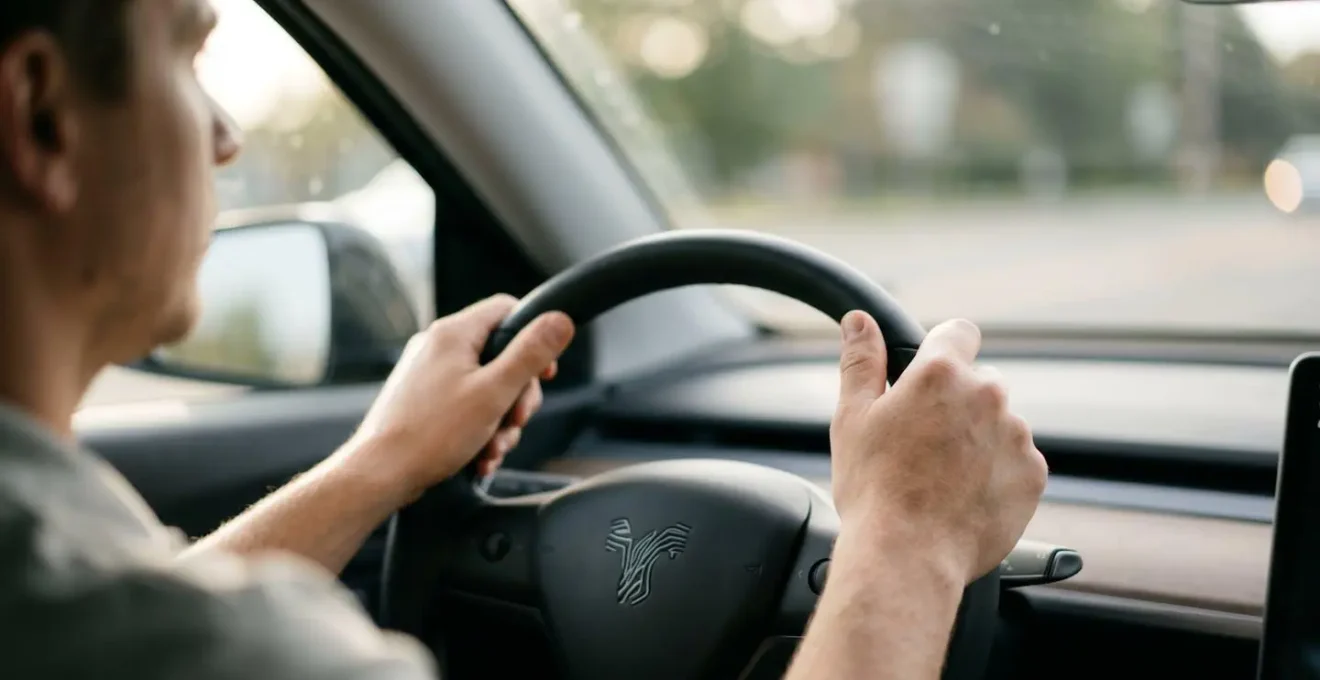
The engineering and legal reasoning for this is simple: the system can fail. It can be confused by poorly painted lane markings, complex junctions, adverse weather, or the unpredictable actions of other road users. When the system decides it can no longer cope, it will disengage and hand control back to you. The critical question is, how long does it take for a distracted human to regain situational awareness and take effective control?
The answer is, far too long. Scientific studies on this « handover » process are sobering. Even in controlled, non-critical scenarios, research on autonomous vehicle handover shows takeover times can range from 1.9 to 25.7 seconds. In a real-world emergency unfolding at 70 mph, you don’t have 25 seconds. You barely have two. This is why systems use torque sensors in the steering wheel and driver-facing cameras to monitor your attention, demanding that you stay engaged in the driving task.
Why Does Your Car Feel Like It Hesitates When Pulling Out on a Wet Roundabout?
This is another classic moment where the car’s intervention feels like a flaw, but is in fact the signature of a perfectly functioning safety system. You’re at the give-way line of a wet, greasy roundabout. You see a gap, you press the accelerator to merge decisively, and for a split second, the car seems to bog down, to hesitate, before finally giving you the power you requested. It feels sluggish and unresponsive precisely when you need it to be agile.
This « hesitation » is not an engine problem. It is the palpable feeling of your Traction Control System (TCS) and Electronic Stability Control (ESC) working in perfect harmony to save you from a potential loss of control. When you accelerate while turning on a low-grip surface like a wet road, the inside front wheel (on a front-wheel-drive car) has less weight on it and is prone to spinning. Your car’s wheel speed sensors, which take thousands of readings per second, detect this instantly.
Case Study: Traction Control Intervention on a Low-Grip Surface
When accelerating on a wet surface while turning, the vehicle’s wheel speed sensors detect in milliseconds that an inside wheel is spinning faster than the others. The Traction Control System (TCS) interprets this as an imminent loss of traction and immediately reduces engine power to prevent wheelspin. Simultaneously, the Electronic Stability Control (ESC) system may apply a minute amount of brake pressure to that specific wheel. This orchestrated response creates the sensation of hesitation but is actually the car’s digital nervous system preventing a dangerous understeer or oversteer scenario, where the tires would lose grip and you would fail to make the turn.
The car’s logic is flawless: allowing the wheel to spin would waste power and, more dangerously, could lead to a complete loss of grip at the front end (understeer), causing you to plow straight on instead of turning into the roundabout. By momentarily cutting engine power, the system allows the tyre to regain traction. What you feel as hesitation is the system’s digital foot feathering the throttle with a speed and precision no human could match. It is choosing grip and control over raw, unusable power.
Key Takeaways
- The sudden braking you felt was likely a calculated AEB intervention based on Time-to-Collision, not a random glitch.
- Windscreen replacement requires mandatory ADAS recalibration to ensure the system’s « eye » is aimed correctly; skipping it can have serious safety and insurance implications.
- Level 2 autonomy is driver *assistance*, not self-driving. The driver is always legally responsible and must remain vigilant and ready to take control instantly.
Why Did That Driver Crash Despite Having Autopilot: Understanding the Human Responsibility?
The headlines are unsettling: « Car on Autopilot Crashes. » These incidents invariably spark a debate about the safety of autonomous features. However, when investigations are completed, the conclusion is almost always the same: it was not a failure of the technology operating within its designed parameters, but a tragic failure of the human driver to understand their role. The most significant risk factor in Level 2 systems is automation complacency—the tendency for humans to over-trust the system and mentally check out.
This is a well-documented psychological phenomenon. The more reliable and effective a system becomes, the more our attention wanders. We begin to text, to watch movies, to believe the car has it covered. But as we’ve established, Level 2 systems have clear limitations and are designed to be supervised. Naturalistic driving studies, where researchers monitor drivers over extended periods, show how quickly this complacency sets in. One such study found that drivers used Level 2 automation over 70% of the time on interstate highways, creating significant opportunity for disengagement.
The « Autopilot » name itself can be misleading, implying a capability far beyond what the system can legally and technically deliver. This leads to a dangerous gap between a driver’s expectation and the technological reality. The system is designed to handle the monotonous 99% of motorway driving, but it relies entirely on the attentive human driver to handle the unexpected 1%—the debris in the road, the complex junction, or the sudden disengagement.
Ultimately, the legal and ethical framework is unambiguous. Until we reach true, internationally-recognised Level 4 or 5 autonomy (where the car requires no human supervision in certain or all conditions), the person in the driver’s seat is the final authority and bears all responsibility. Every car manual and every regulatory body in the world is in agreement on this single, crucial point.
The driver is, and remains, the legal commander of the vehicle at all times, responsible for its every action, regardless of which assistance features are active.
– SAE International and NHTSA, Level 2 Automation Legal Framework and Driver Responsibility
The moment your car braked unexpectedly was a powerful demonstration of incredible engineering designed for your protection. The path to becoming a confident and safe user of this technology is not to fear it, but to understand it. Learn its language, respect its limitations, and never forget your own role as the ultimate, indispensable command system. Your digital co-pilot is an amazing asset, but it is you who must always fly the car.