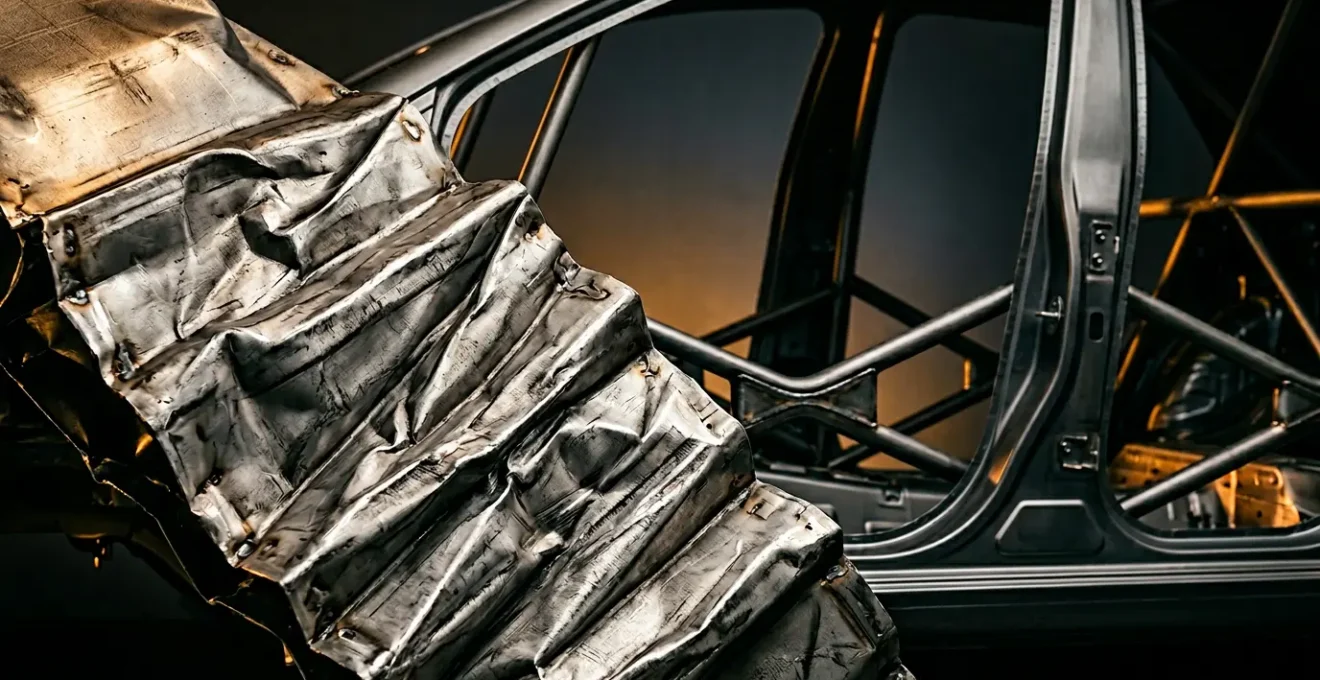
Contrary to what it looks like, a car that crumples catastrophically in a crash is performing exactly as designed. The destruction is not a sign of weakness, but of a sophisticated engineering ballet where sacrificial parts absorb lethal energy. The secret to walking away isn’t that the car is indestructible, but that its front and rear are designed for controlled self-destruction to protect the one non-negotiable part: the rigid survival cell where you sit.
It’s a sight that’s both jarring and strangely reassuring: a car crash scene where the vehicle’s front end is compressed into an unrecognisable tangle of metal, yet the passenger area looks almost untouched. The common explanation you’ll hear is « crumple zones. » While true, this simple term masks a deeply complex and deliberate engineering philosophy. It’s not just about parts that are weak; it’s about a sequence of failures, meticulously choreographed to manage immense forces.
Most people think a stronger, more rigid car is a safer car. In reality, a vehicle that doesn’t deform transfers all the violent energy of a crash directly to its occupants. As a crash safety engineer, my work focuses on designing a vehicle that sacrifices itself to protect what’s inside. This involves creating distinct zones with opposing properties: ductile, energy-absorbing structures at the front and rear, and an incredibly rigid « survival cell » for the occupants.
But if this concept were the whole story, why does a small dent from a parking mishap sometimes lead to an insurance write-off? And how do modern systems like airbags and headrests know exactly how to react based on the severity of an impact? The truth lies in the integration of these systems. The structure manages the energy, while restraint systems manage the occupant’s movement within the protected space.
This article will take you beyond the surface-level explanation. We will dissect the engineering ballet that occurs in milliseconds during a collision. We’ll explore why size isn’t the only factor in safety, how to interpret crash test ratings like an expert, and how even the smallest components are designed with your survival as their only mission.
To fully grasp how these elements work in concert, this guide breaks down the core principles of modern vehicle safety. The following sections explore each critical component, from the overall structural philosophy to the specific systems that protect you and those around you.
Summary: The Engineering Behind Modern Vehicle Crash Safety
- Why Modern Cars Look Totally Destroyed After 40 MPH Crashes Yet Occupants Walk Away?
- Small Hatchback or Large SUV: Which Actually Protects You Better in Multi-Vehicle Crashes?
- How to Read NCAP Crash Test Results: Why Structure Stars Matter More Than Total Scores?
- The Minor Dent That Reduces Your Car’s Crash Protection by 30%
- When to Adjust Your Headrest: The 2-Finger Rule That Prevents Neck Injuries?
- Why Your Car’s Engine Drops Downward During Head-On Collisions?
- Why Do Airbags Deploy Gently in Low-Speed Crashes but Explosively in High-Speed Impacts?
- Why Does Your Car’s Bonnet Buckle on Purpose During Pedestrian Impacts?
Why Modern Cars Look Totally Destroyed After 40 MPH Crashes Yet Occupants Walk Away?
The dramatic destruction of a modern car’s front end is the most visible evidence of its safety system working perfectly. This process is about managing kinetic energy. A car moving at speed contains an enormous amount of energy that, in a crash, must go somewhere. If the car were perfectly rigid, that energy would be transferred almost instantly to the occupants, causing devastating injuries. Instead, engineers design the front and rear of the vehicle as sacrificial crumple zones.
These zones are made from materials and structures designed for controlled deformation. They fold and collapse in a predictable, accordion-like manner, absorbing energy and, crucially, extending the time of the impact. By increasing the duration of the deceleration, even by milliseconds, the peak forces exerted on the occupants are drastically reduced. This is why occupants can often walk away from a crash at speeds under 40 MPH. However, the physics are not linear; when impact speed increases from 40 to 60 mph, the energy that needs to be managed increases by 125%, highlighting the incredible challenge engineers face.
The goal is never to prevent damage to the car; it is to channel the destructive forces along predefined energy pathways in the chassis, directing them around and away from the rigid passenger compartment. This compartment, often called the « safety cage » or « survival cell, » is constructed from ultra-high-strength steel designed to resist deformation and maintain its shape, preserving a survival space for the people inside.
Small Hatchback or Large SUV: Which Actually Protects You Better in Multi-Vehicle Crashes?
When it comes to multi-vehicle crashes, physics presents a stark reality: mass matters. In a collision between two vehicles of different weights, the occupants of the lighter vehicle experience a much greater change in velocity, and therefore, higher forces. The heavier vehicle tends to « win » the momentum battle. This is borne out by real-world data; a study found that in car-versus-SUV head-on crashes, the odds of death were 7.6 times higher for the car driver than the SUV driver. This fundamental size and weight advantage is a compelling argument for larger vehicles.
However, this is not the whole story. The very characteristic that makes an SUV tall and imposing—its high ride height—also raises its centre of gravity. A higher centre of gravity makes a vehicle inherently less stable and more susceptible to rolling over, particularly in single-vehicle incidents or when « tripped » by a kerb or soft ground after a collision.

As the image above visualises, the elevated mass of an SUV creates a greater tipping force during sharp manoeuvres or side impacts. While modern SUVs are equipped with sophisticated Electronic Stability Control (ESC) systems to mitigate this, the fundamental physics remain. Data from safety administrations has consistently shown that SUVs have a higher inherent risk of rollover in single-vehicle crashes compared to traditional passenger cars. The choice is a trade-off: superior protection in multi-vehicle collisions versus a higher intrinsic rollover risk.
How to Read NCAP Crash Test Results: Why Structure Stars Matter More Than Total Scores?
NCAP (New Car Assessment Programme) ratings, like those from Euro NCAP, are an invaluable tool for consumers. They condense a vast amount of complex crash data into a simple star rating. However, looking only at the overall score can be misleading. The total score is a weighted average of four areas: Adult Occupant Protection, Child Occupant Protection, Vulnerable Road User (pedestrian) Protection, and Safety Assist technologies. While all are important, the single most critical element is the one that underpins everything else: structural integrity.
The Adult Occupant score is where you’ll find the results of frontal and side-impact tests. If the vehicle’s survival cell deforms or is compromised in these tests, no amount of airbags or electronic aids can fully protect the occupants. A compromised structure means there is less survival space and that impact forces are intruding into the cabin. This is why an expert reads the detailed report, not just the headline stars. Research consistently shows that a vehicle’s structural performance is the most critical factor in determining real-world outcomes. In fact, IIHS research demonstrates that the vehicle structure rating has the strongest relationship with driver fatality risk in frontal crashes.
As the Insurance Institute for Highway Safety (IIHS) points out, the difference between a « Good » and a « Poor » structural rating has life-or-death implications.
A driver of a vehicle rated Good in the moderate overlap test is 46 percent less likely to die in a frontal crash, compared with a driver of a vehicle rated Poor.
– Insurance Institute for Highway Safety, Consumer Reports analysis of IIHS crash test effectiveness
Therefore, when evaluating a car’s safety, always prioritise the structural test results within the Adult Occupant Protection category. A strong survival cell is the foundation upon which all other safety systems are built.
The Minor Dent That Reduces Your Car’s Crash Protection by 30%
It may seem disproportionate, but a seemingly minor dent or crease in a critical structural area, like a chassis frame rail or a bumper reinforcement bar, can significantly compromise a vehicle’s crashworthiness. While a specific figure like « 30% » depends on the exact location and severity of the damage, the underlying principle is sound. A vehicle’s structure is a finely tuned system of energy pathways, designed to absorb and redirect crash forces in a specific sequence. Previous damage disrupts this system.
Think of an empty aluminium drink can. In its perfect, cylindrical form, it can support a surprising amount of weight. But the moment you put a small dent in its side, it becomes incredibly easy to crush. The dent creates a weak point, a pre-determined path for failure. The same is true for your car’s structural components. A frame rail is designed to crush progressively from the front backwards in a collision. A dent or a crease from a previous, even minor, impact creates a weak point mid-rail. In a subsequent crash, the rail may buckle at that weak point instead of crushing as intended, altering the energy absorption path and potentially directing more force towards the survival cell.

This is why insurance companies are often quick to « write off » vehicles with chassis damage. A repair might make the car look cosmetically perfect, but restoring the engineered crash performance of a compromised ultra-high-strength steel component is incredibly difficult and often impossible outside of the factory. The vehicle’s ability to protect you has been fundamentally altered.
When to Adjust Your Headrest: The 2-Finger Rule That Prevents Neck Injuries?
The head restraint—often incorrectly called a headrest—is one of the most critical yet frequently overlooked safety devices in your car. Its sole purpose is to prevent or reduce whiplash, a neck injury caused by the rapid back-and-forth motion of the head during a rear-end collision. An improperly adjusted head restraint can be almost as ineffective as having none at all. Correct positioning is essential, and it can be easily checked using the simple « 2-Finger Rule ».
The effectiveness of a head restraint depends on two factors: height and distance. It needs to be high enough to catch your head as it whips backward, and close enough to do so early in the crash event. An IIHS study found that the rate of neck injury complaints is 15 percent lower in vehicles with properly designed and positioned restraints. Some modern cars feature active head restraints that move up and forward in a rear impact, but for the vast majority of vehicles, manual adjustment is key.
Proper adjustment ensures that your head’s motion is controlled, preventing the violent hyperextension of the neck that causes whiplash. It takes only a few seconds to check and can make a life-altering difference in a crash.
Your Action Plan: The 2-Finger Head Restraint Check
- Check the Height: Sit in your normal driving position. The top of the head restraint should be at least as high as the top of your head, or ideally, slightly above. It should never be below your eye level, as this can act as a fulcrum and increase injury.
- Check the Distance (The 2-Finger Rule): With your head in a normal, upright position, measure the distance between the back of your head and the front surface of the head restraint. This gap should be as small as possible, ideally less than 4cm, or about the width of two fingers.
- Adjust as Needed: Use the adjustment button on the side of the head restraint posts to raise or lower it. If your restraint has a tilt feature, use it to reduce the horizontal gap.
- Check for All Occupants: Remind any passengers, especially in the front seat, to perform the same check and adjustment.
- Make it a Habit: Check your head restraint position every time you adjust your seat or after the car has been serviced or used by another driver.
Why Your Car’s Engine Drops Downward During Head-On Collisions?
In a severe head-on collision, one of the greatest threats to the occupants is the engine block. It’s a massive, dense, and essentially incompressible object located directly in front of the cabin. If it were to be pushed straight back during a crash, it would act like a battering ram, intruding into the footwell and compromising the survival cell. To prevent this, automotive engineers developed a clever solution: breakaway or « drop-down » engine mounts.
These are not simple, solid brackets. They are specially designed mounting points that are strong enough to hold the engine securely during all normal driving conditions, including heavy braking and cornering. However, in the event of a severe frontal impact, they are designed to fail in a controlled manner. The force of the crash shears the mounts, allowing the engine and transmission assembly to detach from its highest points. This causes the entire powertrain to rotate and drop downwards, passing *under* the passenger compartment’s reinforced floor pan rather than into it.
This engineered failure is another critical part of managing energy pathways. By directing this huge mass away from the occupants, it maintains the integrity of the footwell and dashboard area, which is vital for protecting the driver and front passenger’s legs and lower body. The same principle applies to modern Electric Vehicles (EVs), where the heavy battery pack is already mounted low in the chassis, contributing to a low centre of gravity and staying clear of the cabin in a crash.
Case Study: Tesla Model S High-Speed Crash Survival
Multiple real-world incidents have demonstrated the effectiveness of protecting the survival cell. In a notable 2016 crash in Germany, a Tesla Model S collided with a barrier at high speed. The impact was severe enough to cause the car to go airborne. Despite the terrifying nature of the crash, all five occupants were able to exit the vehicle with serious but non-life-threatening injuries. This outcome was possible because the vehicle’s structure managed the immense energy and kept the occupant compartment intact, preventing intrusion of heavy components.
Why Do Airbags Deploy Gently in Low-Speed Crashes but Explosively in High-Speed Impacts?
An airbag is not a soft pillow; it’s a rapidly inflating restraint that deploys with significant force. Deploying it with maximum force in a low-speed fender-bender would likely cause more injury than the crash itself. Conversely, a gentle deployment in a high-speed collision would be useless. To solve this, modern vehicles are equipped with dual-stage or multi-stage airbag inflators, which allow the system to tailor its response to the severity of the crash.
The car’s brain, the Airbag Control Unit (ACU), receives information from a network of sensors, primarily accelerometers, placed at strategic points on the vehicle. These sensors measure the rate of deceleration. A low-speed impact, like hitting a parking bollard at 5 MPH, results in a slow rate of deceleration. A high-speed head-on collision results in an extremely rapid, violent deceleration. The ACU analyses this data in milliseconds and makes a critical decision.
In a minor crash, the ACU may decide to trigger only the first, smaller stage of the inflator. This produces less gas, inflating the airbag more slowly and with less force—just enough to cushion the occupant in a low-energy event. In a severe, high-speed crash, the ACU triggers both stages of the inflator, sometimes simultaneously or in very quick succession. This produces a large volume of gas almost instantly, resulting in the explosive, full-power deployment needed to protect an occupant from hitting the steering wheel or dashboard in a high-energy impact. This intelligent, tiered response ensures the airbag provides the right level of protection for the specific situation, maximising its effectiveness while minimising the risk of injury from the device itself.
Key Takeaways
- Energy Must Be Managed, Not Resisted: A safe car is not a rigid fortress. It is a machine designed to crumple in a controlled way to absorb and redirect lethal crash energy away from people.
- The Survival Cell is Non-Negotiable: The one part of the car that must not deform is the passenger compartment. It is built from ultra-high-strength materials to maintain its shape and provide a protected space.
- Safety is an Integrated System: The structure (crumple zones), components (engine mounts), and restraints (airbags, seatbelts) all work together in a choreographed sequence to protect you.
Why Does Your Car’s Bonnet Buckle on Purpose During Pedestrian Impacts?
For decades, crash safety focused almost exclusively on protecting the vehicle’s occupants. In recent years, however, there has been a significant and necessary shift to include the safety of Vulnerable Road Users (VRUs), such as pedestrians and cyclists. One of the most important innovations in this area is the design of the car’s bonnet. In a collision with a pedestrian, there are two primary sources of serious injury: the initial impact with the car, and the subsequent impact of the person’s head against a hard surface.
Often, that hard surface is the vehicle’s bonnet, with the solid engine block sitting just centimetres beneath it. To mitigate this, modern bonnets are designed to deform on impact. They are engineered to buckle and absorb energy, acting as a cushion to soften the blow to a pedestrian’s head and body. The hinges and latch are also designed to allow the bonnet to deform without shearing or creating sharp edges. The US Department of Transportation reports a person hit at 42 mph has a 50% risk of death, which underscores why every possible measure to reduce impact severity is critical.
Some advanced systems take this a step further with « active » or « pop-up » bonnets. Sensors in the front bumper detect an impact with a pedestrian, and within milliseconds, pyrotechnic actuators fire to lift the rear edge of the bonnet by several centimetres. This creates a larger gap between the bonnet and the hard engine components beneath, providing a much greater deformation space and significantly improving the cushioning effect. This entire safety philosophy extends beyond the occupants to a wider responsibility for all road users.
By understanding this intricate engineering, you can look at a vehicle not just as a mode of transport, but as a sophisticated system of protection. The next logical step is to ensure the vehicle you drive is maintained correctly and that you know how to assess its safety features before you even get behind the wheel.