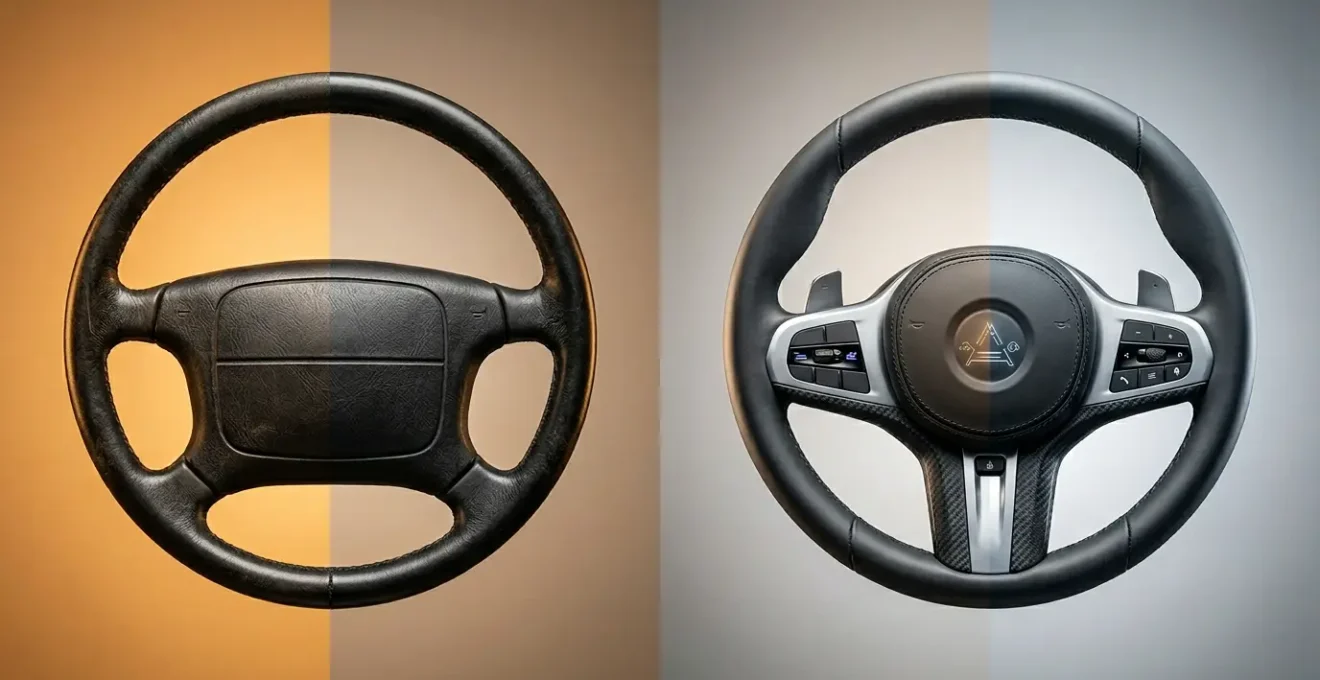
The massive increase in airbags isn’t about adding more padding; it’s about creating a sophisticated, intelligent system that tailors its response to the specific severity and type of a crash.
- Modern airbags use multi-stage inflators to deploy with proportional force, protecting you in both minor and severe impacts.
- The vehicle’s structure, including crumple zones and the safety cell, is the primary safety system, with airbags acting as a precisely timed supplement.
Recommendation: When evaluating a car’s safety, look beyond the airbag count and focus on its NCAP structural integrity score and the specific types of airbags it has (e.g., curtain, knee).
If you’ve recently shopped for a new car, you’ve likely seen the small « SRS Airbag » logos peppered around the cabin—on the steering wheel, dashboard, seats, and even the pillars by the windows. Cars that once proudly advertised two airbags now boast eight, ten, or even twelve. The immediate assumption is that more must be better, a simple equation where quantity equals safety. For many years, that was the core marketing message. However, from the perspective of an occupant restraint systems engineer, this view misses the most significant revolution in automotive safety.
The journey from two frontal airbags to a dozen is not a story of addition, but one of intelligence and integration. Early systems were a brute-force solution: a severe frontal impact triggered an explosive deployment. Today’s vehicles feature a highly sophisticated, networked system of sensors and restraints designed to manage crash energy with far greater precision. It’s no longer about a single, violent event, but a carefully choreographed sequence that considers crash severity, occupant position, and the type of impact.
This article will deconstruct this evolution. We will move beyond the numbers to explore the underlying engineering principles. We will examine how this integrated safety system makes decisions in milliseconds, why a supermini can be surprisingly safe, and how the vehicle’s very structure is the most important safety feature of all. You will learn to see your car not as a collection of parts, but as a holistic system designed with one purpose: to protect its occupants by intelligently managing the physics of a collision.
To navigate this complex topic, we will break down the core components of modern vehicle safety. This guide explores the « why » behind the technology, from smart deployment logic to the critical role of the vehicle’s structure, helping you make more informed safety assessments.
Summary: Deconstructing Modern Automotive Safety Systems
- Why Do Airbags Deploy Gently in Low-Speed Crashes but Explosively in High-Speed Impacts?
- How to Check if Your Vehicle Has Curtain Airbags That Protect in Rollovers?
- Do Superminis Offer the Same Airbag Protection as Executive Saloons?
- The Dashboard Warning That Means Your Airbags Will Not Deploy in a Crash
- How Close Should You Sit to the Steering Wheel for Safe Airbag Deployment?
- How to Read NCAP Crash Test Results: Why Structure Stars Matter More Than Total Scores?
- Why Your Car’s Engine Drops Downward During Head-On Collisions?
- Why Did Your Car’s Cabin Stay Intact While the Front Crumpled Beyond Recognition?
Why Do Airbags Deploy Gently in Low-Speed Crashes but Explosively in High-Speed Impacts?
The answer lies in one of the most significant advancements in restraint technology: the dual-stage or multi-stage inflator. Unlike early airbags that had a single, all-or-nothing deployment, modern systems can tailor the inflation force to the severity of the crash. This is not a guess; it’s a calculated decision made by the Airbag Control Unit (ACU) in milliseconds.
The ACU receives data from a network of sensors, primarily accelerometers, that measure the vehicle’s rate of deceleration. In a low-speed impact, like a parking lot bump or a minor fender-bender, the deceleration is sharp but brief. The ACU recognizes this and, if deployment is necessary at all, will trigger only the first, lower-power inflator stage. This provides a « gentler » cushion, sufficient to prevent the occupant from hitting the steering wheel or dashboard without subjecting them to the full force of an explosive deployment, which could cause injury in a minor crash.
In a high-speed, severe collision, the deceleration is far more intense and sustained. The ACU instantly identifies this as a life-threatening event and fires both inflator stages simultaneously or in rapid succession. This produces the explosive, maximum-volume deployment needed to cushion an occupant moving forward at high velocity. Field data analysis confirms this logic; research on advanced airbag deployment shows a 50% probability of a first-stage-only deployment at around 9 mph, while the threshold for both stages firing is closer to 26 mph. This intelligent deployment logic ensures the response is always proportional to the threat, maximizing protection while minimizing potential for injury from the airbag itself.
How to Check if Your Vehicle Has Curtain Airbags That Protect in Rollovers?
Side curtain airbags are a critical component of a modern integrated safety system, specifically designed to protect occupants’ heads in side impacts and, crucially, during a rollover. Unlike frontal airbags that deflate quickly, their function requires a different approach. Identifying them is straightforward. Look for « SRS Airbag, » « Side Airbag, » or a similar marking on the A-pillars (next to the windscreen), the B-pillars (between the front and rear doors), or along the roofline just above the side windows.
The presence of these airbags is vital because of how they function in a rollover. A standard side-impact or torso airbag in the seat is designed for a single, direct impact. A curtain airbag, however, is designed to stay inflated for much longer. When rollover sensors (gyroscopes) detect the vehicle is beginning to tilt dangerously, they trigger the curtain airbags. They drop down from the roofline to cover the side window area. This creates a protective barrier that serves two purposes: it prevents an occupant’s head from hitting the side of the vehicle or the ground, and it helps prevent ejection, which is a leading cause of fatalities in rollovers.
This is why their design is so unique. To be effective, curtain airbags are designed to stay inflated for more than 10 seconds, protecting occupants through multiple rolls. Their effectiveness is well-documented; independent research demonstrates they are 23% effective in reducing fatalities for belted occupants in rollover crashes. They are a specialized tool for a specific and highly dangerous type of accident.
As the visual shows, the system is discreetly housed in the roof rail, ready to deploy downwards and cover the entire window aperture. This sustained protection is what distinguishes it from other airbags and makes it a non-negotiable feature for comprehensive safety.
Do Superminis Offer the Same Airbag Protection as Executive Saloons?
This is a common and valid question for UK buyers weighing value against safety. Historically, executive saloons were the first to receive advanced safety features, which then trickled down to smaller, more affordable models. While a premium vehicle may still have more specialized airbags (like rear-side airbags or front-centre airbags), the gap in core protection has narrowed dramatically. Thanks to regulatory pressure and NCAP testing, many modern superminis offer a surprisingly high level of airbag protection that was once the exclusive domain of luxury cars.
Today, it is standard for even a budget-friendly supermini to come equipped with frontal airbags, side-impact (torso) airbags, and full-length curtain airbags. Some even offer a driver’s knee airbag. The fundamental protection for frontal, side, and rollover impacts is often present. Where the executive saloon pulls ahead is typically in the *number* and *sophistication* of supplementary systems. For example, industry data shows that while the market average is around 6.3 airbags per vehicle, luxury models average closer to 8.6, often including features like rear-seat side airbags or intricate front-centre airbags designed to prevent occupants from colliding with each other.
However, the number of airbags is not the full story. The most critical factor is how well these systems are integrated with a strong, rigid passenger safety cell. A supermini with 6 airbags and a 5-star NCAP structural rating can be safer than an older executive saloon with 8 airbags but a weaker structure. The extra airbags in the premium car certainly help, and studies show that vehicles equipped with side, curtain, and knee airbags show a 48% reduction in serious injuries compared to those with just frontal bags. But for the buyer on a budget, the good news is that the essential, life-saving airbag systems are now widely available across most price points.
The Dashboard Warning That Means Your Airbags Will Not Deploy in a Crash
Every driver has seen it during the engine start-up sequence: a small red or amber icon of a person sitting with a large circle in front of them. This is the Supplemental Restraint System (SRS) warning light. During the self-check, it illuminates and then turns off. If it stays on, or if it illuminates while you are driving, it is one of the most critical warnings your car can give you. It means the entire airbag system is offline and will not deploy in a crash.
This is not a partial failure. The ACU continuously monitors the health of every component in the SRS network: every airbag, every seatbelt pre-tensioner, every crash sensor, and all the wiring that connects them. If it detects a fault anywhere in this complex circuit—a corroded connector, a faulty seat occupancy sensor, or a damaged « clock spring » in the steering wheel—it immediately deactivates the entire system as a fail-safe measure. This prevents an accidental or unwanted deployment, but the consequence is a total loss of supplemental protection.
The causes can be surprisingly minor. An analysis of SRS malfunctions often reveals issues like moisture getting into a wiring connector under a seat or a faulty sensor that determines if a passenger is present. However, the system’s logic is absolute: a fault in one part means the integrity of the whole system cannot be guaranteed, so it shuts down. This also deactivates the seatbelt pre-tensioners, which work in concert with the airbags to tighten the belts at the moment of impact. Ignoring this light means you are driving with only the basic mechanical function of your seatbelts for protection, dramatically increasing the risk of serious injury in a crash.
How Close Should You Sit to the Steering Wheel for Safe Airbag Deployment?
An airbag is a life-saving device, but it is also a controlled pyrotechnic explosion that inflates at up to 200 mph. The greatest risk of injury from an airbag comes from being too close to it when it deploys. This is why proper seating position is not just about comfort; it is a critical safety parameter. As an engineer, this is the one variable the driver has complete control over, and it’s vital to get it right.
The primary guideline is distance. Safety organizations like the IIHS in the United States are clear: drivers should position themselves so their chest is at least 10 inches away from the center of the steering wheel. This 10-inch zone is the area of maximum inflation force. Sitting within this zone puts you at risk of serious or even fatal injury to the head, neck, or chest from the deploying bag itself, rather than from the crash.
Proper distance is linked to proper arm position. You should be able to comfortably place your wrists on the top of the steering wheel with your shoulders still flat against the seat back. If you have to lean forward, you are too far away. If your arms are sharply bent, you are too close. Furthermore, hand position matters. The old « 10 and 2 » o’clock hand position is now outdated. Modern best practice is to hold the wheel at « 9 and 3 » or even « 8 and 4. » This keeps your forearms out of the direct deployment path of the airbag as it emerges from the center of the wheel, preventing the bag from striking your arms and forcing them into your face.
Your 5-Point Seating Position Safety Check
- Sit with your shoulders fully against the seat back and extend your arms straight forward.
- Adjust your seat so the top of the steering wheel aligns with your wrists. This ensures the minimum 10-inch torso distance.
- If you must move your shoulders forward to reach the wheel, you are too far. If your elbows are sharply bent, you are too close. Use the seat adjustment or telescopic steering column to correct this.
- Ensure you can press the brake pedal fully to the floor without lifting your back from the seat.
- Position your hands at the « 9 and 3 » or « 8 and 4 » o’clock positions to keep your arms clear of the airbag’s deployment path.
How to Read NCAP Crash Test Results: Why Structure Stars Matter More Than Total Scores?
For a UK car buyer, the Euro NCAP star rating is a top-level summary of a vehicle’s safety. However, achieving a 5-star rating is a composite score. To truly understand a car’s protective capabilities, you must look deeper into the individual categories that make up that score. From an engineering standpoint, the most important of these is the « Adult Occupant » protection score, which heavily reflects the structural integrity of the passenger safety cell.
The overall score is a blend of four key areas: Adult Occupant, Child Occupant, Vulnerable Road Users (pedestrians/cyclists), and Safety Assist (active safety systems like automatic braking). A car could theoretically have a slightly lower structural score but compensate with an excellent suite of active safety systems to still achieve a high overall star rating. While these active systems are fantastic at preventing crashes, the Adult Occupant score tells you how the car will protect you when an impact is unavoidable.
When you delve into the detailed NCAP report for a specific car, look for the percentage score in the Adult Occupant category. This score is derived from tests like the frontal offset crash, full-width frontal crash, and side-impact tests (both car and pole). The report shows a color-coded diagram of the crash test dummy, indicating areas of good, adequate, marginal, weak, or poor protection. A car with a high Adult Occupant score and « green » ratings across the dummy’s critical body regions (head, neck, chest) has a robust safety cell that effectively resists intrusion and manages crash forces. This structural performance is the foundation upon which the airbag system works. An airbag is only a supplemental restraint; it cannot do its job if the cabin collapses around you. Therefore, a 95% Adult Occupant score is a far better indicator of fundamental safety than just a generic 5-star badge.
Why Your Car’s Engine Drops Downward During Head-On Collisions?
The behaviour of the engine during a severe frontal collision is not an accident; it’s a meticulously engineered feature of the integrated safety system. In the past, a head-on impact could force the rigid engine and transmission assembly backward, pushing it through the bulkhead (the fire wall) and into the passenger footwell, leading to catastrophic leg and lower body injuries. Modern vehicle design prevents this by treating the powertrain as a manageable block of mass.
The engine is held in place by specialized breakaway engine mounts. These mounts are strong enough to secure the engine under all normal driving conditions, including heavy acceleration and braking. However, they are designed to shear or release in a very specific way when subjected to the extreme forces of a frontal crash. As the front crumple zones absorb the initial impact, the chassis rails beneath the engine are designed to guide the entire powertrain assembly to drop down and slide underneath the passenger safety cell.
This achieves two critical safety objectives. First and most obviously, it prevents the engine from intruding into the cabin, preserving the integrity of the footwell and protecting the occupants’ lower limbs. Second, it plays a vital role in crash energy management. By directing this huge mass downward, it helps to dissipate crash energy away from the direct line of the occupants and extends the deceleration event by a few precious milliseconds. This extension of the crash pulse gives the airbag system the time it needs to accurately sense the crash severity and deploy with the correct force. It’s a perfect example of the synergy between the vehicle’s structure and its supplemental restraints.
Key Takeaways
- System Over Components: A car’s safety comes from the integration of its structure (safety cell, crumple zones) and restraints (airbags, seatbelts), not just the number of airbags.
- Intelligent Deployment: Modern multi-stage airbags tailor their inflation force to the severity of a crash, maximizing protection while minimizing risk from the device itself.
- Structure is Primary: A strong passenger safety cell that resists deformation is the most fundamental safety feature. Airbags are a supplement to a well-engineered structure, not a replacement for one.
Why Did Your Car’s Cabin Stay Intact While the Front Crumpled Beyond Recognition?
This is the core principle of modern crash safety engineering in action: sacrificial design and crash energy management. The dramatic difference between the crumpled front end and the intact passenger cabin is not a sign of failure, but the ultimate sign of success. The entire front section of the vehicle, known as the crumple zone or deformation zone, is designed to do exactly that: crumple in a controlled, predictable way.
From an engineering viewpoint, the enemy in a crash is not the impact itself, but the sudden deceleration. The goal is to slow the occupant down over the longest possible time and distance. The crumple zone is a carefully engineered structure of high-strength but deformable materials that absorb kinetic energy by folding and collapsing. It sacrifices itself to dissipate the forces of the collision before they can reach the passenger cabin. This « soft » front end acts like a giant, built-in shock absorber, extending the duration of the impact from a violent, instantaneous event to a slightly more prolonged one, lasting perhaps 100-150 milliseconds.
In stark contrast, the passenger compartment, or safety cell, is engineered for maximum rigidity. It’s a fortress built from ultra-high-strength steel and advanced alloys, designed to resist deformation and maintain its shape, providing a survival space for the occupants. The airbags and seatbelts work within this protected space. The crumple zone slows the car; the seatbelt slows your body with the car; and the airbag provides the final cushion to slow your head and torso relative to the car’s interior. This is why the combination of airbags with seat belts provides a 61% reduction in frontal crash death risk. The system only works because the safety cell held its shape, a testament to the fact that frontal airbags alone have saved tens of thousands of lives.
Ultimately, when you evaluate the safety of your next vehicle, look beyond the airbag count. Understand that you are buying an integrated safety system where every component, from the steel in the pillars to the sensors in the bumper, works in concert. By prioritising vehicles with high structural integrity scores from trusted sources like Euro NCAP, you are choosing a car whose foundational safety is sound, allowing the dozen airbags within it to do their job to the best of their ability.